Wagner Wolfgang
Helmholtz-Institute for Biomedical Engineering, Stem Cell Biology and Cellular Engineering, RWTH Aachen University Medical School, Aachen, Germany.
Center for Integrated Oncology Aachen Bonn Cologne Düsseldorf (CIO ABCD), Aachen, Germany.
Front Cell Dev Biol. 2022 Feb 23;10:854797. doi: 10.3389/fcell.2022.854797. eCollection 2022.
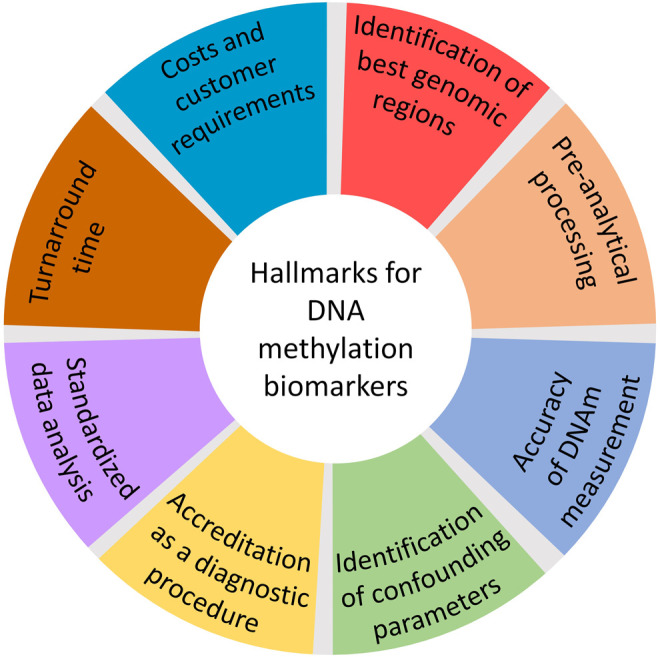
Recent advances in sequencing technologies provide unprecedented opportunities for epigenetic biomarker development. Particularly the DNA methylation pattern-which is modified at specific sites in the genome during cellular differentiation, aging, and disease-holds high hopes for a wide variety of diagnostic applications. While many epigenetic biomarkers have been described, only very few of them have so far been successfully translated into clinical practice and almost exclusively in the field of oncology. This discrepancy might be attributed to the different demands of either publishing a new finding or establishing a standardized and approved diagnostic procedure. This is exemplified for epigenetic leukocyte counts and epigenetic age-predictions. To ease later clinical translation, the following hallmarks should already be taken into consideration when designing epigenetic biomarkers: 1) Identification of best genomic regions, 2) pre-analytical processing, 3) accuracy of DNA methylation measurements, 4) identification of confounding parameters, 5) accreditation as diagnostic procedure, 6) standardized data analysis, 7) turnaround time, and 8) costs and customer requirements. While the initial selection of relevant genomic regions is usually performed on genome wide DNA methylation profiles, it might be advantageous to subsequently establish targeted assays that focus on specific genomic regions. Development of an epigenetic biomarker for clinical application is a long and cumbersome process that is only initiated with the identification of an epigenetic signature.
测序技术的最新进展为表观遗传生物标志物的开发提供了前所未有的机遇。特别是DNA甲基化模式——在细胞分化、衰老和疾病过程中在基因组的特定位点发生修饰——在各种诊断应用中寄予厚望。虽然已经描述了许多表观遗传生物标志物,但到目前为止,只有极少数成功转化为临床实践,而且几乎都仅在肿瘤学领域。这种差异可能归因于发表新发现或建立标准化且获批的诊断程序的不同要求。表观遗传白细胞计数和表观遗传年龄预测就是例证。为便于日后的临床转化,在设计表观遗传生物标志物时应已考虑以下特征:1)最佳基因组区域的识别,2)分析前处理,3)DNA甲基化测量的准确性,4)混杂参数的识别,5)作为诊断程序的认证,6)标准化数据分析,7)周转时间,以及8)成本和客户要求。虽然相关基因组区域的初步选择通常基于全基因组DNA甲基化谱进行,但随后建立专注于特定基因组区域的靶向检测可能是有利的。开发用于临床应用的表观遗传生物标志物是一个漫长而繁琐的过程,仅从识别表观遗传特征开始。