Aamodt Caitlin M, White Stephanie A
Department of Integrative Biology and Physiology, University of California, Los Angeles, Los Angeles, CA, United States.
Department of Pediatrics, University of California San Diego School of Medicine, La Jolla, CA, United States.
Front Behav Neurosci. 2022 Feb 25;16:833383. doi: 10.3389/fnbeh.2022.833383. eCollection 2022.
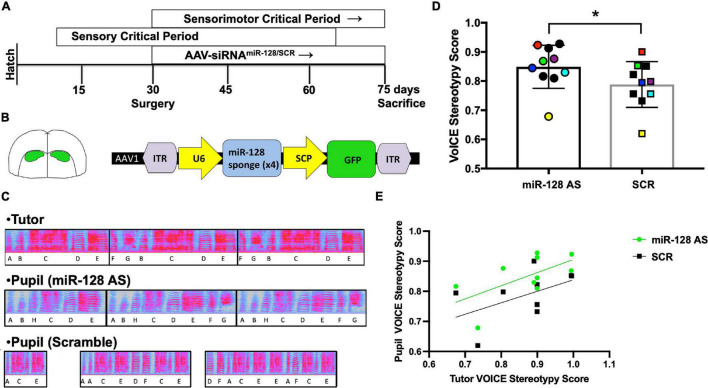
The molecular mechanisms underlying learned vocal communication are not well characterized. This is a major barrier for developing treatments for conditions affecting social communication, such as autism spectrum disorder (ASD). Our group previously generated an activity-dependent gene expression network in the striatopallidal song control nucleus, Area X, in adult zebra finches to identify master regulators of learned vocal behavior. This dataset revealed that the two host genes for microRNA-128, ARPP21 and R3HDM1, are among the top genes whose expression correlates to how much birds sing. Here we examined whether miR-128 itself is behaviorally regulated in Area X and found that its levels decline with singing. We hypothesized that reducing miR-128 during the critical period for vocal plasticity would enhance vocal learning. To test this, we bilaterally injected an antisense miR-128 construct (AS miR-128) or a control scrambled sequence into Area X at post-hatch day 30 (30 d) using sibling-matched experimental and control pupils. The juveniles were then returned to their home cage and raised with their tutors. Strikingly, inhibition of miR-128 in young birds enhanced the organization of learned vocal sequences. Tutor and pupil stereotypy scores were positively correlated, though the correlation was stronger between tutors and control pupils compared to tutors and AS miR-128 pupils. This difference was driven by AS miR-128 pupils achieving higher stereotypy scores despite their tutors' lower syntax scores. AS miR-128 birds with tutors on the higher end of the stereotypy spectrum were more likely to produce songs with faster tempos relative to sibling controls. Our results suggest that low levels of miR-128 facilitate vocal sequence stereotypy. By analogy, reducing miR-128 could enhance the capacity to learn to speak in patients with non-verbal ASD. To our knowledge, this study is the first to directly link miR-128 to learned vocal communication and provides support for miR-128 as a potential therapeutic target for ASD.
习得性发声交流背后的分子机制尚未得到充分表征。这是开发针对影响社交交流的病症(如自闭症谱系障碍,ASD)治疗方法的一个主要障碍。我们团队之前在成年斑胸草雀的纹状体苍白球鸣唱控制核团X区构建了一个活动依赖的基因表达网络,以识别习得性发声行为的主要调节因子。该数据集显示,微小RNA - 128的两个宿主基因ARPP21和R3HDM1,是表达与鸟类鸣叫次数相关性最高的基因之一。在这里,我们研究了X区中微小RNA - 128本身是否受行为调节,发现其水平随鸣叫而下降。我们假设在发声可塑性关键期降低微小RNA - 128水平会增强发声学习能力。为了验证这一点,我们在孵化后第30天(30 d),使用同胞匹配的实验和对照幼鸟,将反义微小RNA - 128构建体(AS miR - 128)或对照乱序序列双侧注射到X区。然后将幼鸟放回它们的家笼中,并与它们的导师一起饲养。令人惊讶的是,抑制幼鸟体内的微小RNA - 128增强了习得性发声序列的组织。导师和幼鸟的刻板分数呈正相关,不过与导师和对照幼鸟相比,导师和AS miR - 128幼鸟之间的相关性更强。这种差异是由于AS miR - 128幼鸟尽管其导师的句法分数较低,但却获得了更高的刻板分数。与同胞对照相比,导师处于刻板谱高端的AS miR - 128鸟类更有可能以更快的节奏唱出歌曲。我们的结果表明,低水平的微小RNA - 128促进发声序列刻板。由此类推,降低微小RNA - 128水平可能增强非言语型ASD患者的语言学习能力。据我们所知,本研究首次将微小RNA - 128与习得性发声交流直接联系起来,并为微小RNA - 128作为ASD的潜在治疗靶点提供了支持。