Li Yu, Han Lei, Zhang Ziding
State Key Laboratory of Agrobiotechnology, College of Biological Sciences, China Agricultural University, Beijing 100193, China.
Cancer Molecular Diagnostics Core, Tianjin Medical University Cancer Institute & Hospital, National Clinical Research Center of Cancer, Key Laboratory of Cancer Prevention and Therapy, Key Laboratory of Cancer Immunology and Biotherapy, Tianjin, China.
Comput Struct Biotechnol J. 2022 Feb 24;20:1056-1067. doi: 10.1016/j.csbj.2022.02.018. eCollection 2022.
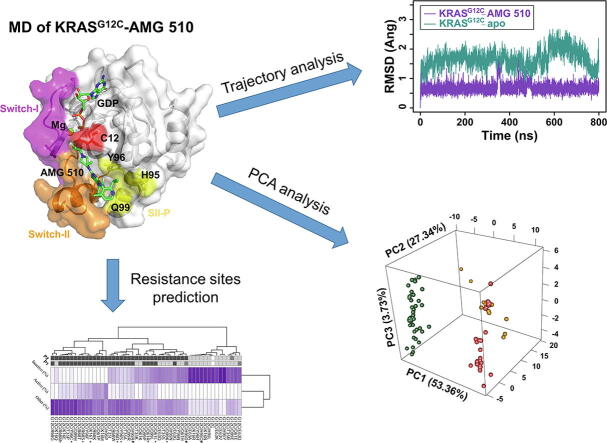
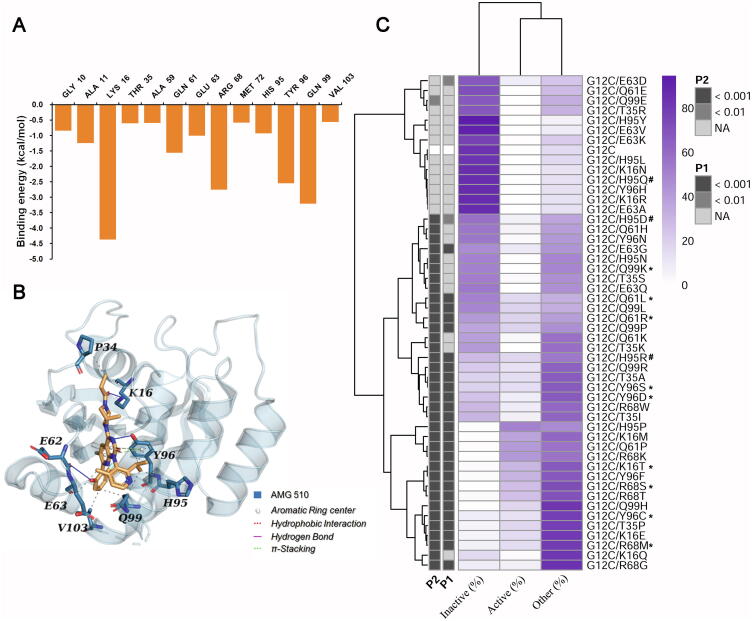
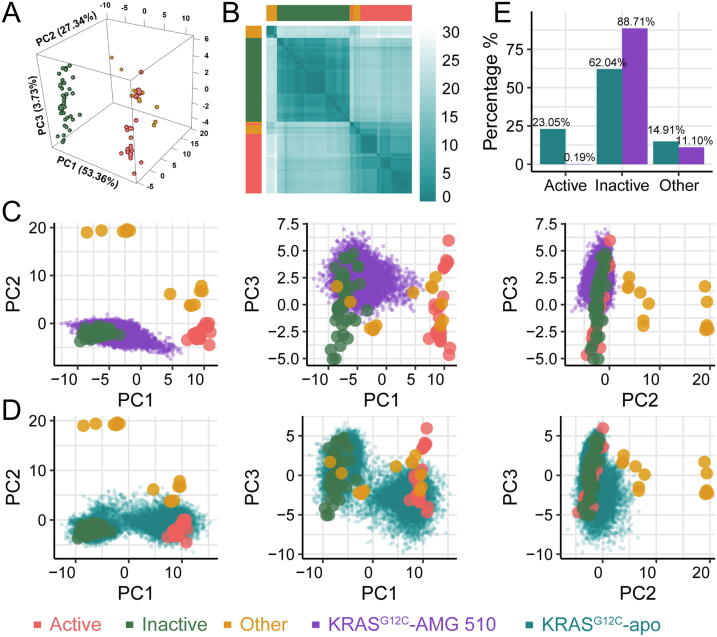
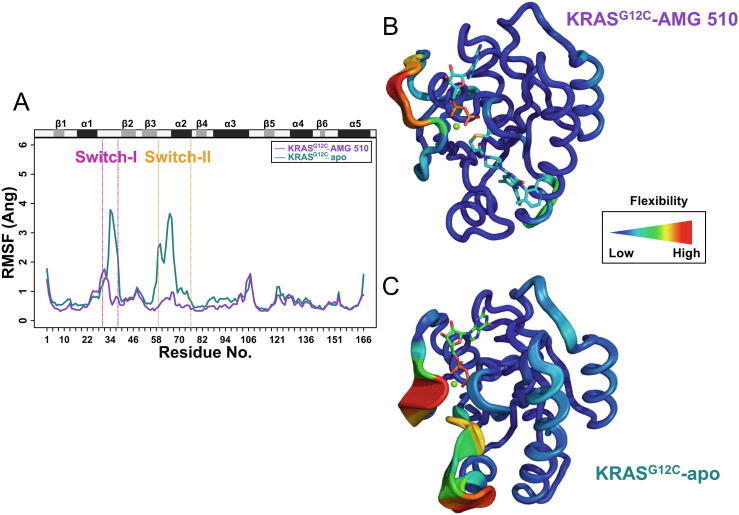
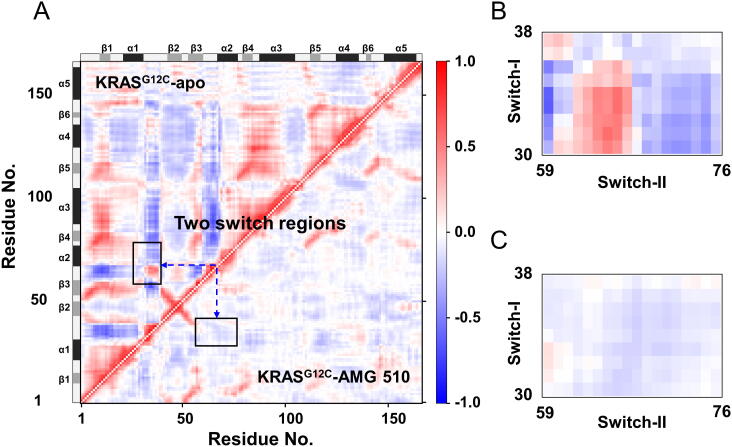
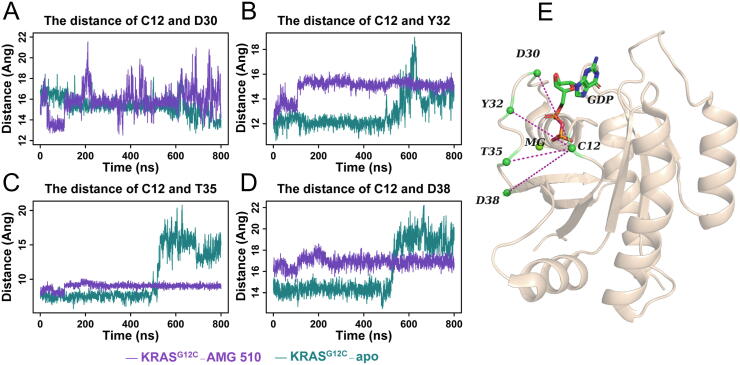
The KRAS mutant is often associated with human cancers, and AMG 510 as a promising covalent inhibitor of KRAS has achieved surprising efficacy in clinical trials. However, the interaction mechanism between KRAS and AMG 510 is not completely understood. Here, we performed all-atom molecular dynamics simulations on the complex of KRAS-AMG 510 to explore the influence of this covalent inhibitor on the conformational change of KRAS. A PCA (Principal Component Analysis) model was constructed based on known KRAS crystal structures to distinguish different conformations (active, inactive, and other). By mapping simulation trajectories onto the PCA model, we observed that the conformations of KRAS bound with AMG 510 were mainly concentrated in the inactive conformation. Further analysis demonstrated that AMG 510 reduced the flexibility of two switch regions to make the complex of KRAS-AMG 510 restricted in the inactive conformation. In the meantime, we also identified key interacting residues between KRAS and AMG 510 through the calculation of binding energy. Finally, we built a series of KRAS second-site mutation systems (i.e. KRAS) to conduct large-scale screening of potential resistance mutations. By further combining MD simulations and the PCA model, we not only recapitulated the currently known resistance mutations of AMG 510 successfully but also proposed some novel potential resistant mutations. Taken together, these results broaden our insight into the influence of AMG 510 on the conformational change of the KRAS mutant at the atomic level, thereby providing crucial hints for the improvement and optimization of drug candidates.
KRAS 突变体常与人类癌症相关,而 AMG 510 作为一种有前景的 KRAS 共价抑制剂在临床试验中取得了惊人的疗效。然而,KRAS 与 AMG 510 之间的相互作用机制尚未完全明确。在此,我们对 KRAS-AMG 510 复合物进行了全原子分子动力学模拟,以探究这种共价抑制剂对 KRAS 构象变化的影响。基于已知的 KRAS 晶体结构构建了主成分分析(PCA)模型,以区分不同构象(活性、非活性和其他)。通过将模拟轨迹映射到 PCA 模型上,我们观察到与 AMG 510 结合的 KRAS 构象主要集中在非活性构象。进一步分析表明,AMG 510 降低了两个开关区域的灵活性,使 KRAS-AMG 510 复合物限制在非活性构象中。同时,我们还通过结合能计算确定了 KRAS 与 AMG 510 之间的关键相互作用残基。最后,我们构建了一系列 KRAS 第二位点突变系统(即 KRAS),以进行潜在耐药突变的大规模筛选。通过进一步结合分子动力学模拟和 PCA 模型,我们不仅成功重现了目前已知的 AMG 510 耐药突变,还提出了一些新的潜在耐药突变。综上所述,这些结果拓宽了我们在原子水平上对 AMG 510 对 KRAS 突变体构象变化影响的认识,从而为药物候选物的改进和优化提供了关键线索。