• 文献检索
  • 文档翻译
  • 深度研究
  • 学术资讯
  • Suppr Zotero 插件Zotero 插件
  • 邀请有礼
  • 套餐&价格
  • 历史记录
应用&插件
Suppr Zotero 插件Zotero 插件浏览器插件Mac 客户端Windows 客户端微信小程序
定价
高级版会员购买积分包购买API积分包
服务
文献检索文档翻译深度研究API 文档MCP 服务
关于我们
关于 Suppr公司介绍联系我们用户协议隐私条款
关注我们

Suppr 超能文献

核心技术专利:CN118964589B侵权必究
粤ICP备2023148730 号-1Suppr @ 2026

文献检索

告别复杂PubMed语法,用中文像聊天一样搜索,搜遍4000万医学文献。AI智能推荐,让科研检索更轻松。

立即免费搜索

文件翻译

保留排版,准确专业,支持PDF/Word/PPT等文件格式,支持 12+语言互译。

免费翻译文档

深度研究

AI帮你快速写综述,25分钟生成高质量综述,智能提取关键信息,辅助科研写作。

立即免费体验

基于互联网的与面对面认知行为疗法治疗成人强迫症的效果比较:一项随机临床试验。

Effect of Internet-Based vs Face-to-Face Cognitive Behavioral Therapy for Adults With Obsessive-Compulsive Disorder: A Randomized Clinical Trial.

机构信息

Centre for Psychiatry Research, Department of Clinical Neuroscience, Karolinska Institutet, Stockholm Health Care Services, Region Stockholm, Karolinska University Hospital, Stockholm, Sweden.

Division of Psychology, Department of Clinical Neuroscience, Karolinska Institutet, Stockholm, Sweden.

出版信息

JAMA Netw Open. 2022 Mar 1;5(3):e221967. doi: 10.1001/jamanetworkopen.2022.1967.

DOI:10.1001/jamanetworkopen.2022.1967
PMID:35285923
原文链接:https://pmc.ncbi.nlm.nih.gov/articles/PMC9907343/
Abstract

IMPORTANCE

Cognitive behavioral therapy (CBT) for obsessive-compulsive disorder (OCD) is a highly specialized treatment that is in short supply worldwide.

OBJECTIVES

To investigate whether both therapist-guided and unguided internet-based CBT (ICBT) are noninferior to face-to-face CBT for adults with OCD, to conduct a health economic evaluation, and to determine whether treatment effects were moderated by source of participant referral.

DESIGN, SETTING, AND PARTICIPANTS: This study is a single-blinded, noninferiority, randomized clinical trial, with a full health economic evaluation, conducted between September 2015 and January 2020, comparing therapist-guided ICBT, unguided ICBT, and individual face-to-face CBT for adults with OCD. Follow-up data were collected up to 12 months after treatment. The study was conducted at 2 specialist outpatient OCD clinics in Stockholm, Sweden. Participants included a consecutive sample of adults with a primary diagnosis of OCD, either self-referred or referred by a clinician. Data analysis was performed from June 2019 to January 2022.

INTERVENTIONS

Guided ICBT, unguided ICBT, and face-to-face CBT delivered over 14 weeks.

MAIN OUTCOMES AND MEASURES

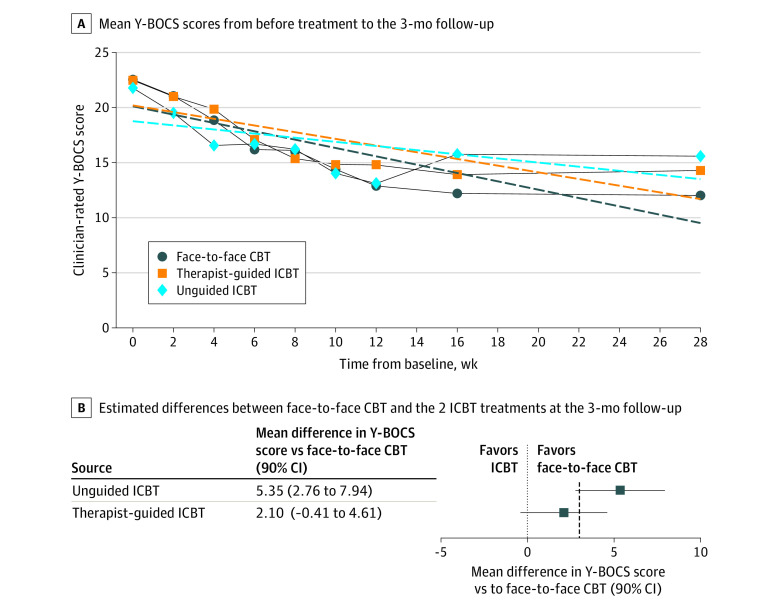
The primary end point was the change in OCD symptom severity from baseline to 3-month follow-up. The noninferiority margin was 3 points on the masked assessor-rated Yale-Brown Obsessive Compulsive Scale.

RESULTS

A total of 120 participants were enrolled (80 women [67%]; mean [SD] age, 32.24 [9.64] years); 38 were randomized to the face-to-face CBT group, 42 were randomized to the guided ICBT group, and 40 were randomized to the unguided ICBT group. The mean difference between therapist-guided ICBT and face-to-face CBT at the primary end point was 2.10 points on the Yale-Brown Obsessive Compulsive Scale (90% CI, -0.41 to 4.61 points; P = .17), favoring face-to-face CBT, meaning that the primary noninferiority results were inconclusive. The difference between unguided ICBT and face-to-face CBT was 5.35 points (90% CI, 2.76 to 7.94 points; P < .001), favoring face-to-face CBT. The health economic analysis showed that both guided and unguided ICBT were cost-effective compared with face-to-face CBT. Source of referral did not moderate treatment outcome. The most common adverse events were anxiety (30 participants [25%]), depressive symptoms (20 participants [17%]), and stress (11 participants [9%]).

CONCLUSIONS AND RELEVANCE

The findings of this randomized clinical trial of ICBT vs face-to-face CBT for adults with OCD do not conclusively demonstrate noninferiority. Therapist-guided ICBT could be a cost-effective alternative to in-clinic CBT for adults with OCD in scenarios where traditional CBT is not readily available; unguided ICBT is probably less efficacious but could be an alternative when providing remote clinician support is not feasible.

TRIAL REGISTRATION

ClinicalTrials.gov Identifier: NCT02541968.

摘要

重要性

针对强迫症(OCD)的认知行为疗法(CBT)是一种高度专业化的治疗方法,在全球范围内供应不足。

目的

研究督导和非督导的基于互联网的认知行为疗法(ICBT)是否与面对面认知行为疗法(CBT)对强迫症成人患者同样有效,进行健康经济学评估,并确定治疗效果是否受患者转诊来源的影响。

设计、地点和参与者:这是一项单盲、非劣效性、随机临床试验,进行了全面的健康经济学评估,比较了督导的 ICBT、非督导的 ICBT 和个体面对面 CBT 对强迫症成人患者的治疗效果。治疗后随访数据收集长达 12 个月。研究在瑞典斯德哥尔摩的 2 个专科门诊强迫症诊所进行。参与者包括由临床医生转介或自我转诊的强迫症成人患者。数据分析于 2019 年 6 月至 2022 年 1 月进行。

干预措施

接受为期 14 周的督导 ICBT、非督导 ICBT 和面对面 CBT。

主要结局和测量指标

主要结局是从基线到 3 个月随访时 OCD 症状严重程度的变化。无偏评估者评定的耶鲁-布朗强迫症量表的非劣效性边界为 3 分。

结果

共有 120 名患者入组(80 名女性[67%];平均[标准差]年龄为 32.24[9.64]岁);38 名患者被随机分配到面对面 CBT 组,42 名患者被随机分配到督导的 ICBT 组,40 名患者被随机分配到非督导的 ICBT 组。在主要结局点,督导的 ICBT 与面对面 CBT 之间的平均差异为耶鲁-布朗强迫症量表 2.10 分(90%CI,-0.41 至 4.61 分;P=0.17),有利于面对面 CBT,这意味着主要的非劣效性结果不确定。非督导的 ICBT 与面对面 CBT 之间的差异为 5.35 分(90%CI,2.76 至 7.94 分;P<0.001),有利于面对面 CBT。健康经济学分析表明,与面对面 CBT 相比,督导和非督导的 ICBT 均具有成本效益。转诊来源并未影响治疗效果。最常见的不良事件是焦虑(30 名患者[25%])、抑郁症状(20 名患者[17%])和压力(11 名患者[9%])。

结论和相关性

这项针对 OCD 成人患者 ICBT 与面对面 CBT 的随机临床试验的结果并未明确证明非劣效性。在传统 CBT 不易获得的情况下,督导的 ICBT 可能是 OCD 成人患者的一种具有成本效益的替代治疗方法;非督导的 ICBT 可能效果较差,但在提供远程临床支持不可行时可能是一种替代方法。

试验注册

ClinicalTrials.gov 标识符:NCT02541968。
https://cdn.ncbi.nlm.nih.gov/pmc/blobs/dc7a/9907343/75fac772fbe0/jamanetwopen-e221967-g003.jpg
https://cdn.ncbi.nlm.nih.gov/pmc/blobs/dc7a/9907343/beea23e7221c/jamanetwopen-e221967-g001.jpg
https://cdn.ncbi.nlm.nih.gov/pmc/blobs/dc7a/9907343/d945c68c73d1/jamanetwopen-e221967-g002.jpg
https://cdn.ncbi.nlm.nih.gov/pmc/blobs/dc7a/9907343/75fac772fbe0/jamanetwopen-e221967-g003.jpg
https://cdn.ncbi.nlm.nih.gov/pmc/blobs/dc7a/9907343/beea23e7221c/jamanetwopen-e221967-g001.jpg
https://cdn.ncbi.nlm.nih.gov/pmc/blobs/dc7a/9907343/d945c68c73d1/jamanetwopen-e221967-g002.jpg
https://cdn.ncbi.nlm.nih.gov/pmc/blobs/dc7a/9907343/75fac772fbe0/jamanetwopen-e221967-g003.jpg

相似文献

1
Effect of Internet-Based vs Face-to-Face Cognitive Behavioral Therapy for Adults With Obsessive-Compulsive Disorder: A Randomized Clinical Trial.基于互联网的与面对面认知行为疗法治疗成人强迫症的效果比较:一项随机临床试验。
JAMA Netw Open. 2022 Mar 1;5(3):e221967. doi: 10.1001/jamanetworkopen.2022.1967.
2
Study protocol for a single-blind, randomised controlled, non-inferiority trial of internet-based versus face-to-face cognitive behaviour therapy for obsessive-compulsive disorder.一项针对强迫症的基于互联网与面对面认知行为疗法的单盲、随机对照、非劣效性试验的研究方案。
BMJ Open. 2018 Sep 5;8(9):e022254. doi: 10.1136/bmjopen-2018-022254.
3
Therapist-supported Internet cognitive behavioural therapy for anxiety disorders in adults.成人焦虑症的治疗师辅助互联网认知行为疗法。
Cochrane Database Syst Rev. 2015 Mar 5(3):CD011565. doi: 10.1002/14651858.CD011565.
4
Therapist-Assisted Internet-Based Cognitive Behavioral Therapy Versus Progressive Relaxation in Obsessive-Compulsive Disorder: Randomized Controlled Trial.治疗师辅助的基于互联网的认知行为疗法与渐进性放松疗法治疗强迫症:随机对照试验
J Med Internet Res. 2018 Aug 8;20(8):e242. doi: 10.2196/jmir.9566.
5
Therapist-supported Internet cognitive behavioural therapy for anxiety disorders in adults.治疗师支持的针对成人焦虑症的互联网认知行为疗法。
Cochrane Database Syst Rev. 2016 Mar 12;3(3):CD011565. doi: 10.1002/14651858.CD011565.pub2.
6
Effect of an Internet-Delivered Stepped-Care Program vs In-Person Cognitive Behavioral Therapy on Obsessive-Compulsive Disorder Symptoms in Children and Adolescents: A Randomized Clinical Trial.互联网递增效度治疗方案与面对面认知行为疗法治疗儿童和青少年强迫症症状的效果比较:一项随机临床试验。
JAMA. 2021 May 11;325(18):1863-1873. doi: 10.1001/jama.2021.3839.
7
Internet-Based Cognitive Behavioral Therapy With Real-Time Therapist Support via Videoconference for Patients With Obsessive-Compulsive Disorder, Panic Disorder, and Social Anxiety Disorder: Pilot Single-Arm Trial.针对强迫症、惊恐障碍和社交焦虑障碍患者,通过视频会议提供实时治疗师支持的基于互联网的认知行为疗法:单臂试验试点
J Med Internet Res. 2018 Dec 17;20(12):e12091. doi: 10.2196/12091.
8
Efficacy and Cost-Effectiveness Analysis of Internet-Based Cognitive Behavioral Therapy for Obsessive-Compulsive Disorder: Randomized Controlled Trial.基于互联网的认知行为疗法治疗强迫症的疗效和成本效益分析:随机对照试验。
J Med Internet Res. 2023 May 24;25:e41283. doi: 10.2196/41283.
9
Internet-Delivered Cognitive Behavioural Therapy for Major Depression and Anxiety Disorders: A Health Technology Assessment.互联网提供的针对重度抑郁症和焦虑症的认知行为疗法:一项卫生技术评估。
Ont Health Technol Assess Ser. 2019 Feb 19;19(6):1-199. eCollection 2019.
10
Clinical effectiveness, cost-effectiveness and acceptability of low-intensity interventions in the management of obsessive-compulsive disorder: the Obsessive-Compulsive Treatment Efficacy randomised controlled Trial (OCTET).低强度干预措施治疗强迫症的临床疗效、成本效益及可接受性:强迫症治疗疗效随机对照试验(OCTET)
Health Technol Assess. 2017 Jun;21(37):1-132. doi: 10.3310/hta21370.

引用本文的文献

1
Therapists' Role in Patient Adherence to Internet-Based Cognitive Behavioral Therapy: Qualitative Study.治疗师在患者坚持基于互联网的认知行为疗法中的作用:定性研究。
J Med Internet Res. 2025 Sep 10;27:e71852. doi: 10.2196/71852.
2
Benefits and barriers associated with using cognitive-behavioral therapy to treat obsessive-compulsive disorder: a narrative review.使用认知行为疗法治疗强迫症的益处与障碍:一项叙述性综述。
Front Psychiatry. 2025 Jul 28;16:1593384. doi: 10.3389/fpsyt.2025.1593384. eCollection 2025.
3
Efficacy of the mHealth App Intellect in Improving Subclinical Obsessive-Compulsive Disorder in University Students: Randomized Controlled Trial With a 4-Week Follow-Up.

本文引用的文献

1
Effect of an Internet-Delivered Stepped-Care Program vs In-Person Cognitive Behavioral Therapy on Obsessive-Compulsive Disorder Symptoms in Children and Adolescents: A Randomized Clinical Trial.互联网递增效度治疗方案与面对面认知行为疗法治疗儿童和青少年强迫症症状的效果比较:一项随机临床试验。
JAMA. 2021 May 11;325(18):1863-1873. doi: 10.1001/jama.2021.3839.
2
Study protocol for a single-blind, randomised controlled, non-inferiority trial of internet-based versus face-to-face cognitive behaviour therapy for obsessive-compulsive disorder.一项针对强迫症的基于互联网与面对面认知行为疗法的单盲、随机对照、非劣效性试验的研究方案。
BMJ Open. 2018 Sep 5;8(9):e022254. doi: 10.1136/bmjopen-2018-022254.
3
移动健康应用程序“智能”对改善大学生亚临床强迫症的疗效:一项为期4周随访的随机对照试验。
JMIR Mhealth Uhealth. 2024 Dec 16;12:e63316. doi: 10.2196/63316.
4
Predictors of dropout in self-guided internet-delivered cognitive behaviour therapy for obsessive-compulsive disorder: An exploratory study.强迫症自我引导式互联网认知行为疗法中退出治疗的预测因素:一项探索性研究。
Br J Clin Psychol. 2025 Jun;64(2):458-474. doi: 10.1111/bjc.12517. Epub 2024 Nov 20.
5
Therapist-guided remote versus in-person cognitive behavioural therapy: a systematic review and meta-analysis of randomized controlled trials.治疗师指导的远程与面对面认知行为疗法:随机对照试验的系统评价和荟萃分析。
CMAJ. 2024 Mar 17;196(10):E327-E340. doi: 10.1503/cmaj.230274.
6
Long-term effectiveness and cost-effectiveness of guided internet-based cognitive behavioral therapy for obsessive-compulsive disorder: 24-month follow-up.基于互联网的强迫症指导性认知行为疗法的长期有效性和成本效益:24个月随访
Internet Interv. 2024 Feb 8;35:100725. doi: 10.1016/j.invent.2024.100725. eCollection 2024 Mar.
7
Study protocol for a single-blind, parallel-group, randomised, controlled non-inferiority trial of 4-day intensive versus standard cognitive behavioural therapy for adults with obsessive-compulsive disorder.一项为期 4 天的密集型与标准认知行为疗法治疗成人强迫症的单盲、平行组、随机、对照非劣效性试验的研究方案。
BMJ Open. 2023 Dec 14;13(12):e076361. doi: 10.1136/bmjopen-2023-076361.
8
The Appa Health App for Youth Mental Health: Development and Usability Study.青少年心理健康的阿帕健康应用程序:开发与可用性研究。
JMIR Form Res. 2023 Oct 4;7:e49998. doi: 10.2196/49998.
9
Efficacy of an Internet-based intervention with self-applied exposure therapy in virtual reality for people with panic disorder: study protocol for a randomized controlled trial.基于互联网的自我应用暴露疗法在虚拟现实中治疗惊恐障碍的疗效:一项随机对照试验的研究方案。
Trials. 2023 Aug 12;24(1):521. doi: 10.1186/s13063-023-07536-1.
10
Error in Results.结果中的错误。
JAMA Netw Open. 2023 Jun 1;6(6):e2323948. doi: 10.1001/jamanetworkopen.2023.23948.
Therapist-Guided, Internet-Delivered Cognitive-Behavioral Therapy for Adolescents With Obsessive-Compulsive Disorder: A Randomized Controlled Trial.
治疗师指导的、基于互联网的认知行为疗法治疗青少年强迫症:一项随机对照试验。
J Am Acad Child Adolesc Psychiatry. 2017 Jan;56(1):10-19.e2. doi: 10.1016/j.jaac.2016.09.515. Epub 2016 Oct 25.
4
Towards an international expert consensus for defining treatment response, remission, recovery and relapse in obsessive-compulsive disorder.迈向关于强迫症治疗反应、缓解、康复及复发定义的国际专家共识。
World Psychiatry. 2016 Feb;15(1):80-1. doi: 10.1002/wps.20299.
5
D-Cycloserine vs Placebo as Adjunct to Cognitive Behavioral Therapy for Obsessive-Compulsive Disorder and Interaction With Antidepressants: A Randomized Clinical Trial.D-环丝氨酸与安慰剂作为强迫症认知行为治疗的辅助治疗与抗抑郁药的相互作用:一项随机临床试验。
JAMA Psychiatry. 2015 Jul;72(7):659-67. doi: 10.1001/jamapsychiatry.2015.0546.
6
Internet cognitive behavioural treatment for obsessive compulsive disorder: A randomised controlled trial.强迫症的互联网认知行为疗法:一项随机对照试验。
Behav Res Ther. 2014 Dec;63:99-106. doi: 10.1016/j.brat.2014.09.012. Epub 2014 Oct 7.
7
Telephone cognitive-behavioral therapy for adolescents with obsessive-compulsive disorder: a randomized controlled non-inferiority trial.针对青少年强迫症患者的电话认知行为疗法:一项随机对照非劣效性试验。
J Am Acad Child Adolesc Psychiatry. 2014 Dec;53(12):1298-1307.e2. doi: 10.1016/j.jaac.2014.09.012. Epub 2014 Sep 30.
8
Long-term efficacy of Internet-based cognitive behavior therapy for obsessive-compulsive disorder with or without booster: a randomized controlled trial.基于互联网的认知行为疗法对伴或不伴强化干预的强迫症的长期疗效:一项随机对照试验
Psychol Med. 2014 Oct;44(13):2877-87. doi: 10.1017/S0033291714000543. Epub 2014 Mar 14.
9
Reporting of noninferiority and equivalence randomized trials: extension of the CONSORT 2010 statement.非劣效性和等效性随机试验报告:CONSORT 2010 声明的扩展。
JAMA. 2012 Dec 26;308(24):2594-604. doi: 10.1001/jama.2012.87802.
10
Cognitive-behavioral therapy for obsessive-compulsive disorder: a meta-analysis of treatment outcome and moderators.强迫症的认知行为疗法:治疗结果和调节因素的荟萃分析。
J Psychiatr Res. 2013 Jan;47(1):33-41. doi: 10.1016/j.jpsychires.2012.08.020. Epub 2012 Sep 20.