Rück Christian, Lundström Lina, Flygare Oskar, Enander Jesper, Bottai Matteo, Mataix-Cols David, Andersson Erik
Centre for Psychiatry Research, Department of Clinical Neuroscience, Karolinska Institutet, Stockholm, Sweden.
Stockholm Health Care Services, Stockholm, Sweden.
BMJ Open. 2018 Sep 5;8(9):e022254. doi: 10.1136/bmjopen-2018-022254.
Expert guidelines recommend cognitive-behavioural therapy (CBT) as a first-line treatment for obsessive-compulsive disorder (OCD), but the majority of patients with OCD do not have access to CBT. Internet-delivered CBT (ICBT) has the potential to make this evidence-based treatment more accessible while requiring less therapist time than traditional face-to-face (f2f) CBT. Data from six clinical trials suggest that ICBT for OCD is both efficacious and cost-effective, but whether ICBT is non-inferior to traditional f2f CBT for OCD is yet unknown.
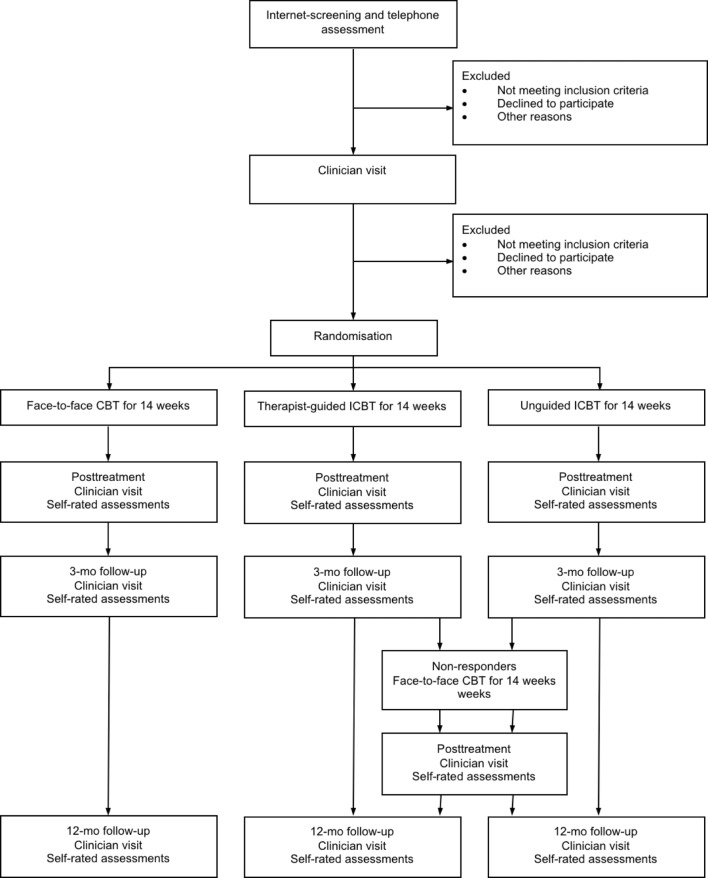
A single-blind, randomised, controlled, non-inferiority trial comparing therapist-guided ICBT, unguided ICBT and individual (f2f) CBT for adult OCD patients. The primary objective is to investigate whether ICBT is non-inferior to gold standard f2f CBT. Secondary objectives are to investigate if ICBT is equally effective when delivered unguided, to establish the cost-effectiveness of ICBT and to investigate if the treatment outcome differs between self-referred and clinically referred patients. Participants will be recruited at two specialist OCD clinics in Stockholm and also through online self-referral. Participants will be randomised to one of three treatment conditions: F2f CBT, ICBT with therapist support or unguided ICBT. The total number of participants will be 120, and masked assessments will be administered at baseline, biweekly during treatment, at post-treatment and at 3-month and 12-month follow-ups. The main outcome measure is the clinician-rated Yale-Brown Obsessive Compulsive Scale (Y-BOCS) at 3-month follow-up. The margin of non-inferiority is set to 3 points on the Y-BOCS using a 90% CI.
The study has been approved by the Regional Ethics Board of Stockholm (REPN 2015/1099-31/2) and registered at Clinicaltrials.gov (NCT02541968). The study will be reported in accordance with the Consolidated Standards of Reporting Trials statement for non-pharmacological trials. The results will be published in peer-reviewed academic journals and disseminated to patient organisations and media.
NCT02541968; Pre-results.
专家指南推荐认知行为疗法(CBT)作为强迫症(OCD)的一线治疗方法,但大多数强迫症患者无法获得CBT治疗。基于互联网的CBT(ICBT)有可能使这种循证治疗方法更易获得,同时与传统面对面(f2f)CBT相比,所需治疗师的时间更少。六项临床试验的数据表明,用于治疗强迫症的ICBT既有效又具有成本效益,但ICBT治疗强迫症是否不劣于传统的面对面CBT尚不清楚。
一项单盲、随机、对照、非劣效性试验,比较针对成年强迫症患者的治疗师指导的ICBT、非指导的ICBT和个体(面对面)CBT。主要目的是研究ICBT是否不劣于金标准的面对面CBT。次要目的是研究非指导的ICBT是否同样有效,确定ICBT的成本效益,并研究自我转诊患者和临床转诊患者的治疗结果是否存在差异。参与者将在斯德哥尔摩的两家专业强迫症诊所招募,也通过在线自我转诊招募。参与者将被随机分配到三种治疗条件之一:面对面CBT、有治疗师支持的ICBT或非指导的ICBT。参与者总数将为120名,在基线、治疗期间每两周、治疗后以及3个月和12个月随访时进行盲法评估。主要结局指标是在3个月随访时由临床医生评定的耶鲁-布朗强迫症量表(Y-BOCS)。使用90%置信区间,非劣效性界限设定为Y-BOCS上的3分。
该研究已获得斯德哥尔摩地区伦理委员会(REPN 2015/1099-31/2)批准,并在Clinicaltrials.gov(NCT02541968)注册。该研究将按照非药物试验的报告试验综合标准声明进行报告。研究结果将发表在同行评审的学术期刊上,并传播给患者组织和媒体。
NCT02541968;预结果。