• 文献检索
  • 文档翻译
  • 深度研究
  • 学术资讯
  • Suppr Zotero 插件Zotero 插件
  • 邀请有礼
  • 套餐&价格
  • 历史记录
应用&插件
Suppr Zotero 插件Zotero 插件浏览器插件Mac 客户端Windows 客户端微信小程序
定价
高级版会员购买积分包购买API积分包
服务
文献检索文档翻译深度研究API 文档MCP 服务
关于我们
关于 Suppr公司介绍联系我们用户协议隐私条款
关注我们

Suppr 超能文献

核心技术专利:CN118964589B侵权必究
粤ICP备2023148730 号-1Suppr @ 2026

文献检索

告别复杂PubMed语法,用中文像聊天一样搜索,搜遍4000万医学文献。AI智能推荐,让科研检索更轻松。

立即免费搜索

文件翻译

保留排版,准确专业,支持PDF/Word/PPT等文件格式,支持 12+语言互译。

免费翻译文档

深度研究

AI帮你快速写综述,25分钟生成高质量综述,智能提取关键信息,辅助科研写作。

立即免费体验

母亲谈论婴儿的动作:动词如何对应婴儿的实时行为。

Mothers talk about infants' actions: How verbs correspond to infants' real-time behavior.

机构信息

Department of Psychology, New York University.

Department of Applied Psychology, New York University.

出版信息

Dev Psychol. 2022 Mar;58(3):405-416. doi: 10.1037/dev0001285.

DOI:10.1037/dev0001285
PMID:35286106
原文链接:https://pmc.ncbi.nlm.nih.gov/articles/PMC9012493/
Abstract

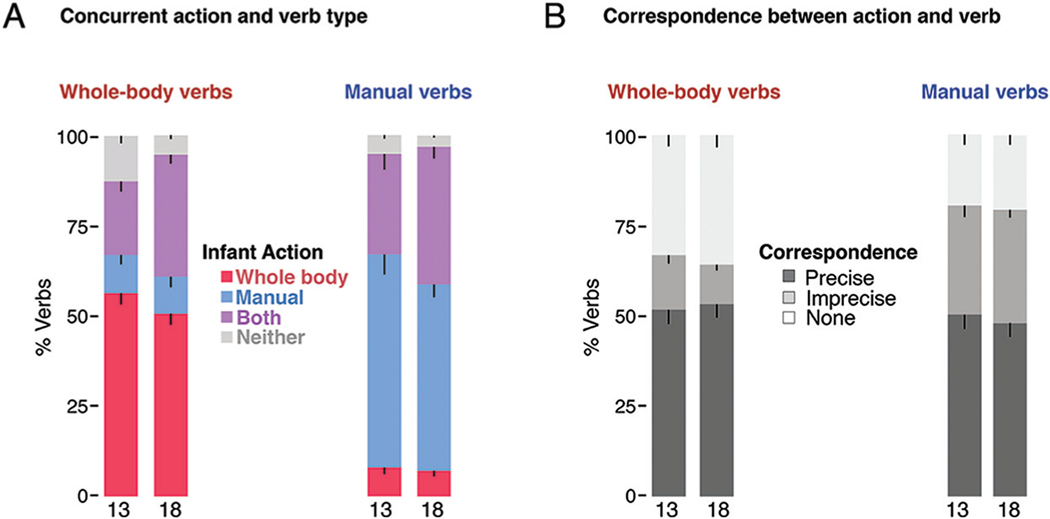
Infants learn nouns during object-naming events-moments when caregivers name the object of infants' play (e.g., ball as infant holds a ball). Do caregivers also label the actions of infants' play (e.g., roll as infant rolls a ball)? We investigated connections between mothers' verb inputs and infants' actions. We video-recorded 32 infant-mother dyads for 2 hr at home (13 month olds, n = 16; 18 month olds, n = 16; girls, n = 16; White, n = 23; Asian, n = 2; Black, n = 1; other, n = 1; multiple races, n = 5; Hispanic/Latinx, n = 2). Dyads were predominantly from middle-class to upper middle-class households. We identified each manual verb (e.g., press, shake) and whole-body verb (e.g., kick, go) that mothers directed to infants. We coded whether infants displayed manual and/or whole-body actions during a 6-s window surrounding the verb (i.e., 3 s prior and 3 s after the named verb). Mothers' verbs and infant actions were largely congruent: Whole-body verbs co-occurred with whole-body actions, and manual verbs co-occurred with manual actions. Moreover, half of mothers' verbs corresponded precisely to infants' concurrent action (e.g., infant pressed button as mother said, "Press the button"). In most instances, mothers commented on rather than instigated infants' actions. Findings suggest that verb learning is embodied, such that infants' motor actions offer powerful cues to verb meanings. Furthermore, our approach highlights the value of cross-domain research integrating infants' developing motor and language skills to understand word learning. (PsycInfo Database Record (c) 2022 APA, all rights reserved).

摘要

婴儿在物体命名事件中学习名词,此时照料者会说出婴儿玩耍的物体的名称(例如,当婴儿拿着球时,说出“球”)。照料者是否也会给婴儿玩耍的动作贴上标签(例如,当婴儿滚动球时,说出“滚”)?我们研究了母亲动词输入与婴儿动作之间的联系。我们在家中对 32 个婴儿-母亲对子进行了 2 小时的视频记录(13 个月大的婴儿,n = 16;18 个月大的婴儿,n = 16;女孩,n = 16;白人,n = 23;亚洲人,n = 2;黑人,n = 1;其他,n = 1;多种族,n = 5;西班牙裔/拉丁裔,n = 2)。这些对子主要来自中产阶级到上层中产阶级家庭。我们确定了母亲对婴儿说的每一个手动动词(例如,按压、摇晃)和全身动词(例如,踢、走)。我们对婴儿在动词周围 6 秒的窗口内是否显示手动和/或全身动作进行了编码(即命名动词之前 3 秒和之后 3 秒)。母亲的动词和婴儿的动作大多是一致的:全身动词与全身动作同时出现,手动动词与手动动作同时出现。此外,母亲的一半动词与婴儿同时进行的动作完全相符(例如,当母亲说“按按钮”时,婴儿按下按钮)。在大多数情况下,母亲是在评论而不是引发婴儿的动作。研究结果表明,动词学习是具体的,即婴儿的动作提供了动词意义的有力线索。此外,我们的方法强调了跨领域研究的价值,即将婴儿不断发展的运动和语言技能结合起来,以理解单词学习。(PsycInfo 数据库记录(c)2022 APA,保留所有权利)。

https://cdn.ncbi.nlm.nih.gov/pmc/blobs/ab61/9012493/8c8dc8aaaa46/nihms-1792493-f0004.jpg
https://cdn.ncbi.nlm.nih.gov/pmc/blobs/ab61/9012493/f0eb92507b20/nihms-1792493-f0001.jpg
https://cdn.ncbi.nlm.nih.gov/pmc/blobs/ab61/9012493/9478204b78ec/nihms-1792493-f0002.jpg
https://cdn.ncbi.nlm.nih.gov/pmc/blobs/ab61/9012493/e7b6fb84607a/nihms-1792493-f0003.jpg
https://cdn.ncbi.nlm.nih.gov/pmc/blobs/ab61/9012493/8c8dc8aaaa46/nihms-1792493-f0004.jpg
https://cdn.ncbi.nlm.nih.gov/pmc/blobs/ab61/9012493/f0eb92507b20/nihms-1792493-f0001.jpg
https://cdn.ncbi.nlm.nih.gov/pmc/blobs/ab61/9012493/9478204b78ec/nihms-1792493-f0002.jpg
https://cdn.ncbi.nlm.nih.gov/pmc/blobs/ab61/9012493/e7b6fb84607a/nihms-1792493-f0003.jpg
https://cdn.ncbi.nlm.nih.gov/pmc/blobs/ab61/9012493/8c8dc8aaaa46/nihms-1792493-f0004.jpg

相似文献

1
Mothers talk about infants' actions: How verbs correspond to infants' real-time behavior.母亲谈论婴儿的动作:动词如何对应婴儿的实时行为。
Dev Psychol. 2022 Mar;58(3):405-416. doi: 10.1037/dev0001285.
2
"Go, go, go!" Mothers' verbs align with infants' locomotion.“走,走,走!”母亲的动词与婴儿的运动相匹配。
Dev Sci. 2023 Nov;26(6):e13397. doi: 10.1111/desc.13397. Epub 2023 Apr 20.
3
The Origins of Verb Learning: Preverbal and Postverbal Infants' Learning of Word-Action Relations.动词学习的起源:语言前和语言后婴儿对单词-动作关系的学习
J Speech Lang Hear Res. 2017 Dec 20;60(12):3538-3550. doi: 10.1044/2017_JSLHR-L-17-0085.
4
Let's talk action: Infant-directed speech facilitates infants' action learning.让我们付诸行动:对婴儿说话有助于婴儿学习动作。
Dev Psychol. 2020 Sep;56(9):1623-1631. doi: 10.1037/dev0001079. Epub 2020 Jul 23.
5
What Mothers Do After Infants Vocalize: Implications for Vocal Development or Word Learning?婴儿发声后母亲的行为:对发声发展或词汇学习有何影响?
J Speech Lang Hear Res. 2019 Aug 15;62(8):2680-2690. doi: 10.1044/2019_JSLHR-S-18-0136. Epub 2019 Aug 7.
6
Verbs in Mothers' Input to Six-Month-Olds: Synchrony between Presentation, Meaning, and Actions Is Related to Later Verb Acquisition.母亲对六个月大婴儿的语言输入中的动词:呈现、意义和动作之间的同步与后期动词习得有关。
Brain Sci. 2017 Apr 29;7(5):52. doi: 10.3390/brainsci7050052.
7
Contingencies Between Infants' Gaze, Vocal, and Manual Actions and Mothers' Object-Naming: Longitudinal Changes From 4 to 9 Months.婴儿的注视、发声和手动动作与母亲物体命名之间的偶联关系:4至9个月的纵向变化
Dev Neuropsychol. 2016 Jul-Dec;41(5-8):342-361. doi: 10.1080/87565641.2016.1274313.
8
The distributional and embodied contexts of verbs in caregiver-infant interactions.照顾者与婴儿互动中动词的分布及体现语境。
J Child Lang. 2025 Jan;52(1):180-194. doi: 10.1017/S0305000923000636. Epub 2024 Jan 8.
9
Twenty four-month-old infants' interpretations of novel verbs and nouns in dynamic scenes.24个月大婴儿对动态场景中新颖动词和名词的理解。
Cogn Psychol. 2009 Aug;59(1):67-95. doi: 10.1016/j.cogpsych.2009.02.001. Epub 2009 Mar 20.
10
Maternal object naming is less adapted to preterm infants' than to term infants' word mapping.母亲对物体的命名比对足月婴儿的单词映射适应性差。
J Child Psychol Psychiatry. 2020 Apr;61(4):447-458. doi: 10.1111/jcpp.13128. Epub 2019 Nov 11.

引用本文的文献

1
Infant manipulation complexity trajectories as predictors of language outcomes at 2 years of age.婴儿操作复杂性轨迹作为2岁时语言结果的预测指标
Infant Behav Dev. 2025 Jun 3;80:102080. doi: 10.1016/j.infbeh.2025.102080.
2
Parent-Reported Relations Between Vocabulary and Motor Development in Infancy: Differences Between Verbs and Nouns.家长报告的婴儿期词汇与运动发展之间的关系:动词和名词之间的差异。
Infancy. 2025 Jan-Feb;30(1):e12638. doi: 10.1111/infa.12638.
3
Moment-to-moment cascades: Infants' real-time locomotor posture structures opportunities for joint object play with caregivers.

本文引用的文献

1
Young Children's Interactions with Objects: Play as Practice and Practice as Play.幼儿与物品的互动:将玩耍视为实践,将实践视为玩耍。
Annu Rev Dev Psychol. 2021 Dec;3(1):165-186. doi: 10.1146/annurev-devpsych-050720-102538. Epub 2021 Sep 16.
2
Infant exuberant object play at home: Immense amounts of time-distributed, variable practice.婴儿在家中过度地进行物体游戏:大量时间分散、变化的练习。
Child Dev. 2022 Jan;93(1):150-164. doi: 10.1111/cdev.13669. Epub 2021 Sep 13.
3
Cracking the code: Social and contextual cues to language input in the home environment.
瞬间级联:婴儿的实时运动姿势为与照顾者进行联合物体游戏创造了机会。
Dev Psychol. 2024 Oct 31. doi: 10.1037/dev0001870.
4
Leader-follower dynamics during early social interactions matter for infant word learning.在早期社会互动中,领导者-跟随者动态对婴儿的单词学习很重要。
Proc Natl Acad Sci U S A. 2024 Sep 17;121(38):e2321008121. doi: 10.1073/pnas.2321008121. Epub 2024 Sep 10.
5
Hand preference trajectories as predictors of language outcomes above and beyond SES: Infant patterns explain more variance than toddler patterns at 5 years of age.作为社会经济地位之外语言结果预测指标的用手偏好轨迹:婴儿期模式比幼儿期模式在5岁时能解释更多的方差。
Infant Child Dev. 2024 May-Jun;33(3). doi: 10.1002/ICD.2468. Epub 2023 Oct 10.
6
Variations in infants' physical and social environments shape spontaneous locomotion.婴儿的身体和社会环境的变化塑造了自发的运动。
Dev Psychol. 2024 Jun;60(6):991-1001. doi: 10.1037/dev0001745. Epub 2024 Apr 22.
7
Early object skill supports growth in role-differentiated bimanual manipulation in infants.早期物体技能支持婴儿中角色分化的双手操作的发展。
Infant Behav Dev. 2024 Mar;74:101925. doi: 10.1016/j.infbeh.2024.101925. Epub 2024 Jan 28.
8
Motor-language links in children with Down syndrome: a scoping review to revisit the literature with a developmental cascades lens.唐氏综合征患儿的运动与语言联系:一项基于发展级联视角重新审视文献的范围综述
Front Psychol. 2023 Oct 2;14:1275325. doi: 10.3389/fpsyg.2023.1275325. eCollection 2023.
9
"Go, go, go!" Mothers' verbs align with infants' locomotion.“走,走,走!”母亲的动词与婴儿的运动相匹配。
Dev Sci. 2023 Nov;26(6):e13397. doi: 10.1111/desc.13397. Epub 2023 Apr 20.
10
Infant locomotion shapes proximity to adults during everyday play in the U.S.婴儿在日常游戏中的运动方式会影响他们与成年人的亲近程度。
Infancy. 2023 Mar;28(2):190-205. doi: 10.1111/infa.12503. Epub 2022 Sep 30.
破解语言密码:家庭环境中语言输入的社会和语境线索。
Infancy. 2020 Nov;25(6):809-826. doi: 10.1111/infa.12361. Epub 2020 Aug 31.
4
Can Young Children Ignore Irrelevant Events, or Subevents, During Verb Learning?幼儿在动词学习过程中能否忽略不相关的事件或子事件?
J Cogn Dev. 2019;20(3):411-432. doi: 10.1080/15248372.2019.1607861. Epub 2019 May 13.
5
Stabilities of Infant Behaviors and Maternal Responses to Them.婴儿行为及其对它们的反应的稳定性。
Infancy. 2020 May-Jun;25(3):226-245. doi: 10.1111/infa.12326. Epub 2020 Feb 12.
6
The Signal in the Noise: The Visual Ecology of Parents' Object Naming.噪声中的信号:父母物体命名的视觉生态学
Infancy. 2019 May-Jun;24(3):455-476. doi: 10.1111/infa.12278. Epub 2018 Dec 25.
7
Object interaction and walking: Integration of old and new skills in infant development.物体交互与行走:婴儿发育中旧技能与新技能的整合。
Infancy. 2019 Jul-Aug;24(4):547-569. doi: 10.1111/infa.12289. Epub 2019 Apr 7.
8
Where Infants Go: Real-Time Dynamics of Locomotor Exploration in Crawling and Walking Infants.婴儿去向何方:爬行和学步婴儿运动探索的实时动态
Child Dev. 2020 May;91(3):1001-1020. doi: 10.1111/cdev.13250. Epub 2019 Jun 5.
9
Routine Language: Speech Directed to Infants During Home Activities.日常语言:在家活动中对婴儿说的话。
Child Dev. 2019 Nov;90(6):2135-2152. doi: 10.1111/cdev.13089. Epub 2018 May 15.
10
The cost of simplifying complex developmental phenomena: a new perspective on learning to walk.简化复杂发育现象的代价:学习走路的新视角。
Dev Sci. 2018 Jul;21(4):e12615. doi: 10.1111/desc.12615. Epub 2017 Oct 22.