School of Health and Human Performance, Dublin City University, Dublin 9, Ireland.
School of Sport, Ulster University, Coleraine, UK.
BMC Public Health. 2022 Mar 15;22(1):501. doi: 10.1186/s12889-022-12931-5.
Developing physical literacy at population levels provides a transformative appeal for those working in sport, health, education, recreation and physical activity settings. Interdisciplinary approaches to development of policy in this area is recommended. The purpose of this study was to gather empirical data from key stakeholders working with young people in areas related to physical literacy across the Republic of Ireland and Northern Ireland, to capture their current understanding and awareness of the physical literacy to help inform the development of the first all-island consensus statement for physical literacy.
A total of 1,241 participants (52% male), from a range of stakeholder groups (health, physical activity, sport, recreation and education) completed a researcher developed physical literacy questionnaire. A one-way MANOVA was carried out to investigate differences across stakeholder grouping in terms of perceived importance of three domains of physical literacy. Overlap of independent confidence intervals was analysed to determine importance of the physical literacy domains within stakeholder grouping.
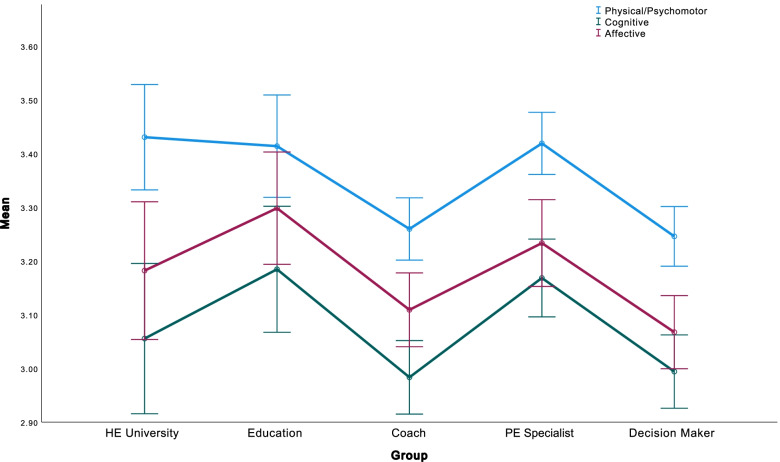
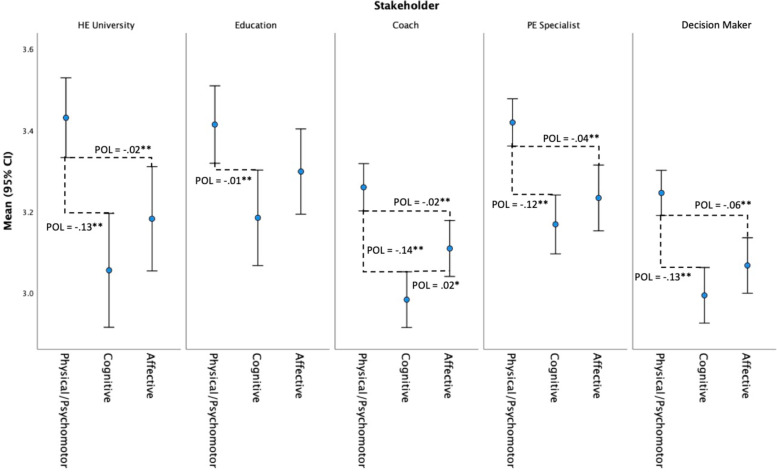
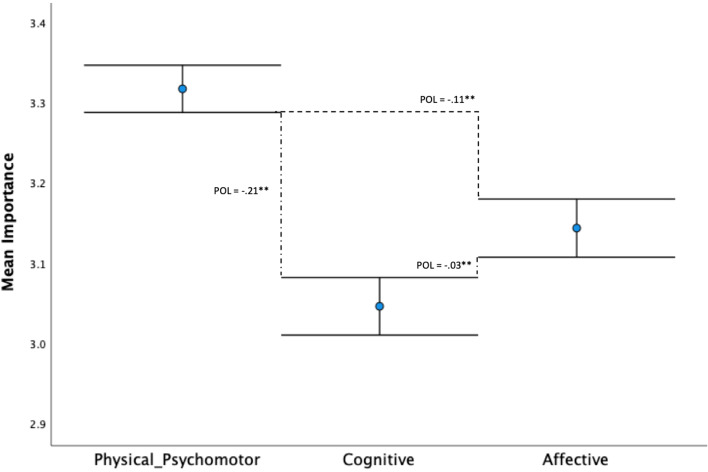
A majority (63%) of respondents indicated they were aware of an existing definition of physical literacy, but this varied by stakeholder group (e.g. 86% for higher education, versus 47% of coaches). Participants working in higher education (69%), or working as physical education specialists (67%), were more likely to rate themselves as experts or near experts in physical literacy, while coaches, education generalists, and decision makers were more likely rate themselves as having no expertise (9%, 12% and 12% respectively). Non-specialist teachers and physical education teachers rated the importance of all domains of physical literacy significantly higher than decision makers, and significantly higher than coaches in the cognitive and affective domains. All stakeholders significantly rated the importance of the physical/psychomotor domain of physical literacy higher than the affective or cognitive domains of physical literacy.
Differences observed across stakeholder groups underline the importance of developing a shared vision for physical literacy, and the need to clarify and gain consensus on a definition of the term and its domains. Engaging and understanding the voice of stakeholders is critical in ensuring the relevance, ownership of and commitment to physical literacy statement operationalisation.
在人口层面上发展身体素养,为从事体育、健康、教育、娱乐和体育活动的工作者提供了一个变革性的吸引力。建议采用跨学科方法制定该领域的政策。本研究的目的是从爱尔兰共和国和北爱尔兰与身体素养相关领域的青年工作的主要利益相关者那里收集实证数据,以了解他们对身体素养的当前理解和认识,以帮助制定爱尔兰岛第一个关于身体素养的共识声明。
共有 1241 名参与者(52%为男性)来自不同的利益相关者群体(健康、体育活动、体育、娱乐和教育),完成了一项由研究人员开发的身体素养问卷。采用单因素方差分析(MANOVA)来研究不同利益相关者群体在身体素养三个领域的重要性感知方面的差异。通过分析独立置信区间的重叠,确定了利益相关者群体内部身体素养领域的重要性。
大多数(63%)受访者表示他们已经了解现有的身体素养定义,但这因利益相关者群体而异(例如,高等教育为 86%,而教练为 47%)。在高等教育领域工作(69%)或担任体育教育专家(67%)的参与者更有可能将自己评为身体素养方面的专家或接近专家,而教练、教育通才和决策者更有可能将自己评为没有专业知识(分别为 9%、12%和 12%)。非专业教师和体育教师对身体素养所有领域的重要性评价显著高于决策者,对认知和情感领域的重要性评价显著高于教练。所有利益相关者都显著地评价了身体素养的身体/心理运动领域的重要性高于身体素养的情感或认知领域。
利益相关者群体之间观察到的差异强调了为身体素养制定共同愿景的重要性,以及澄清和达成对该术语及其领域的定义的共识的必要性。参与并理解利益相关者的意见对于确保身体素养声明实施的相关性、所有权和承诺至关重要。