Husain Seerab, Sivakumar Arvind, Rengalakshmi Sri
Department of orthodontic and Dentofacial orthopaedics, Saveetha Dental College and Hospital, Saveetha Institute of Medical and technical Sciences, Saveetha University, Chennai, India.
Bioinformation. 2021 Dec 31;17(12):1126-1129. doi: 10.6026/973206300171126. eCollection 2021.
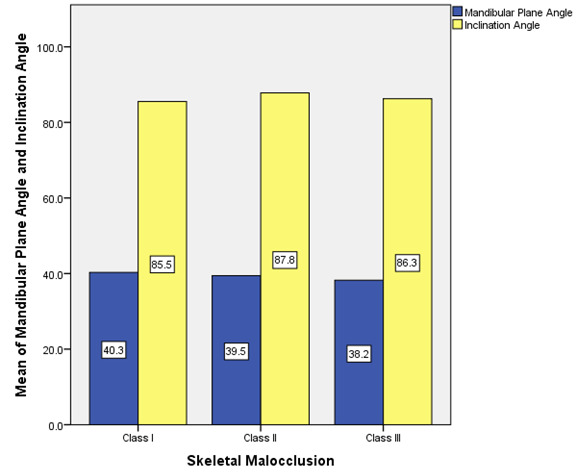
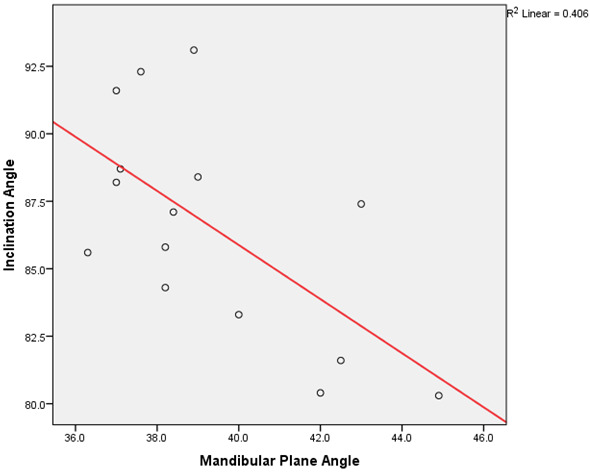
The skeletal discrepancies in the vertical dimensions can either lead to a long face or a short face. The palatal plane inclination is one such contributing factor. The study sample comprised of 15 lateral cephalograms collected between the time period of June 2019 - March 2020 with 5 cephalograms belonging to skeletal Class I, II and III respectively. The inclination angle and mandibular plane angle were measured using the FACAD software. The obtained results were tabulated and statistically analysed using Pearson's correlation test to determine the correlation between the two variables. There was a statistically significant negative correlation between the skeletal malocclusions with a p value of 0.011. Thus, palatal plane inclination is not a major contributing factor for vertical growth pattern and it is suggestive of a multifactorial influence.
垂直维度上的骨骼差异可能导致长脸或短脸。腭平面倾斜度就是一个这样的影响因素。研究样本包括2019年6月至2020年3月期间收集的15张头颅侧位片,其中分别有5张头颅侧位片属于骨骼I类、II类和III类。使用FACAD软件测量倾斜角和下颌平面角。将获得的结果制成表格,并使用Pearson相关检验进行统计分析,以确定两个变量之间的相关性。骨骼错牙合之间存在统计学上显著的负相关,p值为0.011。因此,腭平面倾斜度不是垂直生长模式的主要影响因素,这表明存在多因素影响。