TrypanoGEN Research Group, members of The H3Africa Consortium.
Malawi Med J. 2021 Dec;33(4):230-235. doi: 10.4314/mmj.v33i4.2.
is the cause of the acute form of human African trypanosomiasis (HAT) in eastern and southern African countries, including Malawi. For a long time, untreated HAT infections were believed to be 100% fatal. However, recent studies show that infection by can result in a wide range of clinical outcomes in its human host. Apart from other factors such as parasite diversity, cytokines have been strongly implicated to play a major role in the outcome of infections.In this study, we quantify the levels of three cytokines Interleukin-8 (IL-8), Tumor Necrotic Factor alpha (TNF-α) and Interleukin -10 (IL-10) in plasma amongst HAT cases (treated and untreated) and controls recruited during medical survey.
Two-hundred and thirty-three plasma samples (HAT cases and controls) from Rumphi, one of the endemic areas in Malawi were used. Blood collected was centrifuged, plasma extracted and stored in cryovials at -80°C until processing. Plasma cytokine concentration was measured using ELISA.
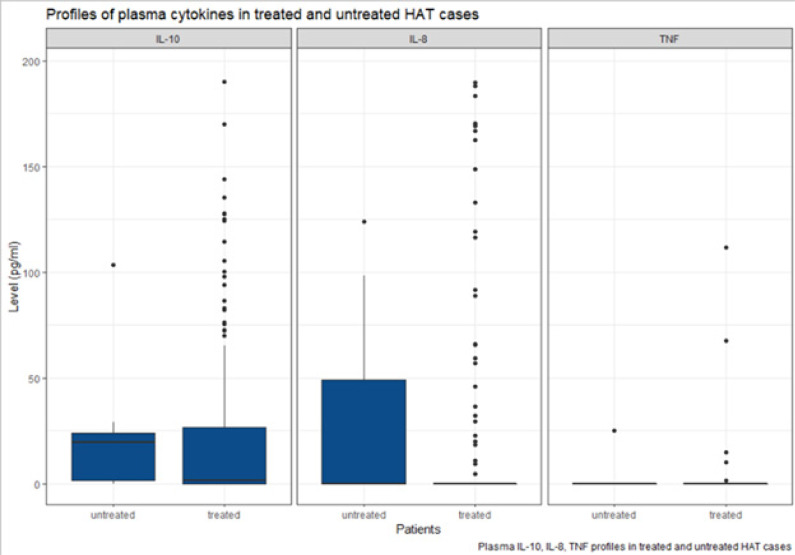
Plasma samples for 233 individuals, 76 HAT cases and 157 controls were quantified. Among the cases, nine had their plasma collected before treatment (untreated) and the rest were treated before blood for plasma analysis was collected. Controls had significantly higher mean plasmatic levels of TNF-α (94.5 ±474.12 pg/ml) and IL-8 (2258.6 ±5227.4 pg/ml) than cases TNF-α (29.35±181.58 pg/ml) and IL-8 (1191.3±4236.09 pg/ml). Controls and cases had similar mean levels of IL-10 in plasma. Only IL-8 had statistically significant higher median levels in the untreated than treated HAT cases P=0.006.
Our data suggest that cytokines could be considered as biomarkers of HAT infection and treatment. Further studies with a larger cohort of cases and additional cytokines which are known to be associated with HAT infection outcomes will be required to evaluate these cytokines further.
是导致东非和南非国家(包括马拉维)人体锥虫病(HAT)急性形式的原因。长期以来,未经治疗的 HAT 感染被认为是 100%致命的。然而,最近的研究表明,感染可以导致其人类宿主出现广泛的临床结果。除了寄生虫多样性等其他因素外,细胞因子也被强烈认为在感染的结果中起主要作用。在这项研究中,我们在接受治疗和未接受治疗的 HAT 病例和在医学调查中招募的对照者的血浆中定量了三种细胞因子白细胞介素-8(IL-8)、肿瘤坏死因子-α(TNF-α)和白细胞介素-10(IL-10)的水平。
使用来自马拉维伦菲利一个流行地区的 233 份血浆样本(HAT 病例和对照者)。采集的血液离心后,提取血浆并储存在 -80°C 的冷冻管中直至处理。使用 ELISA 测量血浆细胞因子浓度。
对 233 个人的血浆样本进行了定量,其中包括 76 例 HAT 病例和 157 例对照者。在病例中,有 9 人在未经治疗(未治疗)之前收集了血浆,其余的人在收集血浆进行分析之前接受了治疗。对照者的 TNF-α(94.5±474.12pg/ml)和 IL-8(2258.6±5227.4pg/ml)的平均血浆水平显著高于病例 TNF-α(29.35±181.58pg/ml)和 IL-8(1191.3±4236.09pg/ml)。对照者和病例的血浆中 IL-10 水平相似。仅 IL-8 在未经治疗的 HAT 病例中具有统计学意义更高的中位数水平,P=0.006。
我们的数据表明,细胞因子可以被视为 HAT 感染和治疗的生物标志物。需要对更多病例和其他已知与 HAT 感染结果相关的细胞因子进行更大队列的研究,以进一步评估这些细胞因子。