Department of Biology, Indiana University, Bloomington, Indiana, United States of America.
Basic Sciences Division, Fred Hutchinson Cancer Research Center, Seattle, Washington, United States of America.
PLoS Pathog. 2022 Mar 16;18(3):e1010393. doi: 10.1371/journal.ppat.1010393. eCollection 2022 Mar.
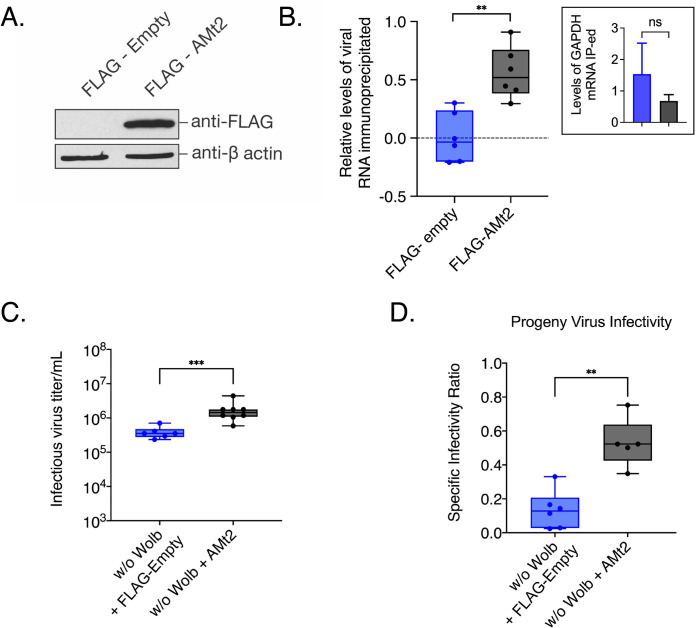
Arthropod endosymbiont Wolbachia pipientis is part of a global biocontrol strategy to reduce the replication of mosquito-borne RNA viruses such as alphaviruses. We previously demonstrated the importance of a host cytosine methyltransferase, DNMT2, in Drosophila and viral RNA as a cellular target during pathogen-blocking. Here we report a role for DNMT2 in Wolbachia-induced alphavirus inhibition in Aedes species. Expression of DNMT2 in mosquito tissues, including the salivary glands, is elevated upon virus infection. Notably, this is suppressed in Wolbachia-colonized animals, coincident with reduced virus replication and decreased infectivity of progeny virus. Ectopic expression of DNMT2 in cultured Aedes cells is proviral, increasing progeny virus infectivity, and this effect of DNMT2 on virus replication and infectivity is dependent on its methyltransferase activity. Finally, examining the effects of Wolbachia on modifications of viral RNA by LC-MS show a decrease in the amount of 5-methylcytosine modification consistent with the down-regulation of DNMT2 in Wolbachia colonized mosquito cells and animals. Collectively, our findings support the conclusion that disruption of 5-methylcytosine modification of viral RNA is a vital mechanism operative in pathogen blocking. These data also emphasize the essential role of epitranscriptomic modifications in regulating fundamental alphavirus replication and transmission processes.
节肢动物共生体沃尔巴克氏体(Wolbachia pipientis)是减少蚊媒 RNA 病毒(如甲病毒)复制的全球生物控制策略的一部分。我们之前证明了宿主胞嘧啶甲基转移酶 DNMT2 在果蝇和病毒 RNA 作为病原体阻断过程中的细胞靶标中的重要性。在这里,我们报告了 DNMT2 在沃尔巴克氏体诱导的登革热病毒抑制中的作用。在病毒感染后,蚊子组织(包括唾液腺)中的 DNMT2 表达水平升高。值得注意的是,在沃尔巴克氏体定殖的动物中,这种表达被抑制,同时病毒复制减少,后代病毒的感染力降低。在培养的 Aedes 细胞中异位表达 DNMT2 是有利的,增加了后代病毒的感染力,并且 DNMT2 对病毒复制和感染力的这种影响依赖于其甲基转移酶活性。最后,通过 LC-MS 检查沃尔巴克氏体对病毒 RNA 修饰的影响,发现 5-甲基胞嘧啶修饰的量减少,与沃尔巴克氏体定殖的蚊子细胞和动物中 DNMT2 的下调一致。总之,我们的发现支持这样的结论,即破坏病毒 RNA 的 5-甲基胞嘧啶修饰是病原体阻断中的一个重要机制。这些数据还强调了表观转录修饰在调节基本甲病毒复制和传播过程中的重要作用。