Rupp Sophia Kristina, Stengel Andreas
Department of Psychosomatic Medicine and Psychotherapy, University Hospital Tübingen, Tübingen, Germany.
Charité Center for Internal Medicine and Dermatology, Department for Psychosomatic Medicine, Charité - Universitätsmedizin Berlin, Corporate Member of Freie Universität Berlin, Humboldt-Universität zu Berlin and Berlin Institute of Health, Berlin, Germany.
Front Neurosci. 2022 Feb 28;16:844564. doi: 10.3389/fnins.2022.844564. eCollection 2022.
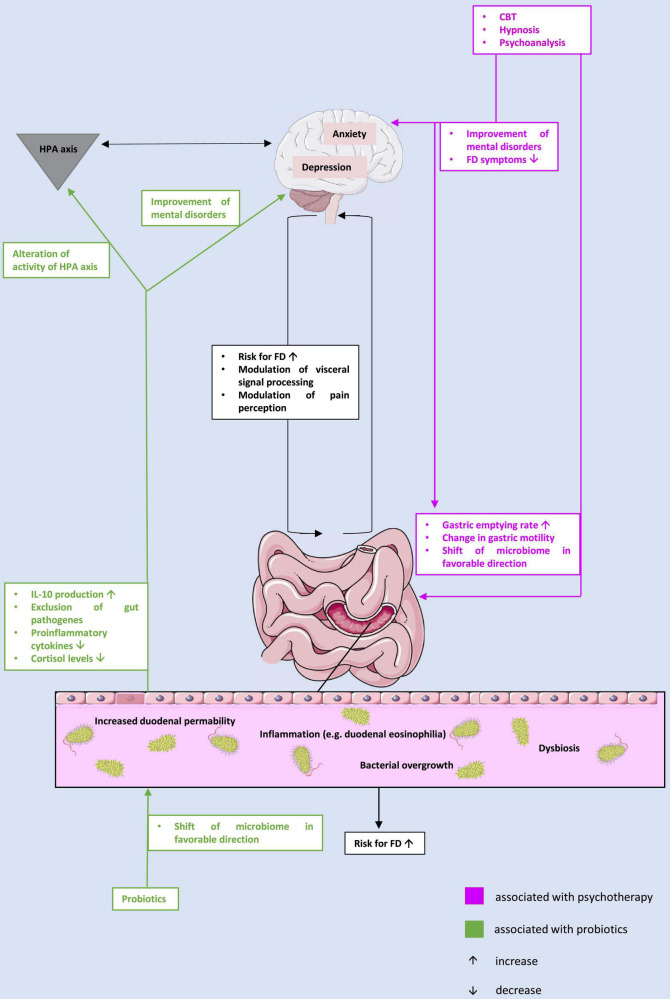
Functional dyspepsia is one of the most commonly diagnosed disorders of the gut-brain interaction worldwide. The precise pathogenesis of functional dyspepsia is complex and remains incompletely understood. Therefore, advances in the understanding of functional dyspepsia could change clinical practice. The aim of this review is to highlight the relevance of psychotherapy and probiotics in the context of the microbiota-gut-brain axis in the pathophysiology and especially in the treatment of functional dyspepsia. Therefore, studies which have been conducted to investigate the role of psychotherapy and probiotics in FD and the microbiota-gut-brain axis in the pathophysiology of functional dyspepsia were examined, and the outcomes of this research summarized. There might be a link between changes in the microbiome and functional dyspepsia. Even though, specific alterations in the microbiome that may be pathognomonic in functional dyspepsia remain unclear, the use of probiotics became a viable treatment option for patients with functional dyspepsia. Since mental illness also plays an important role in the pathophysiology of functional dyspepsia, psychotherapy is a useful treatment method, with additional study results indicating that psychotherapy may also shift the microbiome in a favorable direction. Moreover, other findings suggest that probiotics can be used not only to alleviate gastrointestinal symptoms in functional dyspepsia, but also to treat or even prevent mental disorders in these patients. In summary, in this review we highlight the bi-directionality of the microbiota-gut-brain axis in the pathophysiology of functional dyspepsia. Although there are multiple treatment approaches, the burden of disease in patients with functional dyspepsia is still enormous and a definitive therapy to cure this disease does not (yet) exist. Lastly, there is a lack of studies on the impact of dysbiosis, mental health and probiotics on pathophysiology and symptomatology in functional dyspepsia which should be investigated in future studies.
功能性消化不良是全球最常诊断出的肠-脑互动障碍之一。功能性消化不良的确切发病机制复杂,仍未完全明了。因此,对功能性消化不良认识的进展可能会改变临床实践。本综述的目的是强调心理治疗和益生菌在微生物群-肠-脑轴背景下对功能性消化不良病理生理学尤其是治疗方面的相关性。因此,我们审视了为研究心理治疗和益生菌在功能性消化不良中的作用以及微生物群-肠-脑轴在功能性消化不良病理生理学中的作用而开展的研究,并总结了这项研究的结果。微生物组的变化与功能性消化不良之间可能存在联系。尽管功能性消化不良中可能具有诊断意义的微生物组的具体改变仍不清楚,但益生菌的使用已成为功能性消化不良患者可行的治疗选择。由于精神疾病在功能性消化不良的病理生理学中也起重要作用,心理治疗是一种有用的治疗方法,另外的研究结果表明心理治疗也可能使微生物组朝着有利的方向转变。此外,其他研究结果表明,益生菌不仅可用于缓解功能性消化不良的胃肠道症状,还可用于治疗甚至预防这些患者的精神障碍。总之,在本综述中,我们强调了微生物群-肠-脑轴在功能性消化不良病理生理学中的双向性。尽管有多种治疗方法,但功能性消化不良患者的疾病负担仍然巨大,目前(尚未)存在治愈这种疾病的确定性疗法。最后,关于功能失调、心理健康和益生菌对功能性消化不良病理生理学和症状学的影响,缺乏相关研究,未来研究应予以探讨。