
粪便微生物群移植治疗进行性核上性麻痹-理查森综合征患者的疗效:一项2期单中心随机临床试验
Efficacy of faecal microbiota transplantation in patients with progressive supranuclear palsy-Richardson's syndrome: a phase 2, single centre, randomised clinical trial.
作者信息
Tian Haiyan, Wang Jiuqi, Feng Renyi, Zhang Rui, Liu Han, Qin Chi, Meng Lin, Chen Yongkang, Fu Yu, Liang Dongxiao, Yuan Xin, Zhai Yanping, Zhu Qingyong, Jin Lingjing, Teng Junfang, Ding Xuebing, Wang Xuejing
机构信息
Department of Neurology, The First Affiliated Hospital of Zhengzhou University, Zhengzhou, Henan, 450052, China.
Institute of Parkinson and Movement Disorder, Zhengzhou University, Zhengzhou, Henan, 450052, China.
出版信息
EClinicalMedicine. 2023 Mar 17;58:101888. doi: 10.1016/j.eclinm.2023.101888. eCollection 2023 Apr.
BACKGROUND
Faecal microbiota transplantation (FMT) has demonstrated efficacy in treating gastrointestinal (GI) diseases, such as infection (CDI) and inflammatory bowel disease (IBD). GI dysfunction is a frequent and occasionally dominating symptom of progressive supranuclear palsy-Richardson's syndrome (PSP-RS). However, it is not known whether FMT has clinical efficacy for PSP-RS.
METHODS
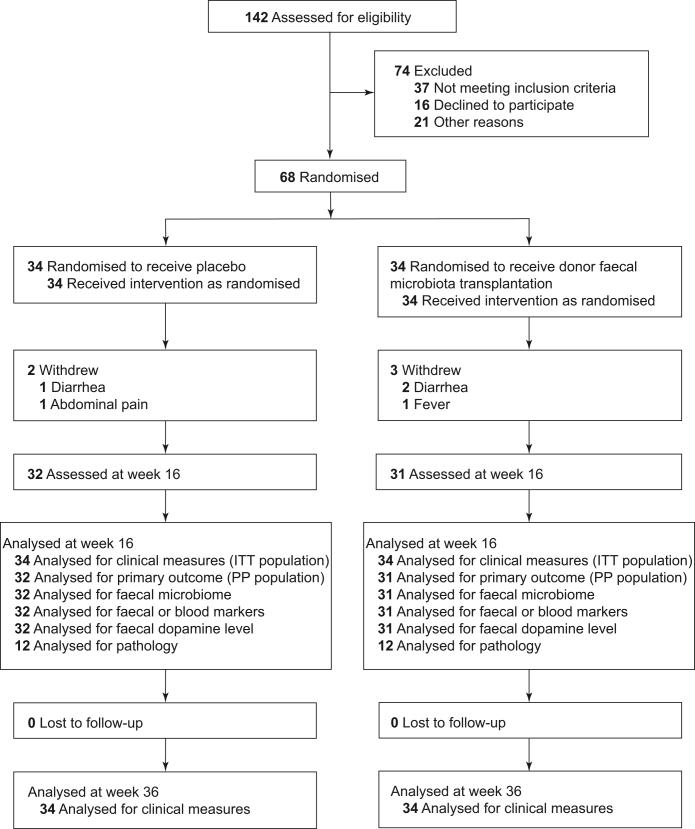
This 36-week, randomised, placebo-controlled, parallel-group, phase 2 clinical trial was performed at a university tertiary referral hospital in China. From August 15 2021 to December 31 2021, a total of 68 newly diagnosed patients with PSP-RS (male 40 [59%], female 28 [41%]) who had never received any antiparkinsonian medications were enrolled and randomly assigned to receive either healthy donor FMT (n = 34, FMT group) or a mixture of 0.9% saline and food colouring (E150c) as sham transplantation (n = 34, placebo group) through transendoscopic enteral tubing (TET). Two days after oral antibiotics, participants received 1 week of transplantation. After an interval of 4 weeks, retransplantation was performed. Then, the last transplantation was given after another interval of 4 weeks, and the participants were followed up for 24 weeks (week 36). Clinicaltrials.gov identifier: ChiCTR-2100045397.
FINDINGS
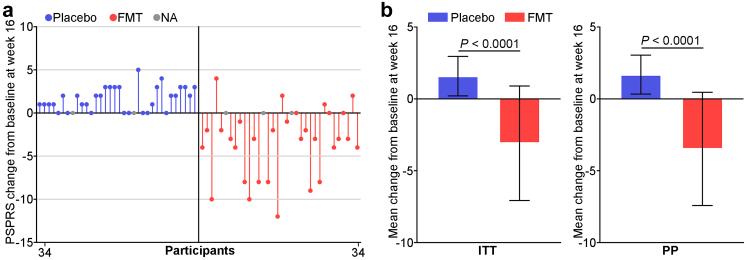
Among 68 patients who were randomised (mean age, 67.2 (SD 5.1); 40 [59%] were male, 28 [41%] were female), 63 participants completed the trial. Efficacy analyses were performed on the intention-to-treat (ITT) analysis set. At week 16, the mean PSP Rating Scale (PSPRS) scores (the primary outcome) improved from 40.1 (SD 7.6) to 36.9 (SD 5.9) in the FMT group, whereas the scores changed from 40.1 (SD 6.9) to 41.7 (SD 6.2) in the placebo group, for a treatment benefit of 4.3 (95% CI, 3.2-5.4) ( < 0.0001). After 3-cycle intervention, symptoms of constipation, depression, and anxiety (the secondary outcome) improved significantly at week 16 in the FMT group compared with the placebo group, the majority of which were maintained at the 24-week follow-up (week 36).
INTERPRETATION
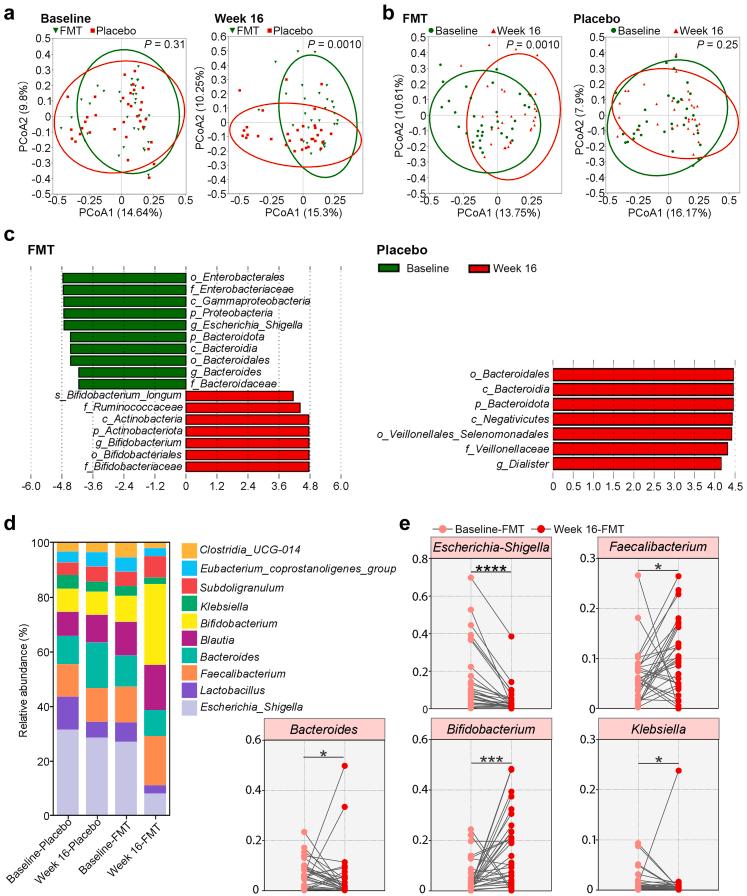
Our findings suggest that, compared with placebo, FMT treatment significantly improved motor and nonmotor symptoms in patients with PSP-RS, as well as reduced intestinal inflammation and enhanced the intestinal barrier by regulating the intestinal microbiota composition.
FUNDING
The National Natural Science Foundation of China (No. 82122022, 82171248, 81873791, and 82230084), Natural Science Foundation of Henan Province for Excellent Young Scholars (no. 202300410357), and Henan Province Young and Middle-Aged Health Science and Technology Innovation Talent Project (YXKC2020033).
背景
粪菌移植(FMT)已被证明在治疗胃肠道(GI)疾病方面有效,如感染性腹泻(CDI)和炎症性肠病(IBD)。胃肠功能障碍是进行性核上性麻痹-理查森综合征(PSP-RS)常见且有时占主导地位的症状。然而,尚不清楚FMT对PSP-RS是否具有临床疗效。
方法
这项为期36周的随机、安慰剂对照、平行组2期临床试验在中国一家大学三级转诊医院进行。从2021年8月15日至2021年12月31日,共纳入68例新诊断的PSP-RS患者(男性40例[59%],女性28例[41%]),这些患者从未接受过任何抗帕金森药物治疗,并通过经内镜肠内导管(TET)随机分配接受健康供体FMT(n = 34,FMT组)或0.9%生理盐水和食用色素(E150c)的混合物作为假移植(n = 34,安慰剂组)。口服抗生素两天后,参与者接受为期1周的移植。间隔4周后,进行再次移植。然后,在又间隔4周后进行最后一次移植,并对参与者进行24周(第36周)的随访。Clinicaltrials.gov标识符:ChiCTR-2100045397。
结果
在68例随机分组的患者中(平均年龄67.2岁(标准差5.1);男性40例[59%],女性28例[41%]),63例参与者完成了试验。在意向性治疗(ITT)分析集上进行疗效分析。在第16周时,FMT组的平均PSP评定量表(PSPRS)评分(主要结局)从40.1(标准差7.6)改善至36.9(标准差5.9),而安慰剂组的评分从40.1(标准差6.9)变为41.7(标准差6.2),治疗获益为4.3(95%CI,3.2 - 5.4)(P < 0.0001)。经过3个周期的干预,与安慰剂组相比,FMT组在第16周时便秘、抑郁和焦虑症状(次要结局)有显著改善,其中大多数在24周随访(第36周)时得以维持。
解读
我们的研究结果表明,与安慰剂相比,FMT治疗显著改善了PSP-RS患者的运动和非运动症状,以及通过调节肠道微生物群组成减轻了肠道炎症并增强了肠道屏障。
资助
中国国家自然科学基金(项目编号82122022、82171248、81873791和82230084)、河南省优秀青年科学基金(项目编号202300410357)以及河南省中青年卫生科技创新人才项目(YXKC2020033)。
 Zotero 插件