Department of Internal Medicine, University Medical Center Groningen, University of Groningen, Groningen, The Netherlands.
Division of Clinical Chemistry, Department of Laboratory Medicine (LABMED), H5, Alfred Nobels Alle 8, Karolinska Institutet, 141 83, Stockholm, Sweden.
Cardiovasc Diabetol. 2022 Mar 16;21(1):41. doi: 10.1186/s12933-022-01475-y.
New onset diabetes after transplantation (NODAT) is a frequent and serious complication of renal transplantation resulting in worse graft and patient outcomes. The pathophysiology of NODAT is incompletely understood, and no prospective biomarkers have been established to predict NODAT risk in renal transplant recipients (RTR). The present work aimed to determine whether remnant lipoprotein (RLP) cholesterol could serve as such a biomarker that would also provide a novel target for therapeutic intervention.
This longitudinal cohort study included 480 RTR free of diabetes at baseline. 53 patients (11%) were diagnosed with NODAT during a median [interquartile range, IQR] follow-up of 5.2 [4.1-5.8] years. RLP cholesterol was calculated by subtracting HDL and LDL cholesterol from total cholesterol values (all directly measured).
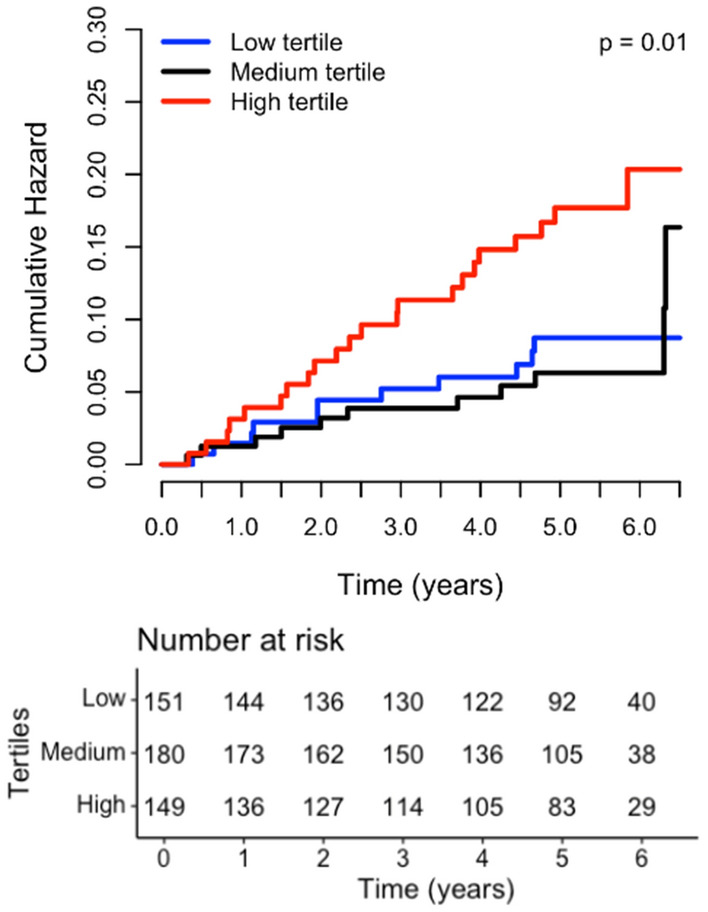
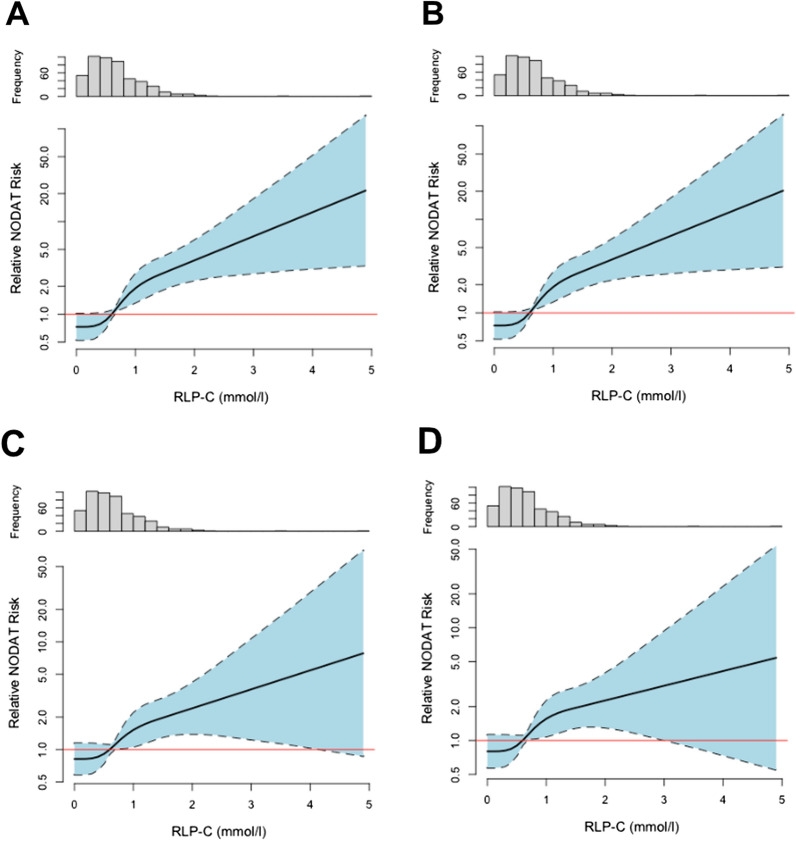
Baseline remnant cholesterol values were significantly higher in RTR who subsequently developed NODAT (0.9 [0.5-1.2] mmol/L vs. 0.6 [0.4-0.9] mmol/L, p = 0.001). Kaplan-Meier analysis showed that higher RLP cholesterol values were associated with an increased risk of incident NODAT (log rank test, p < 0.001). Cox regression demonstrated a significant longitudinal association between baseline RLP cholesterol levels and NODAT (HR, 2.27 [1.64-3.14] per 1 SD increase, p < 0.001) that remained after adjusting for plasma glucose and HbA1c (p = 0.002), HDL and LDL cholesterol (p = 0.008) and use of immunosuppressive medication (p < 0.001), among others. Adding baseline remnant cholesterol to the Framingham Diabetes Risk Score significantly improved NODAT prediction (change in C-statistic, p = 0.01).
This study demonstrates that baseline RLP cholesterol levels strongly associate with incident NODAT independent of several other recognized risk factors.
移植后新发糖尿病(NODAT)是肾移植的一种常见且严重的并发症,会导致移植物和患者预后更差。NODAT 的病理生理学机制尚未完全阐明,也没有前瞻性的生物标志物来预测肾移植受者(RTR)的 NODAT 风险。本研究旨在确定残余脂蛋白(RLP)胆固醇是否可作为此类生物标志物,同时为治疗干预提供新的靶点。
这是一项纵向队列研究,纳入了 480 名基线时无糖尿病的 RTR。在中位 [四分位间距,IQR] 5.2 [4.1-5.8] 年的随访中,有 53 名(11%)患者被诊断为 NODAT。RLP 胆固醇通过从总胆固醇值中减去 HDL 和 LDL 胆固醇(均直接测量)来计算。
随后发生 NODAT 的 RTR 患者的基线残余胆固醇值明显更高(0.9 [0.5-1.2] mmol/L 比 0.6 [0.4-0.9] mmol/L,p=0.001)。Kaplan-Meier 分析显示,较高的 RLP 胆固醇值与发生 NODAT 的风险增加相关(对数秩检验,p<0.001)。Cox 回归分析显示,基线 RLP 胆固醇水平与 NODAT 之间存在显著的纵向关联(每增加 1 SD,HR 为 2.27 [1.64-3.14],p<0.001),调整血糖和糖化血红蛋白(p=0.002)、HDL 和 LDL 胆固醇(p=0.008)以及免疫抑制药物的使用(p<0.001)等因素后,该关联仍然存在。将基线残余胆固醇加入 Framingham 糖尿病风险评分显著提高了 NODAT 的预测能力(C 统计量变化,p=0.01)。
本研究表明,基线 RLP 胆固醇水平与独立于其他几个公认的危险因素的 NODAT 事件强烈相关。