Yepes-Calderón Manuela, Sotomayor Camilo G, Gomes-Neto António W, Gans Rijk O B, Berger Stefan P, Rimbach Gerald, Esatbeyoglu Tuba, Rodrigo Ramón, Geleijnse Johanna M, Navis Gerjan J, Bakker Stephan J L
Division of Nephrology, Department of Internal Medicine, University Medical Center Groningen, University of Groningen, 9713 GZ Groningen, The Netherlands.
Department of Internal Medicine, University Medical Center Groningen, University of Groningen, 9713 GZ Groningen, The Netherlands.
J Clin Med. 2019 Apr 4;8(4):453. doi: 10.3390/jcm8040453.
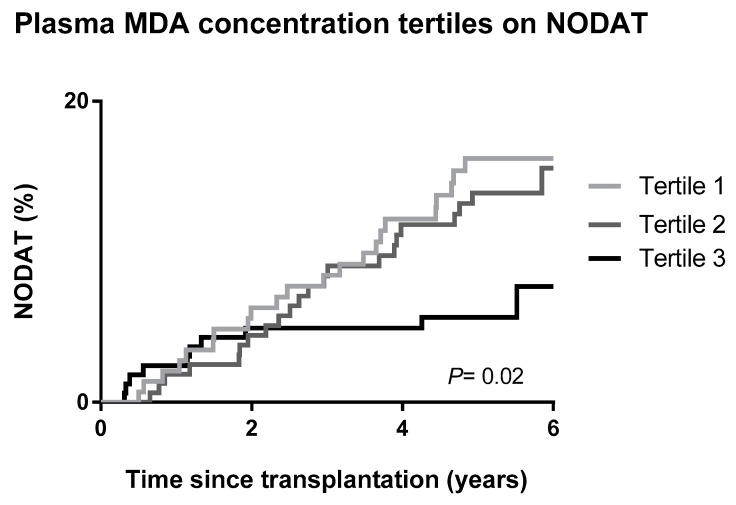
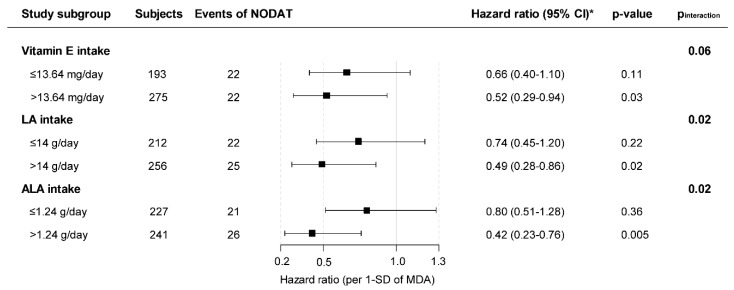
New-onset diabetes after transplantation (NODAT) is a frequent complication in renal transplant recipients (RTR). Although oxidative stress has been associated with diabetes mellitus, data regarding NODAT are limited. We aimed to prospectively investigate the long-term association between the oxidative stress biomarker malondialdehyde (measured by high-performance liquid chromatography) and NODAT in an extensively phenotyped cohort of non-diabetic RTR with a functioning graft ≥1 year. We included 516 RTR (51 ± 13 years-old, 57% male). Median plasma malondialdehyde (MDA) was 2.55 (IQR, 1.92-3.66) µmol/L. During a median follow-up of 5.3 (IQR, 4.6-6.0) years, 56 (11%) RTR developed NODAT. In Cox proportional-hazards regression analyses, MDA was inversely associated with NODAT, independent of immunosuppressive therapy, transplant-specific covariates, lifestyle, inflammation, and metabolism parameters (HR, 0.55; 95% CI, 0.36-0.83 per 1-SD increase; < 0.01). Dietary antioxidants intake (e.g., vitamin E, α-lipoic acid, and linoleic acid) were effect-modifiers of the association between MDA and NODAT, with particularly strong inverse associations within the subgroup of RTR with relatively higher dietary antioxidants intake. In conclusion, plasma MDA concentration is inversely and independently associated with long-term risk of NODAT in RTR. Our findings support a potential underrecognized role of oxidative stress in post-transplantation glucose homeostasis.
移植后新发糖尿病(NODAT)是肾移植受者(RTR)中常见的并发症。尽管氧化应激与糖尿病有关,但关于NODAT的数据有限。我们旨在前瞻性研究氧化应激生物标志物丙二醛(通过高效液相色谱法测量)与NODAT在具有≥1年功能移植物的非糖尿病RTR广泛表型队列中的长期关联。我们纳入了516名RTR(年龄51±13岁,57%为男性)。血浆丙二醛(MDA)中位数为2.55(四分位间距,1.92 - 3.66)µmol/L。在中位随访5.3(四分位间距,4.6 - 6.0)年期间,56名(11%)RTR发生了NODAT。在Cox比例风险回归分析中,MDA与NODAT呈负相关,独立于免疫抑制治疗、移植特异性协变量、生活方式、炎症和代谢参数(风险比,0.55;95%置信区间,每增加1个标准差为0.36 - 0.83;P<0.01)。膳食抗氧化剂摄入量(如维生素E、α -硫辛酸和亚油酸)是MDA与NODAT之间关联的效应修饰因素,在膳食抗氧化剂摄入量相对较高的RTR亚组中,两者的负相关尤为强烈。总之,血浆MDA浓度与RTR中NODAT的长期风险呈负相关且独立相关。我们的研究结果支持氧化应激在移植后葡萄糖稳态中可能未被充分认识的作用。