Center for Global Health Science and Security, Georgetown University, Washington, District of Columbia, USA.
Talus Analytics, Boulder, Colorado, USA.
BMJ Glob Health. 2022 Mar;7(3). doi: 10.1136/bmjgh-2022-008642.
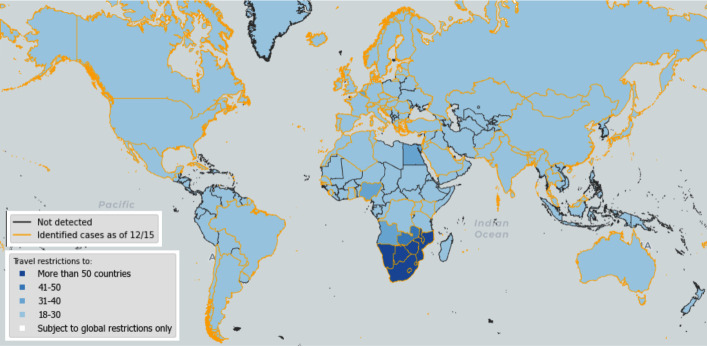
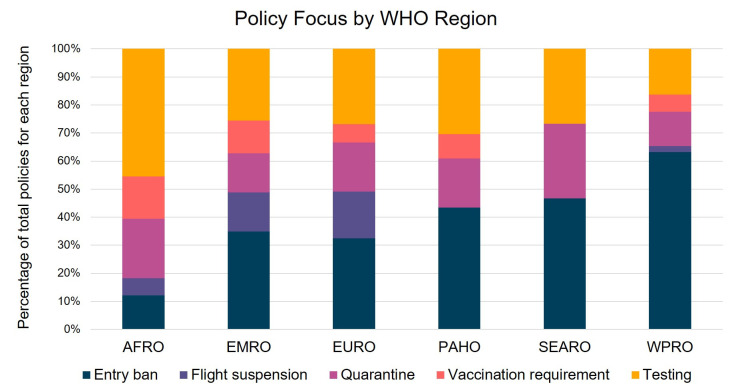
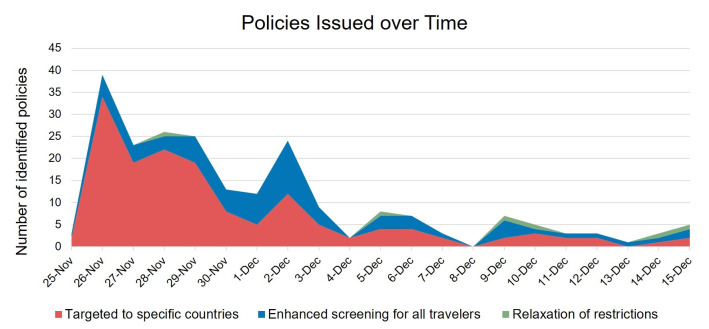
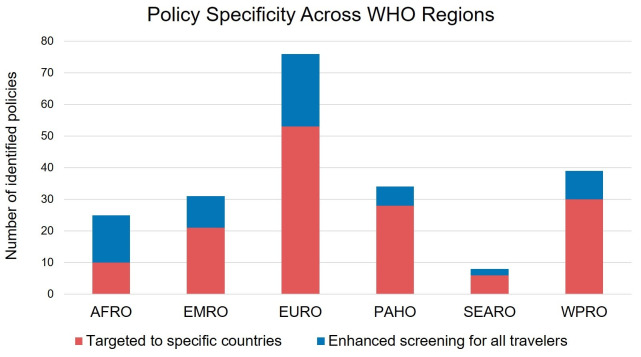
Following the identification of the Omicron variant of the SARS-CoV-2 virus in late November 2021, governments worldwide took actions intended to minimise the impact of the new variant within their borders. Despite guidance from the WHO advising a risk-based approach, many rapidly implemented stringent policies focused on travel restrictions. In this paper, we capture 221 national-level travel policies issued during the 3 weeks following publicisation of the Omicron variant. We characterise policies based on whether they target travellers from specific countries or focus more broadly on enhanced screening, and explore differences in approaches at the regional level. We find that initial reactions almost universally focused on entry bans and flight suspensions from Southern Africa, and that policies continued to target travel from these countries even after community transmission of the Omicron variant was detected elsewhere in the world. While layered testing and quarantine requirements were implemented by some countries later in this 3-week period, these enhanced screening policies were rarely the first response. The timing and conditionality of quarantine and testing requirements were not coordinated between countries or regions, creating logistical complications and burdening travellers with costs. Overall, response measures were rarely tied to specific criteria or adapted to match the unique epidemiology of the new variant.
继 2021 年 11 月底发现 SARS-CoV-2 病毒的奥密克戎变异株后,全球各国政府采取行动,旨在减轻新变异株在其境内的影响。尽管世卫组织的指导意见建议采取基于风险的方法,但许多国家迅速实施了严格的政策,重点是旅行限制。在本文中,我们收集了在奥密克戎变异株公布后的 3 周内发布的 221 项国家级旅行政策。我们根据政策是针对特定国家的旅行者还是更广泛地侧重于加强筛查来对政策进行分类,并探讨区域层面的方法差异。我们发现,最初的反应几乎普遍集中在对来自南部非洲的入境禁令和航班暂停上,即使在世界其他地方发现奥密克戎变异株已在社区传播,这些政策仍继续针对来自这些国家的旅行。虽然一些国家在这 3 周内晚些时候实施了分层检测和检疫要求,但这些加强筛查政策很少是第一反应。检疫和检测要求的时间和条件在国家或地区之间没有协调,造成了后勤方面的复杂问题,并给旅行者带来了费用负担。总体而言,应对措施很少与特定标准挂钩,也没有根据新变异株的独特流行病学进行调整。