INSERM U1015, Gustave Roussy, Villejuif, France.
Medical Oncology, Hôpital Saint-Louis, Paris, France.
J Immunother Cancer. 2022 Mar;10(3). doi: 10.1136/jitc-2021-004191.
Prostate cancer (PC) responds to androgen deprivation therapy (ADT) usually in a transient fashion, progressing from hormone-sensitive PC (HSPC) to castration-resistant PC (CRPC). We investigated a mouse model of PC as well as specimens from PC patients to unravel an unsuspected contribution of thymus-derived T lymphocytes and the intestinal microbiota in the efficacy of ADT.
Preclinical experiments were performed in PC-bearing mice, immunocompetent or immunodeficient. In parallel, we prospectively included 65 HSPC and CRPC patients (Oncobiotic trial) to analyze their feces and blood specimens.
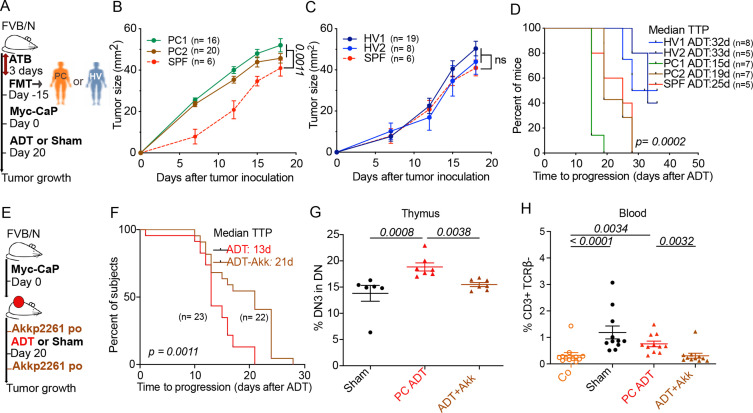
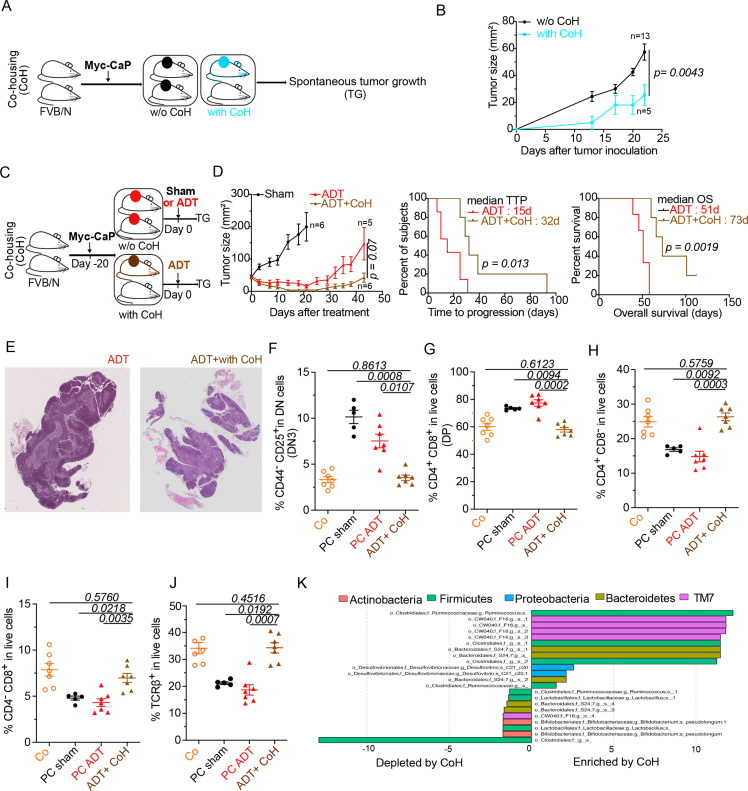
In PC-bearing mice, ADT increased thymic cellularity and output. PC implanted in T lymphocyte-depleted or athymic mice responded less efficiently to ADT than in immunocompetent mice. Moreover, depletion of the intestinal microbiota by oral antibiotics reduced the efficacy of ADT. PC reduced the relative abundance of in the gut, and this effect was reversed by ADT. Moreover, cohousing of PC-bearing mice with tumor-free mice or oral gavage with improved the efficacy of ADT. This appears to be applicable to PC patients because long-term ADT resulted in an increase of thymic output, as demonstrated by an increase in circulating recent thymic emigrant cells (sjTRECs). Moreover, as compared with HSPC controls, CRPC patients demonstrated a shift in their intestinal microbiota that significantly correlated with sjTRECs. While feces from healthy volunteers restored ADT efficacy, feces from PC patients failed to do so.
These findings suggest the potential clinical utility of reversing intestinal dysbiosis and repairing acquired immune defects in PC patients.
前列腺癌(PC)通常对雄激素剥夺疗法(ADT)有短暂的反应,从激素敏感型 PC(HSPC)进展为去势抵抗型 PC(CRPC)。我们研究了一种 PC 小鼠模型以及 PC 患者的标本,以揭示胸腺来源的 T 淋巴细胞和肠道微生物群在 ADT 疗效中的意外贡献。
在携带 PC 的免疫功能正常或免疫缺陷小鼠中进行临床前实验。同时,我们前瞻性地纳入了 65 例 HSPC 和 CRPC 患者(Oncobiotic 试验),以分析他们的粪便和血液标本。
在携带 PC 的小鼠中,ADT 增加了胸腺细胞的数量和输出。与免疫功能正常的小鼠相比,在 T 淋巴细胞耗竭或无胸腺小鼠中植入的 PC 对 ADT 的反应效率较低。此外,口服抗生素耗尽肠道微生物群会降低 ADT 的疗效。PC 减少了肠道中的相对丰度,而 ADT 则逆转了这种影响。此外,将携带 PC 的小鼠与无肿瘤小鼠共住或口服灌胃可以改善 ADT 的疗效。这似乎适用于 PC 患者,因为长期 ADT 导致胸腺输出增加,这表现为循环近期胸腺迁出细胞(sjTRECs)的增加。此外,与 HSPC 对照相比,CRPC 患者的肠道微生物群发生了转变,这与 sjTRECs 显著相关。虽然来自健康志愿者的粪便可以恢复 ADT 的疗效,但来自 PC 患者的粪便则不能。
这些发现提示了在 PC 患者中逆转肠道菌群失调和修复获得性免疫缺陷的潜在临床应用价值。