Department of Computing Science, University of Alberta, Edmonton, AB, Canada.
Alberta Machine Intelligence Institute (Amii), Edmonton, AB, Canada.
Sci Rep. 2022 Mar 16;12(1):4472. doi: 10.1038/s41598-022-08601-6.
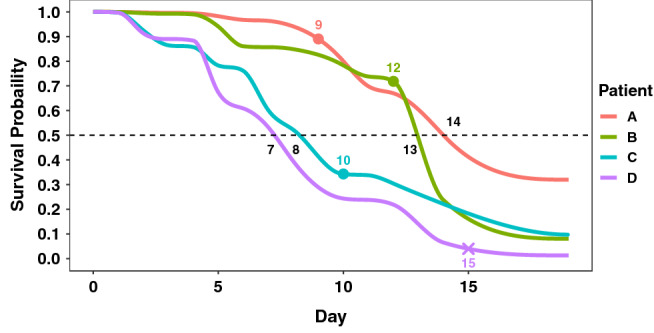
Since it emerged in December of 2019, COVID-19 has placed a huge burden on medical care in countries throughout the world, as it led to a huge number of hospitalizations and mortalities. Many medical centers were overloaded, as their intensive care units and auxiliary protection resources proved insufficient, which made the effective allocation of medical resources an urgent matter. This study describes learned survival prediction models that could help medical professionals make effective decisions regarding patient triage and resource allocation. We created multiple data subsets from a publicly available COVID-19 epidemiological dataset to evaluate the effectiveness of various combinations of covariates-age, sex, geographic location, and chronic disease status-in learning survival models (here, "Individual Survival Distributions"; ISDs) for hospital discharge and also for death events. We then supplemented our datasets with demographic and economic information to obtain potentially more accurate survival models. Our extensive experiments compared several ISD models, using various measures. These results show that the "gradient boosting Cox machine" algorithm outperformed the competing techniques, in terms of these performance evaluation metrics, for predicting both an individual's likelihood of hospital discharge and COVID-19 mortality. Our curated datasets and code base are available at our Github repository for reproducing the results reported in this paper and for supporting future research.
自 2019 年 12 月爆发以来,COVID-19 给世界各国的医疗保健带来了巨大的负担,导致大量住院和死亡。许多医疗中心不堪重负,因为它们的重症监护室和辅助保护资源明显不足,这使得有效分配医疗资源成为当务之急。本研究描述了学习生存预测模型,这些模型可以帮助医疗专业人员在患者分诊和资源分配方面做出有效决策。我们从一个公开的 COVID-19 流行病学数据集创建了多个数据子集,以评估在学习生存模型(即“个体生存分布”(ISD))中,各种协变量(年龄、性别、地理位置和慢性病状况)组合对于医院出院和死亡事件的有效性。然后,我们用人口统计学和经济信息补充我们的数据集,以获得潜在更准确的生存模型。我们的广泛实验比较了几种 ISD 模型,使用了各种度量标准。这些结果表明,在预测个体出院和 COVID-19 死亡率的可能性方面,“梯度提升 Cox 机”算法在这些性能评估指标上优于竞争技术。我们在 Github 存储库中提供了经过整理的数据集和代码库,用于重现本文报告的结果,并支持未来的研究。