Division of Regenerative Therapy, Juntendo University Graduate School of Medicine, Tokyo, Japan.
Department of Plastic and Reconstructive Surgery, Juntendo University School of Medicine, Tokyo, Japan.
Stem Cells Transl Med. 2022 Mar 17;11(2):146-158. doi: 10.1093/stcltm/szab018.
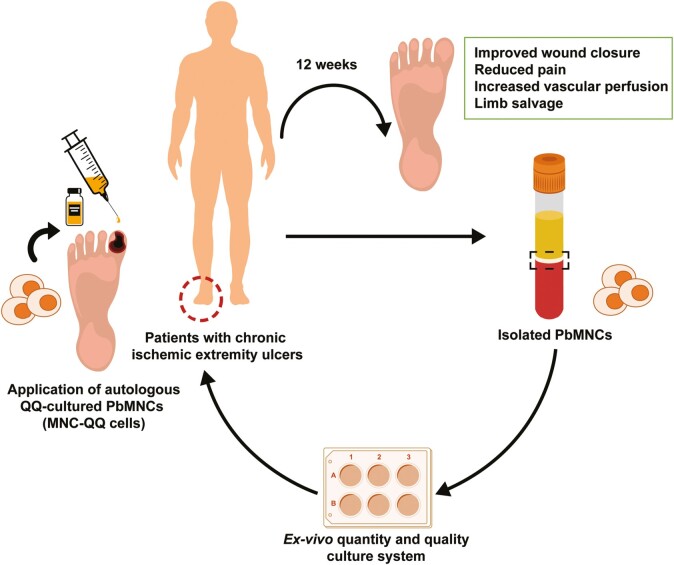
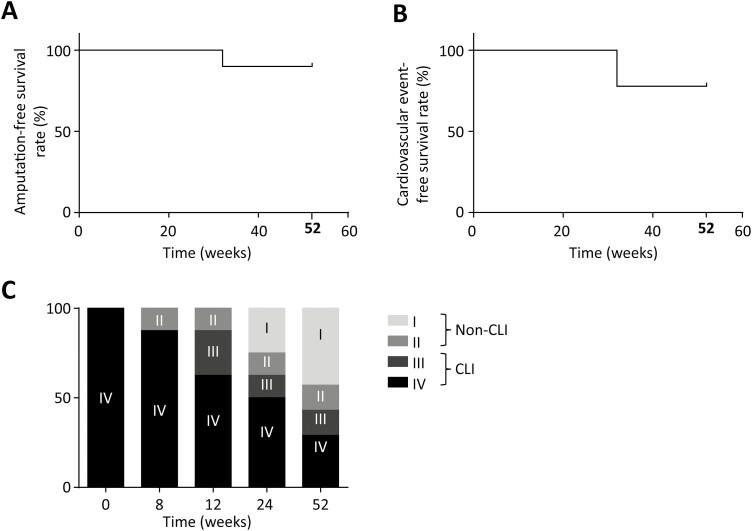
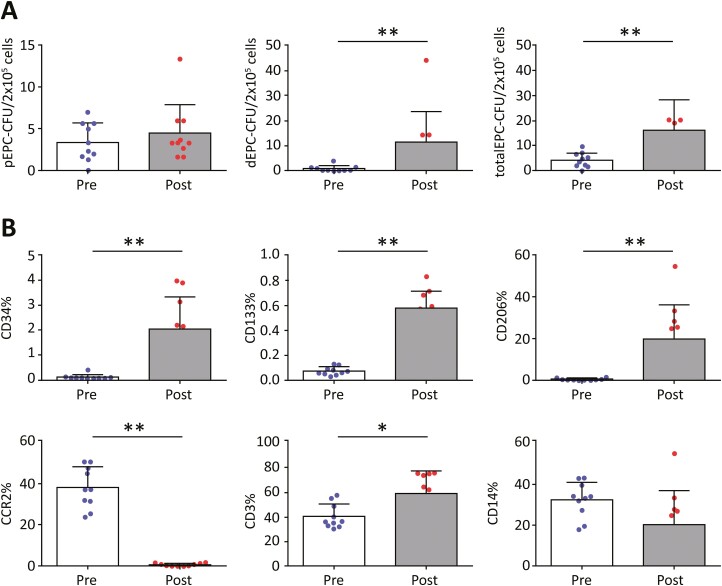
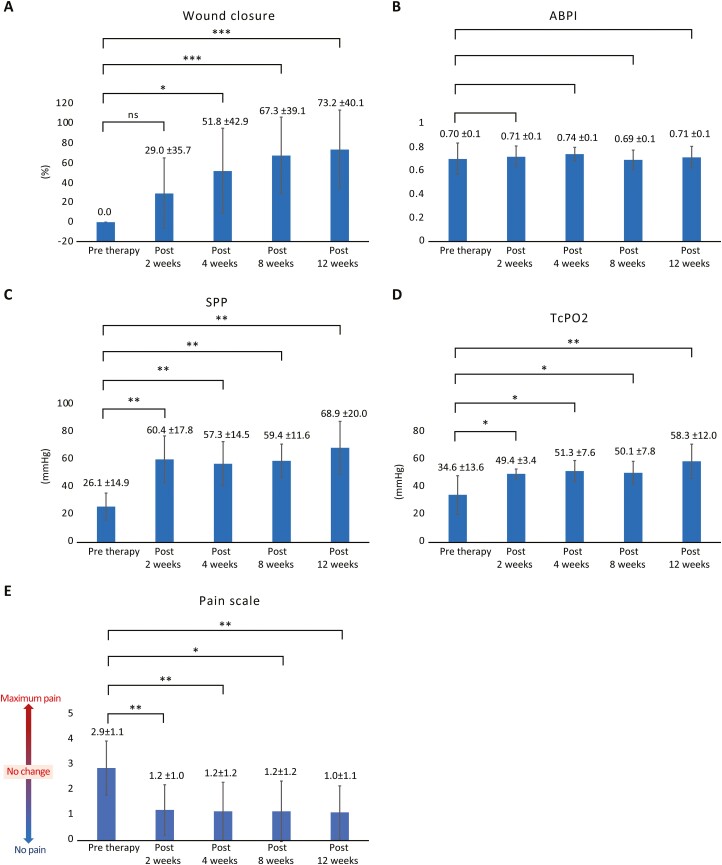
Non-healing wounds are among the main causes of morbidity and mortality. We recently described a novel, serum-free ex vivo expansion system, the quantity and quality culture system (QQc), which uses peripheral blood mononuclear cells (PBMNCs) for effective and noninvasive regeneration of tissue and vasculature in murine and porcine models. In this prospective clinical study, we investigated the safety and efficacy of QQ-cultured peripheral blood mononuclear cell (MNC-QQ) therapy for chronic non-healing ischemic extremity wounds. Peripheral blood was collected from 9 patients with 10 chronic (>1 month) non-healing wounds (8 males, 1 female; 64-74 years) corresponding to ischemic extremity ulcers. PBMNCs were isolated and cultured using QQc. Within a 20-cm area surrounding the ulcer, 2 × 10⁷ cells were injected under local anesthesia. Wound healing was monitored photometrically every 2 weeks. The primary endpoint was safety, whereas the secondary endpoint was efficacy at 12-week post-injection. All patients remained ambulant, and no deaths, other serious adverse events, or major amputations were observed for 12 weeks after cell transplantation. Six of the 10 cases showed complete wound closure with an average wound closure rate of 73.2% ± 40.1% at 12 weeks. MNC-QQ therapy increased vascular perfusion, skin perfusion pressure, and decreased pain intensity in all patients. These results indicate the feasibility and safety of MNC-QQ therapy in patients with chronic non-healing ischemic extremity wounds. As the therapy involves transplanting highly vasculogenic cells obtained from a small blood sample, it may be an effective and highly vasculogenic strategy for limb salvage.
非愈合性伤口是发病率和死亡率的主要原因之一。我们最近描述了一种新型的、无血清的体外扩增系统,即数量和质量培养系统(QQc),该系统使用外周血单核细胞(PBMNC)在鼠和猪模型中有效且非侵入性地再生组织和脉管系统。在这项前瞻性临床研究中,我们研究了 QQ 培养的外周血单核细胞(MNC-QQ)治疗慢性非愈合性缺血性肢体伤口的安全性和有效性。从 9 名患有 10 处慢性(> 1 个月)非愈合性伤口(8 名男性,1 名女性;64-74 岁)的患者中采集外周血,这些伤口对应缺血性肢体溃疡。使用 QQc 分离和培养 PBMNC。在溃疡周围 20cm 的区域内,局部麻醉下注射 2×10⁷ 个细胞。每两周通过光度法监测伤口愈合情况。主要终点是安全性,次要终点是注射后 12 周的疗效。所有患者在细胞移植后 12 周内仍可走动,未发生死亡、其他严重不良事件或主要截肢。10 例中有 6 例完全闭合伤口,平均 12 周时的伤口闭合率为 73.2%±40.1%。MNC-QQ 治疗增加了所有患者的血管灌注、皮肤灌注压,并降低了疼痛强度。这些结果表明,MNC-QQ 治疗慢性非愈合性缺血性肢体伤口是可行和安全的。由于该治疗涉及从少量血液样本中移植高血管生成细胞,因此它可能是一种有效的、高度血管生成的保肢策略。