Infectious Diseases Department, Mater Misericordiae University Hospital, Dublin 7, Ireland; School of Medicine, University College Dublin, Dublin 4, Ireland.
School of Medicine, University College Dublin, Dublin 4, Ireland.
Int J Infect Dis. 2022 May;118:236-243. doi: 10.1016/j.ijid.2022.03.013. Epub 2022 Mar 14.
Few studies to date have explored the health-related quality of life (HRQoL) in patients with long COVID.
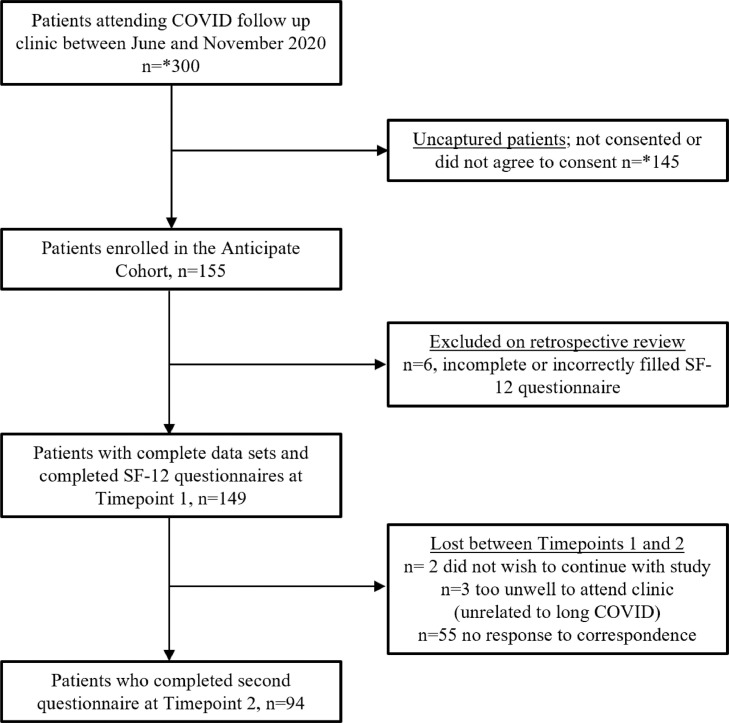
The Anticipate Study is a prospective single-centre observational cohort study. Hospitalised and nonhospitalised patients were seen at a dedicated post-COVID clinic at a 2-4 month (Timepoint 1) and 7-14 month follow-up (Timepoint 2). The main objectives of this study are to assess the longitudinal impact of COVID-19 in patients using the 12-item Short Form Survey (SF-12) score, a health-related quality of life tool, and to identify predictors of developing post-COVID-19 syndrome (PoCS). In addition, we aimed to describe symptomatology and identify predictors of PoCS at 1-year.
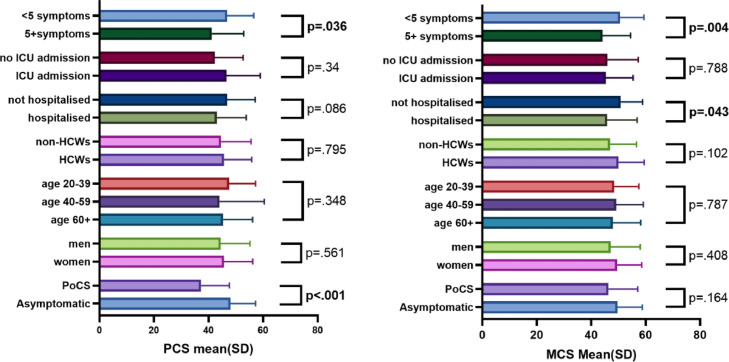
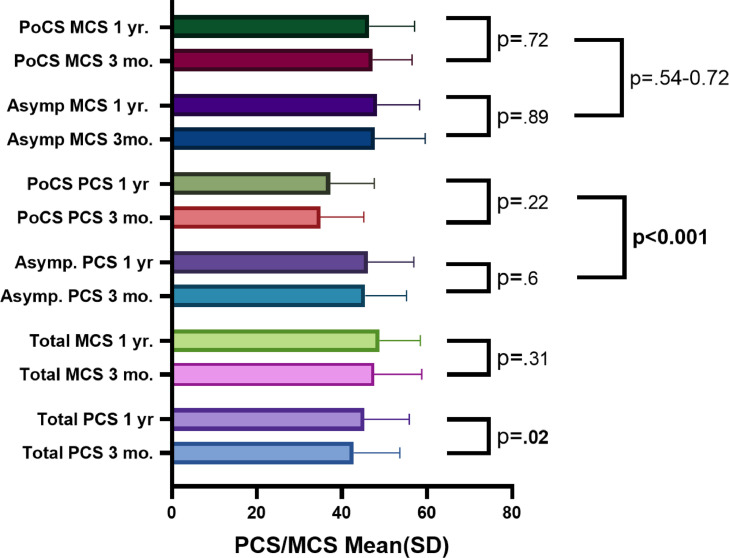
A total of 155 patients were enrolled, 105 (68%) were female aged 43.3 (31-52) years. In total 149 (96%) and 94 (61%) patients completed follow-up at median 96 (76-118) days and 364 (303-398) days. The overall cohort had significantly reduced physical composite score (PCS) of the SF-12 (45.39 [10.58] vs 50 [10], p = 0.02). Participants with PoCS had significantly lower scores than those without symptoms at 1-year follow-up (37.2 [10.4] v 46.1 [10.9] p <0.001), and scores for these patients did not improve over the 2 Timepoints (PCS 34.95 [10.5] - 37.2 [10.4], p = 0.22). Fatigue was the most common symptom. Those with 5 or more symptoms at initial diagnosis had lower PCS and mental composite score (MCS) at 1-year. Predictors of PoCS at 1-year were lower PCS and higher baseline heart rate (HR) at clinic review median 3 months after COVID-19.
Patients with PoCS have lower PCS scores during follow-up, which did not significantly improve up to a 1-year follow-up. Lower PCS scores and higher HR at rest can be used in the weeks after COVID-19 can help predict those at risk of PoCS at 1 year.
目前,很少有研究探讨长新冠患者的健康相关生活质量(HRQoL)。
Anticipate 研究是一项前瞻性单中心观察队列研究。在专门的新冠后诊所,对住院和非住院患者进行了评估,分别在 2-4 个月(时间点 1)和 7-14 个月(时间点 2)进行随访。本研究的主要目的是使用 12 项简短形式调查(SF-12)评分评估 COVID-19 对患者的纵向影响,这是一种健康相关生活质量工具,并确定发生新冠后综合征(PoCS)的预测因素。此外,我们旨在描述症状并确定 1 年后发生 PoCS 的预测因素。
共纳入 155 例患者,其中 105 例(68%)为女性,年龄 43.3(31-52)岁。共有 149 例(96%)和 94 例(61%)患者在中位随访 96(76-118)天和 364(303-398)天完成了随访。总体队列的 SF-12 生理综合评分(PCS)显著降低(45.39[10.58] vs 50[10],p=0.02)。1 年后有 PoCS 症状的患者的评分明显低于无症状患者(37.2[10.4] vs 46.1[10.9],p<0.001),且这些患者的评分在两个时间点都没有改善(PCS 34.95[10.5]-37.2[10.4],p=0.22)。疲劳是最常见的症状。在初始诊断时有 5 种或更多症状的患者在 1 年时的 PCS 和心理综合评分(MCS)较低。1 年时发生 PoCS 的预测因素是临床评估后 3 个月时的 PCS 和静息心率(HR)较低。
患有 PoCS 的患者在随访期间的 PCS 评分较低,在 1 年的随访中并未显著改善。在 COVID-19 后数周内,较低的 PCS 评分和较高的静息心率(HR)可用于预测 1 年后发生 PoCS 的风险。