Liu Lu, Yang Shufang, Chen Feng, Cheng Ka-Wing
Institute for Food and Bioresource Engineering, College of Engineering, Peking University, Beijing, China.
Shenzhen Key Laboratory of Marine Microbiome Engineering, Institute for Advanced Study, Shenzhen University, Shenzhen, China.
Front Nutr. 2022 Mar 2;9:846282. doi: 10.3389/fnut.2022.846282. eCollection 2022.
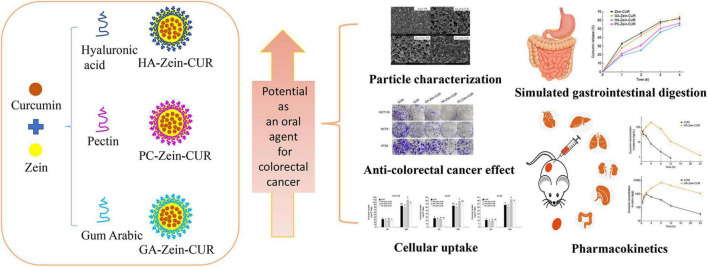
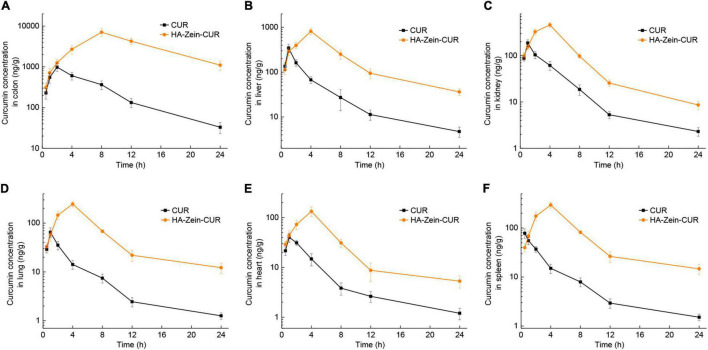
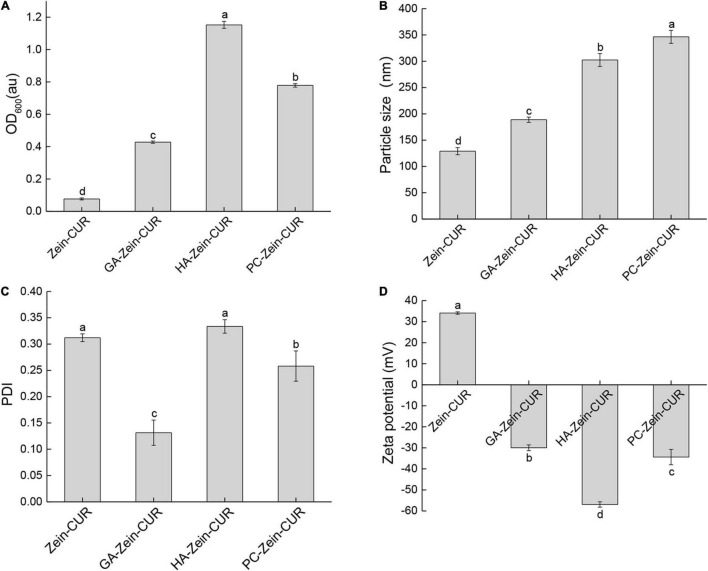
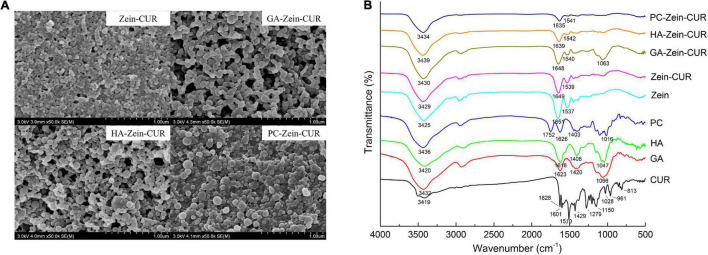
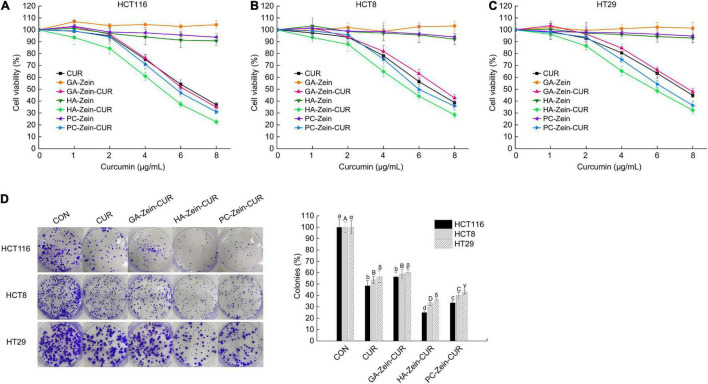
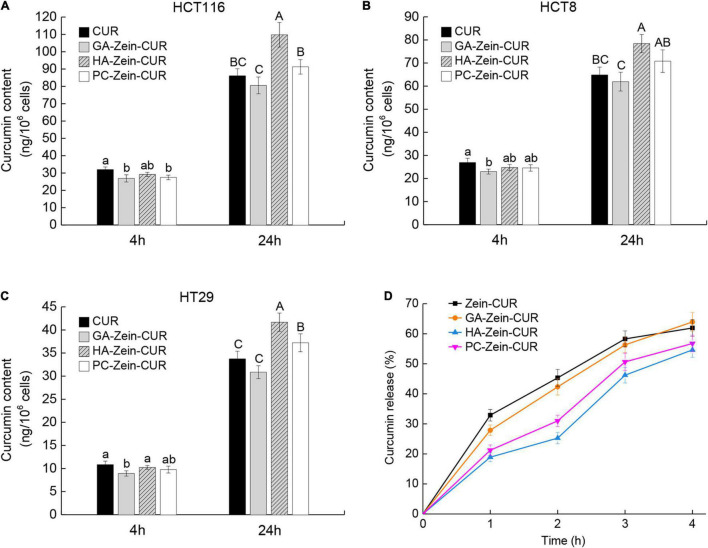
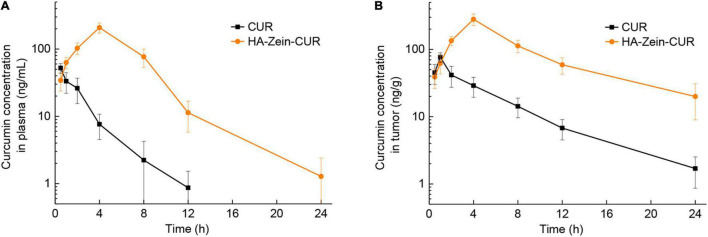
Curcumin (CUR) has demonstrated promising potential as a therapeutic agent against colorectal cancer (CRC). However, its intrinsic shortcomings, including oxidative instability, sensitivity to gastrointestinal (GI) hydrolytic/enzymatic action, and susceptibility to biotransformation and systemic elimination, have greatly undermined its value for application in clinical settings. The development of carriers, in particular oral formulations, for its efficient delivery has remained an important direction in nutraceutical research. In the present work, CUR-encapsulated nanoparticles were fabricated with zein alone (Zein-CUR) and with zein and a polysaccharide (PS) [gum Arabic (GA), hyaluronic acid (HA) and pectin (PC), respectively] (PS-Zein-CUR). Their physicochemical and biological properties were evaluated in a series of and assays. Dynamic light scattering analysis showed an increase in the particle size of the nanoparticles from 129.0 nm (Zein-CUR) to 188.8-346.4 nm (PS-Zein-CUR). The three PS-Zein-CUR formulations had significantly higher (17-22%) CUR encapsulation efficiency (EE) than Zein-CUR. Among them, HA-Zein-CUR exhibited the highest EE and loading capacity. Zeta potential and FTIR spectra indicated the involvement of electrostatic and hydrophobic interactions and hydrogen bonds in the formation of the PS-Zein-CUR. In human CRC cell lines (HCT8, HCT29, and HCT116), the three PS-Zein-CUR and CUR all effectively inhibited cell viability and colony formation (HA-Zein-CUR > PC-Zein-CUR > GA-Zein-CUR/CUR). HA-Zein-CUR and PC-Zein-CUR also resulted in significantly higher cellular uptake of CUR than GA-Zein-CUR and CUR. Simulated GI-digestion assay demonstrated significantly improved controlled-release properties of these two formulations. Further pharmacokinetics and tissue distribution assays in a CRC subcutaneous xenograft model in nude mice corroborated the enhanced pharmacokinetic properties of intragastric administration of HA-Zein-CUR compared with that of free CUR (3 times higher C and 9.18 times higher plasma AUC). HA-Zein-CUR also led to enhanced delivery and accumulation of CUR in major organs/tissues, in particular CRC tumors and colon. These results together support that HA-Zein-CUR has promising potential as an oral agent for the control of CRC.
姜黄素(CUR)已显示出作为抗结直肠癌(CRC)治疗剂的潜在前景。然而,其固有的缺点,包括氧化不稳定性、对胃肠道(GI)水解/酶促作用的敏感性以及对生物转化和全身消除的敏感性,极大地削弱了其在临床环境中的应用价值。开发用于其有效递送的载体,特别是口服制剂,仍然是营养保健品研究的一个重要方向。在本研究中,单独用玉米醇溶蛋白(Zein-CUR)以及用玉米醇溶蛋白和多糖(PS)[分别为阿拉伯胶(GA)、透明质酸(HA)和果胶(PC)]制备了包封CUR的纳米颗粒(PS-Zein-CUR)。通过一系列体外和体内试验评估了它们的物理化学和生物学性质。动态光散射分析表明,纳米颗粒的粒径从129.0 nm(Zein-CUR)增加到188.8 - 346.4 nm(PS-Zein-CUR)。三种PS-Zein-CUR制剂的CUR包封效率(EE)显著高于Zein-CUR(高17 - 22%)。其中,HA-Zein-CUR表现出最高的EE和载药量。zeta电位和傅里叶变换红外光谱表明,静电和疏水相互作用以及氢键参与了PS-Zein-CUR的形成。在人CRC细胞系(HCT8、HCT29和HCT1 16)中,三种PS-Zein-CUR和CUR均有效抑制细胞活力和集落形成(HA-Zein-CUR > PC-Zein-CUR > GA-Zein-CUR/CUR)。HA-Zein-CUR和PC-Zein-CUR导致的CUR细胞摄取也显著高于GA-Zein-CUR和CUR。模拟胃肠道消化试验表明,这两种制剂的控释性能显著改善。在裸鼠CRC皮下异种移植模型中的进一步药代动力学和组织分布试验证实,与游离CUR相比,胃内给药的HA-Zein-CUR药代动力学性质增强(Cmax高3倍,血浆AUC高9.18倍)。HA-Zein-CUR还导致CUR在主要器官/组织中,特别是CRC肿瘤和结肠中的递送和积累增强。这些结果共同支持HA-Zein-CUR作为控制CRC的口服制剂具有潜在前景。