El-Achkar Tarek M, Winfree Seth, Talukder Niloy, Barwinska Daria, Ferkowicz Michael J, Al Hasan Mohammad
Division of Nephrology, Department of Medicine, Indiana University, Indianapolis, IN, United States.
Department of Pathology and Microbiology, University of Nebraska Omaha, Omaha, NE, United States.
Front Physiol. 2022 Mar 4;13:832457. doi: 10.3389/fphys.2022.832457. eCollection 2022.
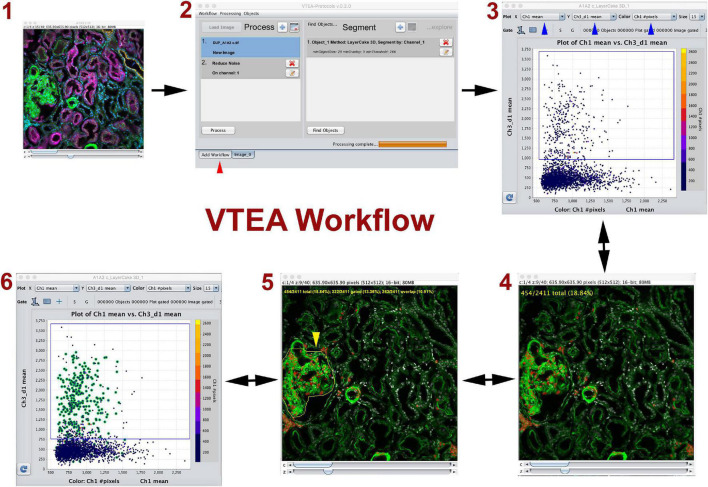
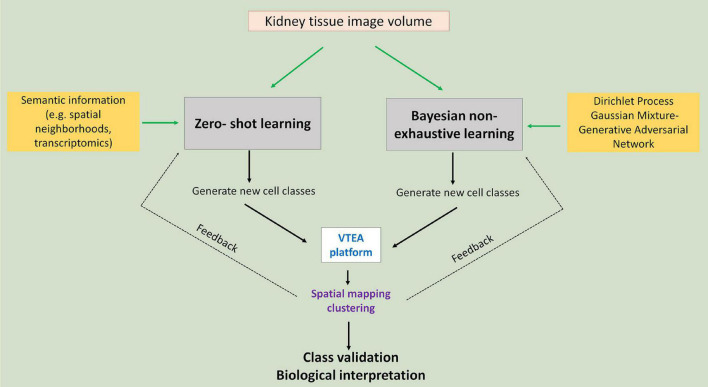
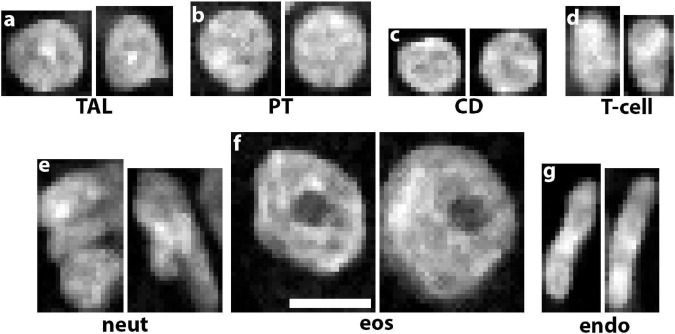
Advances in cellular and molecular interrogation of kidney tissue have ushered a new era of understanding the pathogenesis of kidney disease and potentially identifying molecular targets for therapeutic intervention. Classifying cells and identifying subtypes and states induced by injury is a foundational task in this context. High resolution Imaging-based approaches such as large-scale fluorescence 3D imaging offer significant advantages because they allow preservation of tissue architecture and provide a definition of the spatial context of each cell. We recently described the Volumetric Tissue Exploration and Analysis cytometry tool which enables an interactive analysis, quantitation and semiautomated classification of labeled cells in 3D image volumes. We also established and demonstrated an imaging-based classification using deep learning of cells in intact tissue using 3D nuclear staining with 4',6-diamidino-2-phenylindole (DAPI). In this mini-review, we will discuss recent advancements in analyzing 3D imaging of kidney tissue, and how combining machine learning with cytometry is a powerful approach to leverage the depth of content provided by high resolution imaging into a highly informative analytical output. Therefore, imaging a small tissue specimen will yield big scale data that will enable cell classification in a spatial context and provide novel insights on pathological changes induced by kidney disease.
肾脏组织细胞和分子检测技术的进步开启了一个理解肾脏疾病发病机制并潜在地确定治疗干预分子靶点的新时代。在这种情况下,对细胞进行分类并识别损伤诱导的亚型和状态是一项基础性任务。基于高分辨率成像的方法,如大规模荧光三维成像,具有显著优势,因为它们能够保留组织结构,并能明确每个细胞的空间背景。我们最近描述了体积组织探索与分析流式细胞术工具,该工具能够对三维图像体积中的标记细胞进行交互式分析、定量和半自动分类。我们还利用4',6-二脒基-2-苯基吲哚(DAPI)进行三维细胞核染色,建立并展示了一种基于深度学习的完整组织细胞成像分类方法。在这篇小型综述中,我们将讨论肾脏组织三维成像分析的最新进展,以及将机器学习与细胞术相结合如何成为一种强大的方法,将高分辨率成像提供的丰富内容转化为高度信息性的分析输出。因此,对一个小的组织标本进行成像将产生大规模数据,这些数据将能够在空间背景下进行细胞分类,并为肾脏疾病引起的病理变化提供新的见解。