• 文献检索
  • 文档翻译
  • 深度研究
  • 学术资讯
  • Suppr Zotero 插件Zotero 插件
  • 邀请有礼
  • 套餐&价格
  • 历史记录
应用&插件
Suppr Zotero 插件Zotero 插件浏览器插件Mac 客户端Windows 客户端微信小程序
定价
高级版会员购买积分包购买API积分包
服务
文献检索文档翻译深度研究API 文档MCP 服务
关于我们
关于 Suppr公司介绍联系我们用户协议隐私条款
关注我们

Suppr 超能文献

核心技术专利:CN118964589B侵权必究
粤ICP备2023148730 号-1Suppr @ 2026

文献检索

告别复杂PubMed语法,用中文像聊天一样搜索,搜遍4000万医学文献。AI智能推荐,让科研检索更轻松。

立即免费搜索

文件翻译

保留排版,准确专业,支持PDF/Word/PPT等文件格式,支持 12+语言互译。

免费翻译文档

深度研究

AI帮你快速写综述,25分钟生成高质量综述,智能提取关键信息,辅助科研写作。

立即免费体验

弱监督端到端人工智能在胃肠内窥镜检查中的应用。

Weakly supervised end-to-end artificial intelligence in gastrointestinal endoscopy.

机构信息

Department of Medicine III, University Hospital RWTH Aachen, Pauwelsstrasse 30, 52074, Aachen, Germany.

Department of Medicine, Rhein-Maas-Klinikum, Würselen, Germany.

出版信息

Sci Rep. 2022 Mar 22;12(1):4829. doi: 10.1038/s41598-022-08773-1.

DOI:10.1038/s41598-022-08773-1
PMID:35318364
原文链接:https://pmc.ncbi.nlm.nih.gov/articles/PMC8941159/
Abstract

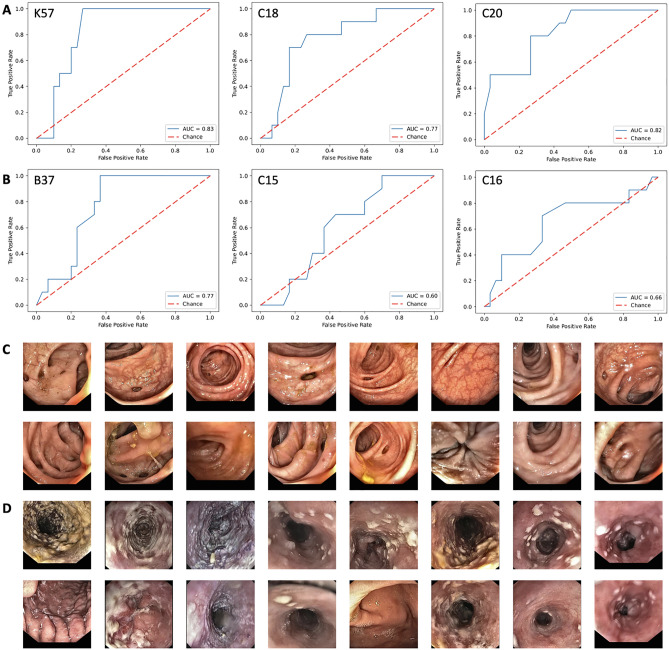
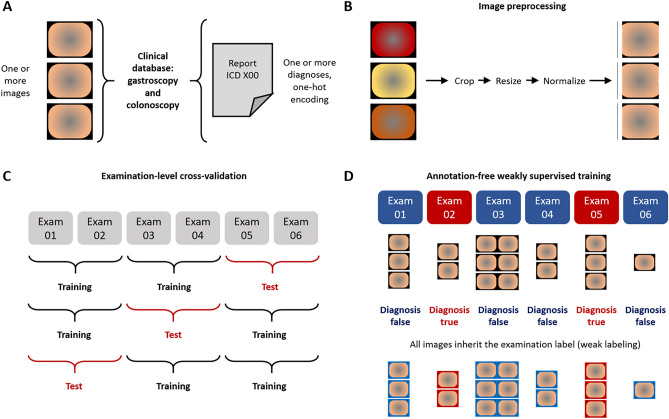
Artificial intelligence (AI) is widely used to analyze gastrointestinal (GI) endoscopy image data. AI has led to several clinically approved algorithms for polyp detection, but application of AI beyond this specific task is limited by the high cost of manual annotations. Here, we show that a weakly supervised AI can be trained on data from a clinical routine database to learn visual patterns of GI diseases without any manual labeling or annotation. We trained a deep neural network on a dataset of N = 29,506 gastroscopy and N = 18,942 colonoscopy examinations from a large endoscopy unit serving patients in Germany, the Netherlands and Belgium, using only routine diagnosis data for the 42 most common diseases. Despite a high data heterogeneity, the AI system reached a high performance for diagnosis of multiple diseases, including inflammatory, degenerative, infectious and neoplastic diseases. Specifically, a cross-validated area under the receiver operating curve (AUROC) of above 0.70 was reached for 13 diseases, and an AUROC of above 0.80 was reached for two diseases in the primary data set. In an external validation set including six disease categories, the AI system was able to significantly predict the presence of diverticulosis, candidiasis, colon and rectal cancer with AUROCs above 0.76. Reverse engineering the predictions demonstrated that plausible patterns were learned on the level of images and within images and potential confounders were identified. In summary, our study demonstrates the potential of weakly supervised AI to generate high-performing classifiers and identify clinically relevant visual patterns based on non-annotated routine image data in GI endoscopy and potentially other clinical imaging modalities.

摘要

人工智能(AI)广泛用于分析胃肠道(GI)内窥镜图像数据。AI 已经导致了几种临床批准的息肉检测算法,但由于手动注释成本高,AI 在这一特定任务之外的应用受到限制。在这里,我们展示了一种弱监督 AI 可以在来自临床常规数据库的数据上进行训练,以学习 GI 疾病的视觉模式,而无需任何手动标记或注释。我们在一个大型内窥镜单位的数据集上训练了一个深度神经网络,该数据集包括来自德国、荷兰和比利时的患者的 N = 29506 次胃镜检查和 N = 18942 次结肠镜检查,仅使用常规诊断数据对 42 种最常见的疾病进行了诊断。尽管数据异质性很高,但 AI 系统在多种疾病的诊断中达到了很高的性能,包括炎症、退行性、感染和肿瘤性疾病。具体来说,对于 13 种疾病,交叉验证后的接收者操作特征曲线下面积(AUROC)超过 0.70,对于原发性数据集的两种疾病,AUROC 超过 0.80。在包括六个疾病类别的外部验证集中,AI 系统能够显著预测憩室病、假丝酵母菌病、结肠癌和直肠癌的存在,AUROC 超过 0.76。反向工程预测结果表明,在图像和图像内层面上学习了合理的模式,并确定了潜在的混杂因素。总之,我们的研究表明,弱监督 AI 具有生成高性能分类器的潜力,并能够根据 GI 内窥镜和潜在的其他临床成像方式的非注释常规图像数据识别临床相关的视觉模式。
https://cdn.ncbi.nlm.nih.gov/pmc/blobs/0b54/8941159/a7d6dd18c6b4/41598_2022_8773_Fig5_HTML.jpg
https://cdn.ncbi.nlm.nih.gov/pmc/blobs/0b54/8941159/b5a6f85f60f7/41598_2022_8773_Fig1_HTML.jpg
https://cdn.ncbi.nlm.nih.gov/pmc/blobs/0b54/8941159/4ab74c503845/41598_2022_8773_Fig2_HTML.jpg
https://cdn.ncbi.nlm.nih.gov/pmc/blobs/0b54/8941159/ad4fd7e49542/41598_2022_8773_Fig3_HTML.jpg
https://cdn.ncbi.nlm.nih.gov/pmc/blobs/0b54/8941159/9710cf6bc19e/41598_2022_8773_Fig4_HTML.jpg
https://cdn.ncbi.nlm.nih.gov/pmc/blobs/0b54/8941159/a7d6dd18c6b4/41598_2022_8773_Fig5_HTML.jpg
https://cdn.ncbi.nlm.nih.gov/pmc/blobs/0b54/8941159/b5a6f85f60f7/41598_2022_8773_Fig1_HTML.jpg
https://cdn.ncbi.nlm.nih.gov/pmc/blobs/0b54/8941159/4ab74c503845/41598_2022_8773_Fig2_HTML.jpg
https://cdn.ncbi.nlm.nih.gov/pmc/blobs/0b54/8941159/ad4fd7e49542/41598_2022_8773_Fig3_HTML.jpg
https://cdn.ncbi.nlm.nih.gov/pmc/blobs/0b54/8941159/9710cf6bc19e/41598_2022_8773_Fig4_HTML.jpg
https://cdn.ncbi.nlm.nih.gov/pmc/blobs/0b54/8941159/a7d6dd18c6b4/41598_2022_8773_Fig5_HTML.jpg

相似文献

1
Weakly supervised end-to-end artificial intelligence in gastrointestinal endoscopy.弱监督端到端人工智能在胃肠内窥镜检查中的应用。
Sci Rep. 2022 Mar 22;12(1):4829. doi: 10.1038/s41598-022-08773-1.
2
Development and validation of artificial intelligence-based prescreening of large-bowel biopsies taken in the UK and Portugal: a retrospective cohort study.基于人工智能的英国和葡萄牙大结肠活检预筛查的开发和验证:一项回顾性队列研究。
Lancet Digit Health. 2023 Nov;5(11):e786-e797. doi: 10.1016/S2589-7500(23)00148-6.
3
Benchmarking weakly-supervised deep learning pipelines for whole slide classification in computational pathology.基于计算病理学的全切片分类的弱监督深度学习管道的基准测试。
Med Image Anal. 2022 Jul;79:102474. doi: 10.1016/j.media.2022.102474. Epub 2022 May 4.
4
Application of artificial intelligence using a convolutional neural network for diagnosis of early gastric cancer based on magnifying endoscopy with narrow-band imaging.应用卷积神经网络的人工智能技术在窄带成像放大内镜下对早期胃癌的诊断
J Gastroenterol Hepatol. 2021 Feb;36(2):482-489. doi: 10.1111/jgh.15190. Epub 2020 Jul 28.
5
State of the Art: The Impact of Artificial Intelligence in Endoscopy 2020.最新进展:2020 年人工智能在内镜检查中的影响。
Curr Gastroenterol Rep. 2021 Apr 14;23(5):7. doi: 10.1007/s11894-021-00810-9.
6
Striving for quality improvement: can artificial intelligence help?追求质量改进:人工智能能提供帮助吗?
Best Pract Res Clin Gastroenterol. 2021 Jun-Aug;52-53:101722. doi: 10.1016/j.bpg.2020.101722. Epub 2020 Dec 29.
7
Identification of upper GI diseases during screening gastroscopy using a deep convolutional neural network algorithm.使用深度卷积神经网络算法在筛查性胃镜检查中对上消化道疾病的识别。
Gastrointest Endosc. 2022 Nov;96(5):787-795.e6. doi: 10.1016/j.gie.2022.06.011. Epub 2022 Jun 16.
8
Application of Artificial Intelligence in Gastrointestinal Endoscopy.人工智能在胃肠内镜中的应用。
J Clin Gastroenterol. 2021 Feb 1;55(2):110-120. doi: 10.1097/MCG.0000000000001423.
9
Pneumothorax detection in chest radiographs: optimizing artificial intelligence system for accuracy and confounding bias reduction using in-image annotations in algorithm training.胸片中的气胸检测:通过在算法训练中使用图像内标注来优化人工智能系统的准确性和减少混杂偏差。
Eur Radiol. 2021 Oct;31(10):7888-7900. doi: 10.1007/s00330-021-07833-w. Epub 2021 Mar 27.
10
Deep learning-based prediction model for diagnosing gastrointestinal diseases using endoscopy images.基于深度学习的内镜图像胃肠道疾病诊断预测模型。
Int J Med Inform. 2023 Sep;177:105142. doi: 10.1016/j.ijmedinf.2023.105142. Epub 2023 Jul 5.

引用本文的文献

1
Hybrid deep learning framework based on EfficientViT for classification of gastrointestinal diseases.基于高效视觉变换器的混合深度学习框架用于胃肠道疾病分类
Sci Rep. 2025 Jul 24;15(1):26982. doi: 10.1038/s41598-025-12128-x.
2
Deep Neural Network Models for Colon Cancer Screening.用于结肠癌筛查的深度神经网络模型
Cancers (Basel). 2022 Jul 29;14(15):3707. doi: 10.3390/cancers14153707.
3
Artificial intelligence in Barrett's oesophagus and the need for shared and combined data.巴雷特食管中的人工智能以及共享和合并数据的必要性。

本文引用的文献

1
Pan-cancer computational histopathology reveals mutations, tumor composition and prognosis.泛癌计算组织病理学揭示了突变、肿瘤组成和预后。
Nat Cancer. 2020 Aug;1(8):800-810. doi: 10.1038/s43018-020-0085-8. Epub 2020 Jul 27.
2
Harnessing multimodal data integration to advance precision oncology.利用多模态数据整合推进精准肿瘤学。
Nat Rev Cancer. 2022 Feb;22(2):114-126. doi: 10.1038/s41568-021-00408-3. Epub 2021 Oct 18.
3
Current status and limitations of artificial intelligence in colonoscopy.结肠镜检查中人工智能的现状和局限性。
United European Gastroenterol J. 2022 Jul;10(6):525-527. doi: 10.1002/ueg2.12260. Epub 2022 Jun 15.
United European Gastroenterol J. 2021 Jun;9(5):527-533. doi: 10.1002/ueg2.12108. Epub 2021 Jun 7.
4
Updates in artificial intelligence in gastroenterology endoscopy in 2020.2020 年胃肠病学内镜人工智能的新进展。
Curr Opin Gastroenterol. 2021 Sep 1;37(5):428-433. doi: 10.1097/MOG.0000000000000774.
5
Artificial intelligence in inflammatory bowel disease endoscopy: current landscape and the road ahead.炎症性肠病内镜检查中的人工智能:现状与未来之路。
Ther Adv Gastrointest Endosc. 2021 Jul 14;14:26317745211017809. doi: 10.1177/26317745211017809. eCollection 2021 Jan-Dec.
6
Colorectal cancer incidence, mortality, and stage distribution in European countries in the colorectal cancer screening era: an international population-based study.结直肠癌筛查时代欧洲国家结直肠癌发病、死亡和分期分布:一项基于人群的国际研究。
Lancet Oncol. 2021 Jul;22(7):1002-1013. doi: 10.1016/S1470-2045(21)00199-6. Epub 2021 May 25.
7
Pan-cancer image-based detection of clinically actionable genetic alterations.泛癌症影像检测临床可操作的基因突变。
Nat Cancer. 2020 Aug;1(8):789-799. doi: 10.1038/s43018-020-0087-6. Epub 2020 Jul 27.
8
Artificial intelligence in GI endoscopy: stumbling blocks, gold standards and the role of endoscopy societies.胃肠道内镜检查中的人工智能:绊脚石、金标准及内镜学会的作用
Gut. 2022 Mar;71(3):451-454. doi: 10.1136/gutjnl-2020-323115. Epub 2021 Jan 21.
9
Artificial Intelligence in Visceral Medicine.内脏医学中的人工智能
Visc Med. 2020 Dec;36(6):471-475. doi: 10.1159/000512440. Epub 2020 Nov 4.
10
Real-time computer aided colonoscopy versus standard colonoscopy for improving adenoma detection rate: A meta-analysis of randomized-controlled trials.实时计算机辅助结肠镜检查与标准结肠镜检查对提高腺瘤检出率的比较:一项随机对照试验的荟萃分析。
EClinicalMedicine. 2020 Nov 21;29-30:100622. doi: 10.1016/j.eclinm.2020.100622. eCollection 2020 Dec.