Kavitha Muthu Subash, Gangadaran Prakash, Jackson Aurelia, Venmathi Maran Balu Alagar, Kurita Takio, Ahn Byeong-Cheol
School of Information and Data Sciences, Nagasaki University, Nagasaki 852-8521, Japan.
BK21 FOUR KNU Convergence Educational Program of Biomedical Sciences for Creative Future Talents, School of Medicine, Kyungpook National University, Daegu 41944, Korea.
Cancers (Basel). 2022 Jul 29;14(15):3707. doi: 10.3390/cancers14153707.
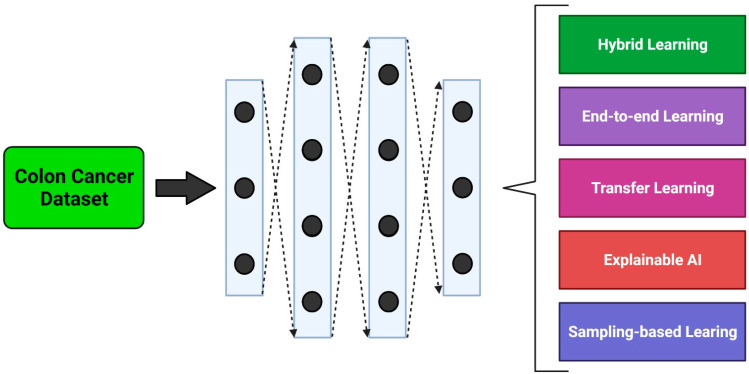
Early detection of colorectal cancer can significantly facilitate clinicians' decision-making and reduce their workload. This can be achieved using automatic systems with endoscopic and histological images. Recently, the success of deep learning has motivated the development of image- and video-based polyp identification and segmentation. Currently, most diagnostic colonoscopy rooms utilize artificial intelligence methods that are considered to perform well in predicting invasive cancer. Convolutional neural network-based architectures, together with image patches and preprocesses are often widely used. Furthermore, learning transfer and end-to-end learning techniques have been adopted for detection and localization tasks, which improve accuracy and reduce user dependence with limited datasets. However, explainable deep networks that provide transparency, interpretability, reliability, and fairness in clinical diagnostics are preferred. In this review, we summarize the latest advances in such models, with or without transparency, for the prediction of colorectal cancer and also address the knowledge gap in the upcoming technology.
早期检测结直肠癌可显著促进临床医生的决策制定并减轻其工作量。这可以通过使用具有内镜和组织学图像的自动系统来实现。近年来,深度学习的成功推动了基于图像和视频的息肉识别与分割技术的发展。目前,大多数诊断性结肠镜检查室都采用了人工智能方法,这些方法在预测浸润性癌症方面被认为表现良好。基于卷积神经网络的架构,连同图像块和预处理方法经常被广泛使用。此外,学习迁移和端到端学习技术已被用于检测和定位任务,这提高了准确性并减少了对有限数据集的用户依赖。然而,在临床诊断中提供透明度、可解释性、可靠性和公平性的可解释深度网络更受青睐。在本综述中,我们总结了此类模型(无论有无透明度)在结直肠癌预测方面的最新进展,并探讨了即将出现的技术中的知识空白。