Department of Medical Imaging Center, Sun Yat-sen University Cancer Center, State Key Laboratory of Oncology in South China, Collaborative Innovation Center for Cancer Medicine, Guangzhou, China.
Department of Pancreatic-Biliary Surgical Center, Sun Yat-sen University Cancer Center, State Key Laboratory of Oncology in South China, Collaborative Innovation Center for Cancer Medicine, Guangzhou, China.
JCO Precis Oncol. 2022 Mar;6:e2100362. doi: 10.1200/PO.21.00362.
Few studies have explored the biomarkers for predicting the heterogeneous outcomes of patients with advanced pancreatic adenocarcinoma showing stable disease (SD) on the initial postchemotherapy computed tomography. We aimed to devise a radiomics signature (RS) to predict these outcomes for further risk stratification.
Patients with advanced pancreatic adenocarcinoma and SD after chemotherapy were included. Pancreatic lesions on initial postchemotherapy computed tomography images were evaluated by radiomics analysis for predicting early death (≤ 1 year). RS was then internally and externally tested. The progression-free survival and objective response rate were compared between the low-risk and high-risk group of patients classified following RS.
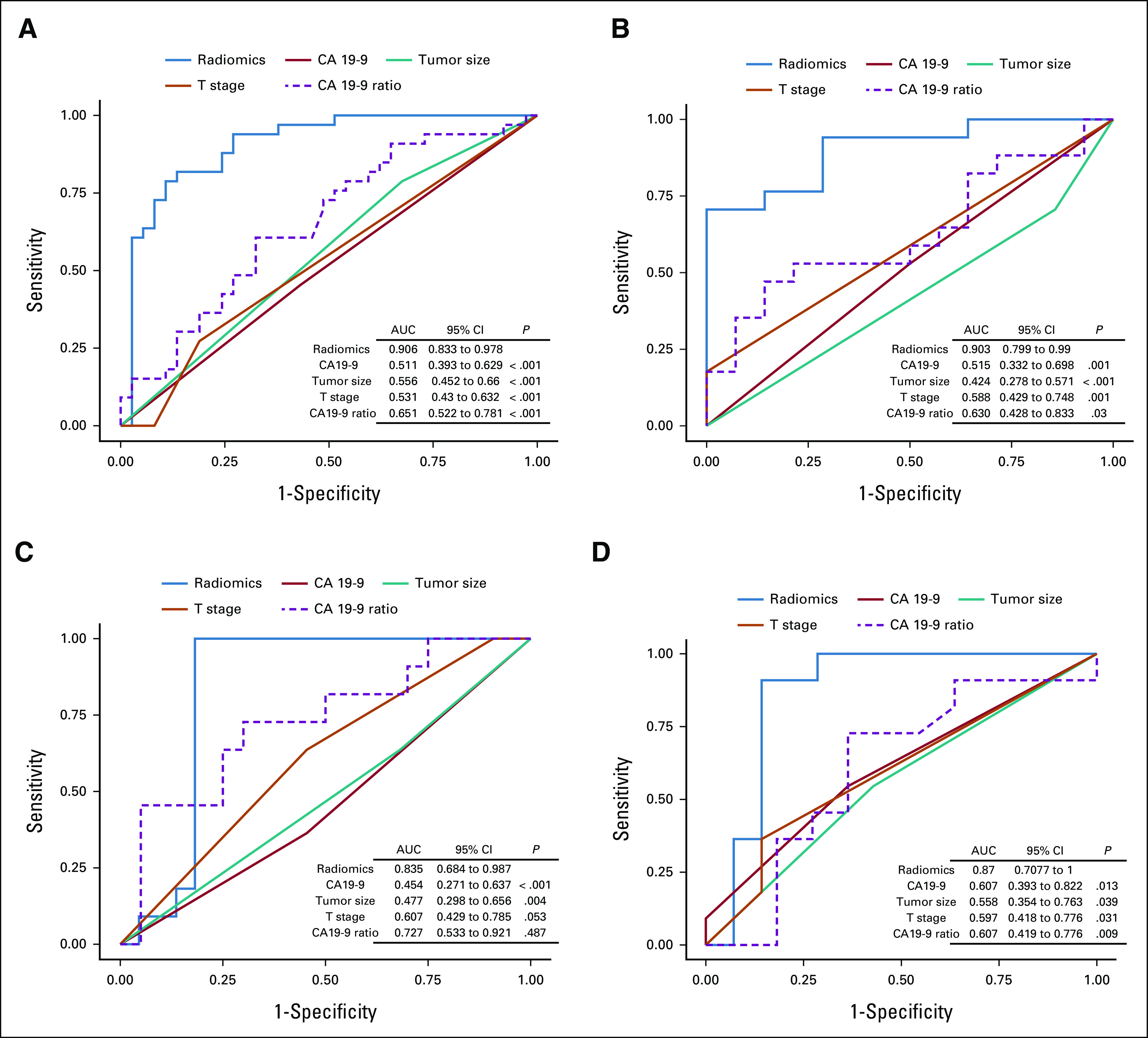
Approximately 62.7% of patients receiving chemotherapy showed SD at first response evaluation in the primary cohort, which were 59.6% and 57.9% in internal and external testing cohorts, respectively. The RS predicted 1-year overall survival well, with areas under the receiver operating characteristic curve of 0.91 in the training cohort, 0.90 in the validation cohort, 0.84 in the internal testing cohort, and 0.87 in the external testing cohort. The high-risk group had a shorter median progression-free survival (7.3 months 9.0 months, = .016, in the training cohort; 5.9 months 9.2 months, = .026, in the internal testing cohort) and a lower objective response rate (2.2% 24.0% in the training cohort) than the low-risk group. In addition, RS was not related to the clinical characteristics and chemotherapy regimens.
RS independently predicts the outcomes of patients with SD after chemotherapy well and can help to improve treatment decisions by identifying patients for whom current treatment may not be suitable.
鲜有研究探索用于预测表现为初始化疗后计算机断层扫描(CT)稳定疾病(SD)的晚期胰腺腺癌患者异质性结局的生物标志物。我们旨在设计一个放射组学特征(RS)来预测这些结果,以便进一步进行风险分层。
纳入化疗后表现为 SD 的晚期胰腺腺癌患者。通过放射组学分析评估初始化疗后 CT 图像上的胰腺病变,以预测早期死亡(≤1 年)。然后对 RS 进行内部和外部测试。根据 RS 对患者进行分类后,比较低危和高危组的无进展生存期和客观缓解率。
在主要队列中,约 62.7%接受化疗的患者在首次反应评估时表现为 SD,内部和外部测试队列中分别为 59.6%和 57.9%。RS 对 1 年总生存率的预测效果良好,训练队列的受试者工作特征曲线下面积为 0.91,验证队列为 0.90,内部测试队列为 0.84,外部测试队列为 0.87。高危组的中位无进展生存期更短(7.3 个月比 9.0 个月,=0.016,在训练队列中;5.9 个月比 9.2 个月,=0.026,在内部测试队列),客观缓解率更低(2.2%比 24.0%,在训练队列中)。此外,RS 与临床特征和化疗方案无关。
RS 可独立预测化疗后 SD 患者的结局,并可通过识别不适合当前治疗的患者来帮助改善治疗决策。