Sun Yu, Zhou Jie, Jiang Yongjun
National Health and Family Planning Commission (NHC) Key Laboratory of AIDS Immunology (China Medical University), National Clinical Research Center for Laboratory Medicine, The First Affiliated Hospital of China Medical University, Shenyang, China.
Front Immunol. 2022 Mar 7;13:842831. doi: 10.3389/fimmu.2022.842831. eCollection 2022.
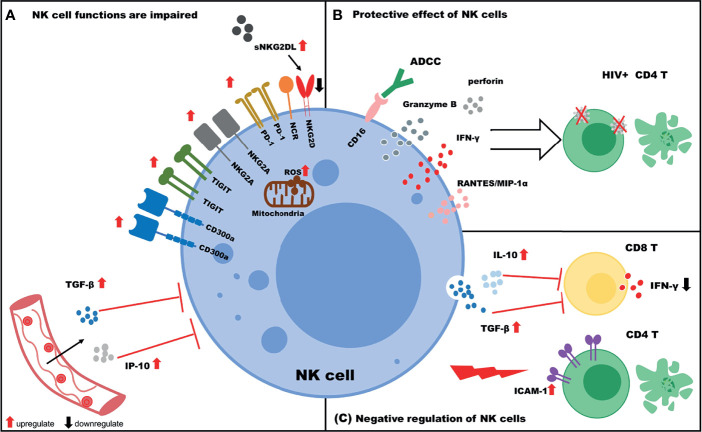
Natural killer (NK) cells play an important immunologic role, targeting tumors and virus-infected cells; however, NK cells do not impede the progression of human immunodeficiency virus (HIV) infection. In HIV infection, NK cells exhibit impaired functions and negatively regulate other immune cell responses, although NK cells can kill HIV-infected cells and thereby suppress HIV replication. Considerable recent research has emerged regarding NK cells in the areas of immune checkpoints, negative regulation, antibody-dependent cell-mediated cytotoxicity and HIV reservoirs during HIV infection; however, no overall summary of these factors is available. This review focuses on several important aspects of NK cells in relation to HIV infection, including changes in NK cell count, subpopulations, and immune checkpoints, as well as abnormalities in NK cell functions and NK cell negative regulation. The protective function of NK cells in inhibiting HIV replication to reduce the viral reservoir and approaches for enhancing NK cell functions are also summarized.
自然杀伤(NK)细胞发挥着重要的免疫作用,以肿瘤细胞和病毒感染细胞为靶点;然而,NK细胞并不阻碍人类免疫缺陷病毒(HIV)感染的进展。在HIV感染中,NK细胞功能受损并对其他免疫细胞反应产生负调节作用,尽管NK细胞可以杀死HIV感染的细胞,从而抑制HIV复制。最近在HIV感染期间NK细胞在免疫检查点、负调节、抗体依赖性细胞介导的细胞毒性和HIV储存库等领域出现了大量研究;然而,目前尚无对这些因素的全面总结。本综述重点关注NK细胞与HIV感染相关的几个重要方面,包括NK细胞数量、亚群和免疫检查点的变化,以及NK细胞功能异常和NK细胞负调节。还总结了NK细胞在抑制HIV复制以减少病毒储存库方面的保护作用以及增强NK细胞功能的方法。