
人工智能算法下的多模态影像学诊断肝癌及其与 EZH2 和 p57 表达的关系。
Multimodal Imaging under Artificial Intelligence Algorithm for the Diagnosis of Liver Cancer and Its Relationship with Expressions of EZH2 and p57.
机构信息
Department of Oncology, Xi'an International Medical Center Hospital, Xi'an City 710000, China.
Department of Oncology, The First Affiliated Hospital of Xi'an Medical College, Xi'an City 710000, China.
出版信息
Comput Intell Neurosci. 2022 Mar 14;2022:4081654. doi: 10.1155/2022/4081654. eCollection 2022.
OBJECTIVE
It aimed to explore the diagnostic efficacy of multimodal ultrasound images based on mask region with convolutional neural network (M-RCNN) segmentation algorithm for small liver cancer and analyze the expression of zeste gene enhancer homolog 2 (EZH2) and p57 (P57 Kip2) genes in cancer cells.
METHODS
A total of 100 patients suspected of small liver cancer were randomly divided into Doppler group (color Doppler ultrasound examination), contrast group (contrast ultrasound examination), elastic group (ultrasound elastography examination), and multimodal group (combined examination of the three methods), with 25 patients in each group. Images were processed by the M-RCNN segmentation algorithm. The results of the pathological biopsy were used to evaluate the diagnostic efficacy of the four methods. The liver tissues were then extracted and divided into observation group 1 (lesion tissue specimen), observation group 2 (liver tissue around cancer lesion), and control group (normal liver tissue), and the expression activities of EZH2 and p57 genes in the three groups were analyzed.
RESULTS
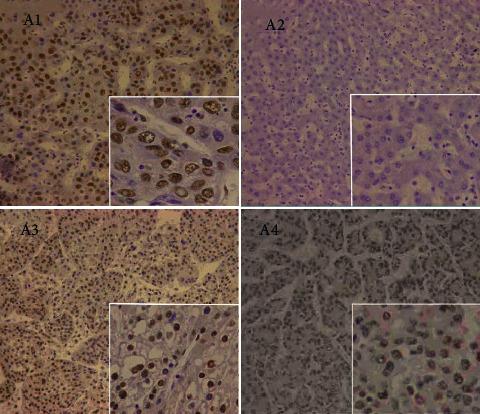
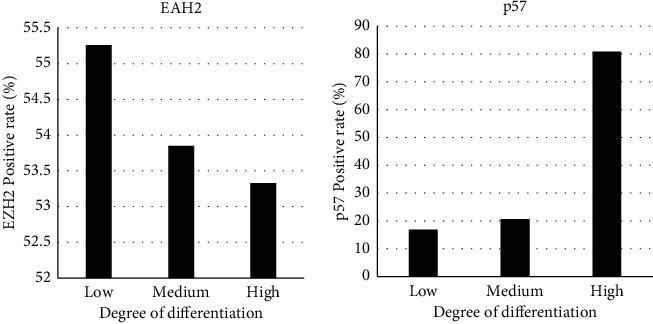
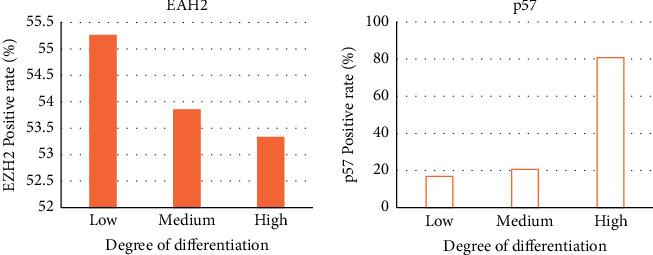
The accuracy of M-RCNN (97.23%) and average precision (AP) (71.90%) were higher than other methods ( < 0.05). Sensitivity (88.87%), specific degree of consistency (90.91%), accuracy (89.47%), and consistence (0.68) of the multimodal group were better than the other three groups ( < 0.05). Low and medium differentiated cancer tissues had an irregular shape, unclear boundary, uneven internal echo, unchanged/enhanced posterior echo, blood flow level 1∼2, elastic score 4∼5, and enhancement mode fast in and fast out. The positive expression rate of EZH2 in observation group 1 (75.95%) was higher than that in the other two groups, the positive expression rate of p57 in observation group 1 (80.79%) was lower than that in the other two groups, and the positive expression rate of p57 in the highly differentiated cancer foci (80.79%) was significantly lower than that in the middle and low differentiated cancer foci ( < 0.05).
CONCLUSIONS
M-RCNN segmentation algorithm had a better segmentation effect. Multimodal ultrasound had a good effect on the benign and malignant diagnosis of small liver cancer and had a high clinical application value. The high expression of EZH2 and the decreased expression of p57 can promote the occurrence of small hepatocellular carcinoma, and the deficiency of the P57 gene was related to the low differentiation of cancer cells.
目的
旨在探讨基于掩膜区域卷积神经网络(M-RCNN)分割算法的多模态超声图像对小肝癌的诊断效能,并分析锌指基因增强子同源物 2(EZH2)和 p57(P57 Kip2)基因在癌细胞中的表达。
方法
将 100 例疑似小肝癌患者随机分为多普勒组(彩色多普勒超声检查)、对比组(对比超声检查)、弹性组(超声弹性成像检查)和多模态组(三种方法联合检查),每组 25 例。采用 M-RCNN 分割算法对图像进行处理。以病理活检结果为金标准,评估四种方法的诊断效能。然后提取肝组织,分为观察组 1(病变组织标本)、观察组 2(癌灶周围肝组织)和对照组(正常肝组织),分析三组 EZH2 和 p57 基因的表达活性。
结果
M-RCNN 的准确率(97.23%)和平均精度(AP)(71.90%)均高于其他方法(<0.05)。多模态组的敏感性(88.87%)、特异性一致性(90.91%)、准确率(89.47%)和一致性(0.68)均优于其他三组(<0.05)。低分化和中分化癌组织形态不规则,边界不清,内部回声不均匀,后回声不变/增强,血流分级 1∼2 级,弹性评分 4∼5 级,增强模式快进快出。观察组 1 中 EZH2 的阳性表达率(75.95%)高于其他两组,观察组 1 中 p57 的阳性表达率(80.79%)低于其他两组,高分化癌灶中 p57 的阳性表达率(80.79%)明显低于中低分化癌灶(<0.05)。
结论
M-RCNN 分割算法具有较好的分割效果。多模态超声对小肝癌的良恶性诊断具有较好的效果,具有较高的临床应用价值。EZH2 高表达、p57 表达减少可促进小肝细胞癌的发生,P57 基因缺失与癌细胞低分化有关。


 Zotero 插件