College of Forestry, Nanjing Forestry University, Nanjing, 210037, China.
Wenzhou Key Laboratory of Resource Plant Innovation and Utilization, Zhejiang Institute of Subtropical Crops, Wenzhou, 325005, Zhejiang, China.
BMC Plant Biol. 2022 Mar 23;22(1):138. doi: 10.1186/s12870-022-03497-w.
Clematis species are attractive ornamental plants with a variety of flower colors and patterns. Heat stress is one of the main factors restricting the growth, development, and ornamental value of Clematis. Clematis lanuginosa and Clematis crassifolia are large-flowered and evergreen Clematis species, respectively, that show different tolerance to heat stress. We compared and analyzed the transcriptome of C. lanuginose and C. crassifolia under heat stress to determine the regulatory mechanism(s) of resistance.
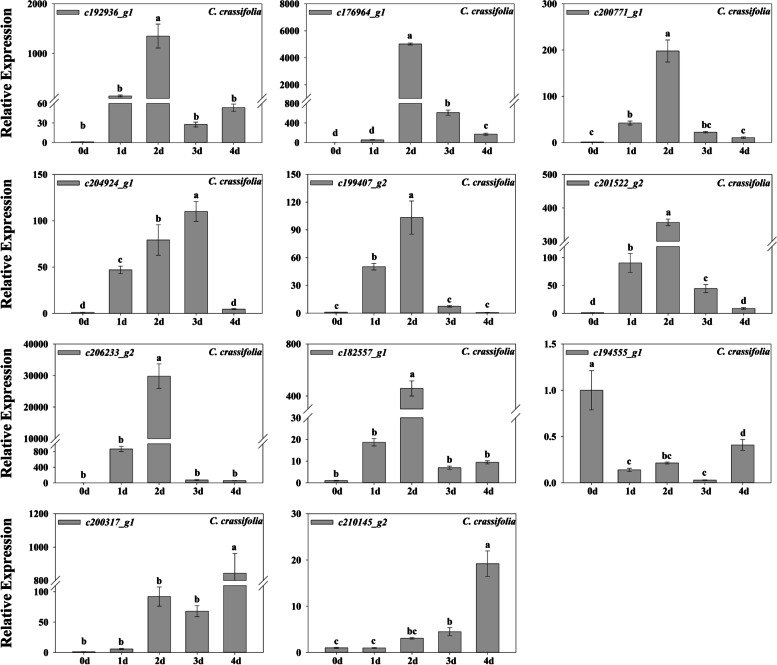
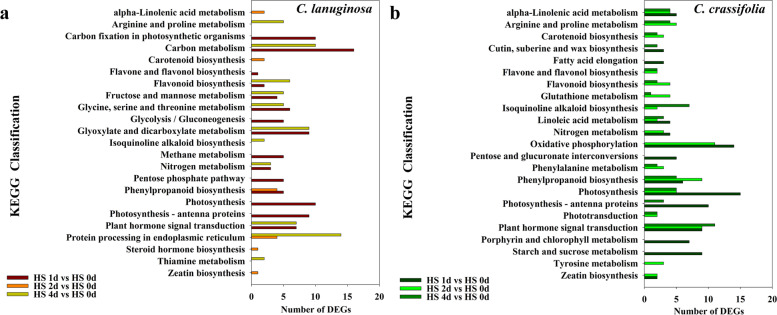
A total of 1720 and 6178 differentially expressed genes were identified from C. lanuginose and C. crassifolia, respectively. The photosynthesis and oxidation-reduction processes of C. crassifolia were more sensitive than C. lanuginose under heat stress. Glycine/serine/threonine metabolism, glyoxylic metabolism, and thiamine metabolism were important pathways in response to heat stress in C. lanuginose, and flavonoid biosynthesis, phenylalanine metabolism, and arginine/proline metabolism were the key pathways in C. crassifolia. Six sHSPs (c176964_g1, c200771_g1, c204924_g1, c199407_g2, c201522_g2, c192936_g1), POD1 (c200317_g1), POD3 (c210145_g2), DREB2 (c182557_g1), and HSFA2 (c206233_g2) may be key genes in the response to heat stress in C. lanuginose and C. crassifolia.
We compared important metabolic pathways and differentially expressed genes in response to heat stress between C. lanuginose and C. crassifolia. The results increase our understanding of the response mechanism and candidate genes of Clematis under heat stress. These data may contribute to the development of new Clematis varieties with greater heat tolerance.
铁线莲属植物是具有各种花色和图案的有吸引力的观赏植物。热应激是限制铁线莲属植物生长、发育和观赏价值的主要因素之一。绒毛铁线莲和粗齿铁线莲分别是大花和常绿的铁线莲属植物,它们对热应激的耐受能力不同。我们比较和分析了热应激下绒毛铁线莲和粗齿铁线莲的转录组,以确定抵抗的调节机制。
从绒毛铁线莲和粗齿铁线莲中分别鉴定出 1720 和 6178 个差异表达基因。热应激下,粗齿铁线莲的光合作用和氧化还原过程比绒毛铁线莲更敏感。甘氨酸/丝氨酸/苏氨酸代谢、乙醛酸代谢和硫胺素代谢是绒毛铁线莲响应热应激的重要途径,而黄酮类生物合成、苯丙氨酸代谢和精氨酸/脯氨酸代谢是粗齿铁线莲的关键途径。6 个 sHSPs(c176964_g1、c200771_g1、c204924_g1、c199407_g2、c201522_g2、c192936_g1)、POD1(c200317_g1)、POD3(c210145_g2)、DREB2(c182557_g1)和 HSFA2(c206233_g2)可能是绒毛铁线莲和粗齿铁线莲响应热应激的关键基因。
我们比较了绒毛铁线莲和粗齿铁线莲对热应激的重要代谢途径和差异表达基因。研究结果增加了我们对铁线莲属植物在热应激下响应机制和候选基因的理解。这些数据可能有助于开发具有更高耐热性的新型铁线莲品种。