Shanghai Botanical Garden, Shanghai, 200231, China.
CAS Center for Excellence in Molecular Plant Sciences, Institute of Plant Physiology and Ecology, Shanghai Institutes for Biological Sciences, Chinese academy of Sciences, Shanghai, 200032, China.
Sci Rep. 2020 Jun 1;10(1):8883. doi: 10.1038/s41598-020-65699-2.
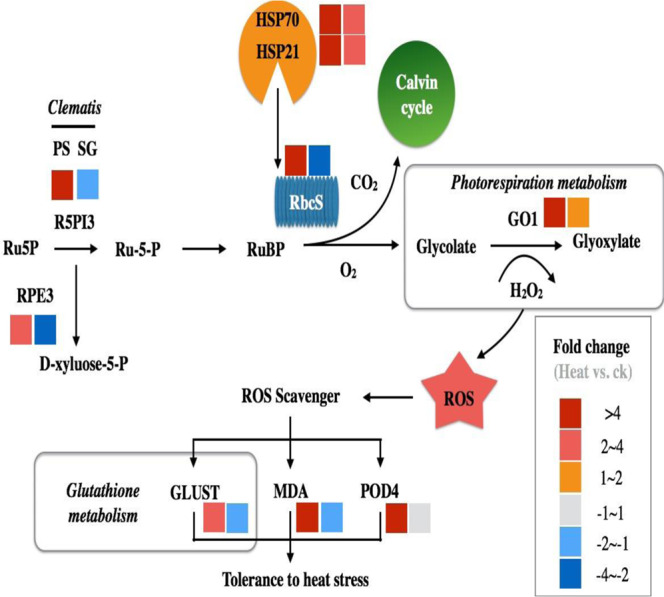
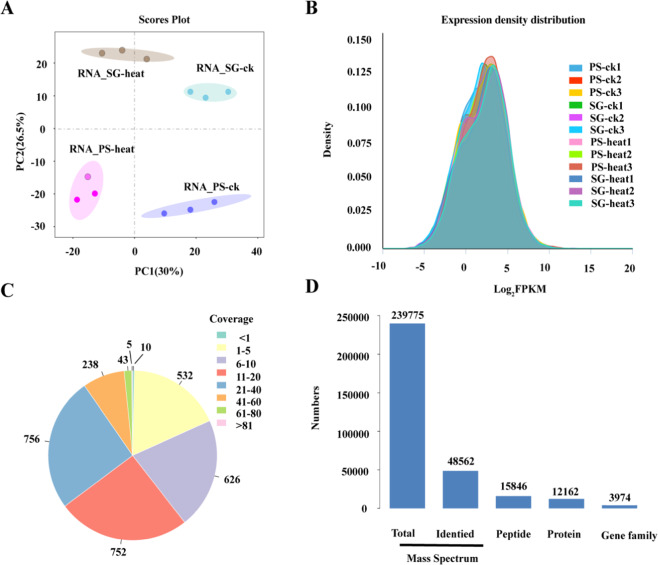
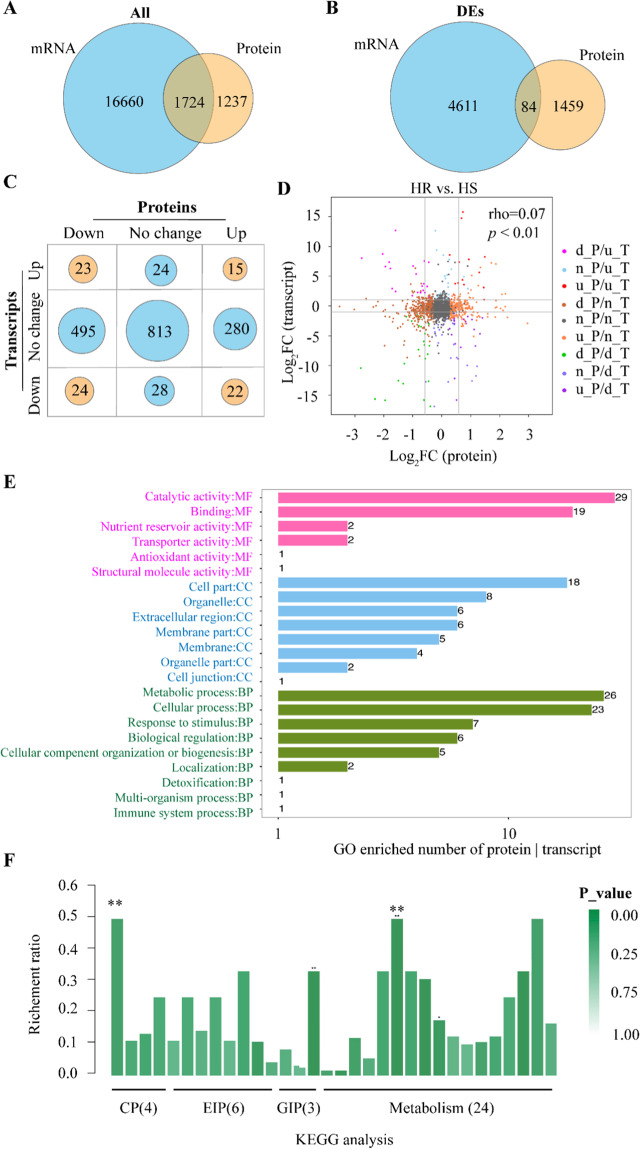
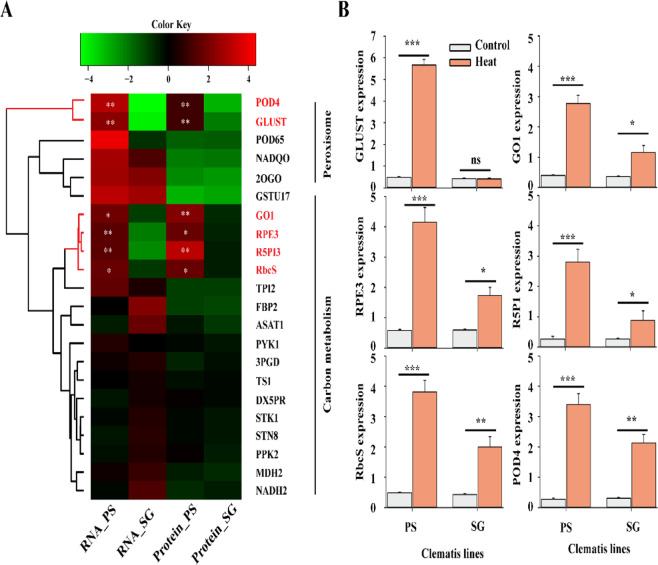
Clematis florida Thun (CfT) is an ornamental and medicinal plant. It is a cold resistant but heat sensitive species and deserves to be further investigated to improve its adaptability to heat stress. Exploring the molecular mechanism potential via an omic-analysis constitutes a promising approach towards improving heat tolerance of CfT. Two CfT lines, heat resistance (HR) and heat sensitive (HS), with differential thermotolerance capacities were used for the integrative analyses of proteomics and transcriptomes. Transcriptomes analysis showed that various pathways were significantly enriched including plant hormone signal transduction and carbon fixation pathways in prokaryotes. Proteomics study revealed the enrichment of some other pathways comprising antioxidant activity and carbohydrates metabolism. Based on combined transcriptomes and proteomics analyses and following heat stress treatment, a total of 1724 annotated genes were overlapped between both CfT lines. Particularly, 84 differential expressed genes (DEGs) were overlapped in both CfT lines. Fifteen out of these 84 genes were up-regulated solely for HR line (PS) but not for HS one (SG). This strongly suggests a potential prominent role for these genes in the thermotolerance process in PS line. We corroborate that two Hsps (Hsp18 and Hsp70) out of 20 detected proteins with higher expression levels in PS than in SG based on either global transcripts or proteins levels. According to the transcriptomes and proteomics analyses, 6 proteins and their corresponding genes were found to be significantly abundant in HR line (PS). Data are available via ProteomeXchange with identifier PXD018192. The expressions levels of these 6 genes were checked also for both CfT lines to evaluate their potential contributions in the heat tolerance process. Thus, their expression levels were approximately 2~4 times higher in HR than in HS line. We provided as well a representative schematic model to highlight the key genes involved in ROS scavenging and photorespiratory pathway in CfT. This model could be helpful also in understanding the mechanism of heat tolerance in CfT.
美丽铁线莲(CfT)是一种观赏和药用植物。它是一种耐寒但耐热敏感的物种,值得进一步研究以提高其对热应激的适应性。通过组学分析探索潜在的分子机制是提高 CfT 耐热性的一种有前途的方法。使用具有不同耐热能力的两个 CfT 系,耐热(HR)和热敏(HS),进行蛋白质组学和转录组学的综合分析。转录组分析表明,包括植物激素信号转导和原核生物中的碳固定途径在内的各种途径显著富集。蛋白质组学研究揭示了一些其他途径的富集,包括抗氧化活性和碳水化合物代谢。基于转录组和蛋白质组学分析的综合结果,并在热应激处理后,在两个 CfT 系之间共鉴定出 1724 个注释基因重叠。特别是,在两个 CfT 系中都有 84 个差异表达基因(DEGs)重叠。这 84 个基因中有 15 个仅在 HR 系(PS)中上调,而在 HS 系(SG)中未上调。这强烈表明这些基因在 PS 系的耐热过程中可能具有重要作用。我们证实,在 PS 中比在 SG 中表达水平更高的 20 种检测到的蛋白质中有两种 HSPs(Hsp18 和 Hsp70)。根据转录组和蛋白质组学分析,在 HR 系(PS)中发现 6 种蛋白质及其对应的基因显著丰富。数据可通过 ProteomeXchange 以标识符 PXD018192 获取。还检查了这 6 个基因在两个 CfT 系中的表达水平,以评估它们在耐热过程中的潜在贡献。因此,它们在 HR 系中的表达水平大约是 HS 系的 2~4 倍。我们还提供了一个代表性的示意模型,突出了 CfT 中参与 ROS 清除和光呼吸途径的关键基因。该模型也有助于理解 CfT 的耐热机制。