Faculty of Medicine, Research Unit of Nursing Science and Health Management, University of Oulu, PO BOX 5000, 90014, Oulu, Finland.
Kajaani University of Applied Sciences, Kajaani, Finland.
BMC Palliat Care. 2022 Mar 23;21(1):40. doi: 10.1186/s12904-022-00915-6.
Nurses have an essential role in providing high-quality palliative care to patients and their families. Hence, they require adequate palliative care education. However, there is only limited insight into how final-year nursing students perceive palliative care education in undergraduate nursing programs. This study aimed to describe nursing students' perspectives of the development needs of palliative care education. An additional two aims emerged based on the collected data, namely, to describe the preferred education for palliative care and the factors which promote or hinder palliative care learning during undergraduate nursing studies.
The research was guided by a descriptive qualitative approach and applied inductive content analysis. The frequencies (f) of identified codes (reduced expressions) were counted to show the noteworthiness of each category in relation to the entirety. The participants were final-year nursing students (n = 766) who had participated in a national survey.
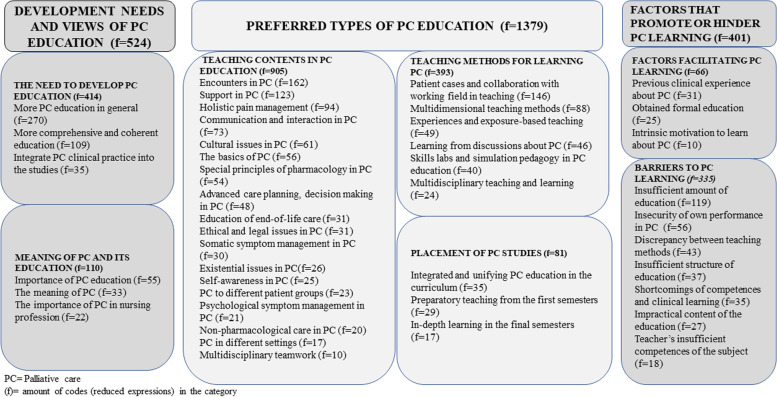
The inductive content analysis identified three unifying categories. The first was 'Development needs and views of palliative care education' (f = 524), which consisted of the main categories 'the need to develop palliative care education' (f = 414) and 'meaning of palliative care and its education' (f = 110). Secondly 'Preferred types of palliative care education' (f = 1379), including the main categories 'teaching contents in palliative care education' (f = 905), 'teaching methods for palliative care learning' (f = 393), and 'placement of palliative care studies' (f = 81). Thirdly 'The facilitators and barriers to palliative care learning' (f = 401), consisting of the main categories 'factors facilitating palliative care learning' (f = 66) and 'barriers to palliative care learning' (f = 335).
This study provides detailed information about nursing student's perspectives of palliative care education and its development needs. Hence, the results are relevant to decision-makers who want to develop undergraduate nursing curricula. This study highlights that palliative care education should be developed by ensuring that all students have equal access to palliative care education provided by highly competent teachers. Possibilities for clinical placements or visits to palliative care units during the education should also be improved. The participating students felt unprepared to provide high-quality palliative care even though they responded that palliative care is an important topic in their nursing studies.
护士在为患者及其家属提供高质量的姑息治疗方面发挥着重要作用。因此,他们需要接受充分的姑息治疗教育。然而,人们对护理专业最后一年学生如何看待本科护理课程中的姑息治疗教育知之甚少。本研究旨在描述护理学生对姑息治疗教育发展需求的看法。根据收集到的数据,还出现了另外两个目标,即描述姑息治疗教育的首选教育方式以及在本科护理学习期间促进或阻碍姑息治疗学习的因素。
本研究采用描述性定性方法和归纳内容分析法进行指导。通过计算每个类别的代码(简化表达)的频率(f),以显示每个类别的重要性与整体的关系。参与者为参与全国性调查的护理专业最后一年学生(n=766)。
归纳内容分析确定了三个统一的类别。第一个是“姑息治疗教育的发展需求和观点”(f=524),其中包括主要类别“发展姑息治疗教育的必要性”(f=414)和“姑息治疗的意义及其教育”(f=110)。其次是“姑息治疗教育的首选类型”(f=1379),包括主要类别“姑息治疗教育的教学内容”(f=905)、“姑息治疗学习的教学方法”(f=393)和“姑息治疗研究的定位”(f=81)。第三是“姑息治疗学习的促进因素和障碍”(f=401),包括主要类别“促进姑息治疗学习的因素”(f=66)和“姑息治疗学习的障碍”(f=335)。
本研究提供了有关护理学生对姑息治疗教育及其发展需求的观点的详细信息。因此,该结果对希望开发本科护理课程的决策者具有重要意义。本研究强调,姑息治疗教育的发展应确保所有学生都能平等地获得由高能力教师提供的姑息治疗教育。还应改善教育期间的临床实习或姑息治疗单位参观机会。尽管学生们表示姑息治疗是他们护理学习中的一个重要课题,但他们还是觉得自己没有准备好提供高质量的姑息治疗。