González-Fernández Francisco Tomás, Martínez-Aranda Luis Manuel, Falces-Prieto Moisés, Nobari Hadi, Clemente Filipe Manuel
Department of Physical Education and Sport, Faculty of Education and Sport Sciences, Campus of Melilla, University of Granada, 52006, Melilla, Spain.
SER Research Group, CESAG, Pontifical University of Comillas, 07013, Palma, Spain.
BMC Sports Sci Med Rehabil. 2022 Mar 23;14(1):45. doi: 10.1186/s13102-022-00438-w.
The postural stability seems to be important in the physical development of the soccer player and the specific tasks related to the game. In addition, it is related to the injury risk and therefore, with the injury prevention and retraining processes. In this context, the Y Balance Test (YBT) is presented as a tool to assess dynamic postural control.
This study aimed to explore the differences and possible correlations in the YBT scores and inter-limb asymmetry for anterior (ANT), posteromedial (PM) and posterolateral (PL) directions by category and field position in soccer players.
173 males soccer players aged between 14 and 33 years old agreed to participate. Five categories and six field position were considered in this study. A standardised protocol was used at multiple clubs during the pre-season assessment of musculoskeletal function in soccer players. All the players performed the Y Balance Test (YBT) (official YBT Kit), assessing the dominant and non-dominant leg for three YBT directions (anterior-AN, posteromedial-PM and posterolateral-PL), inter-limb asymmetry and composite score.
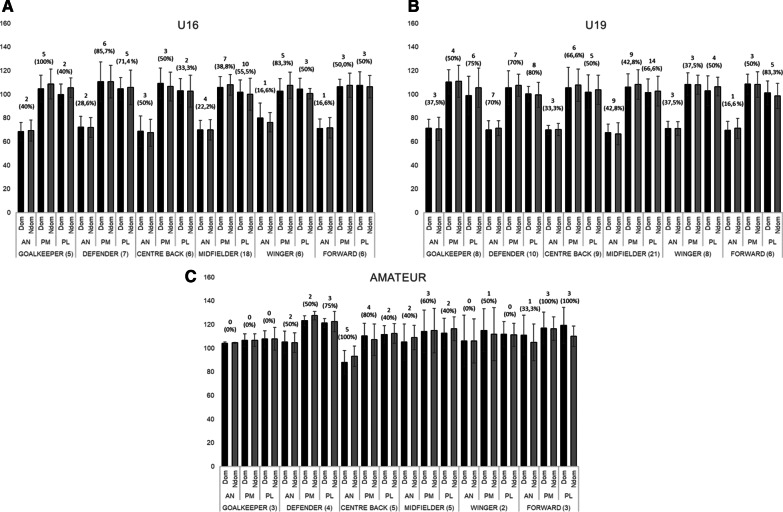
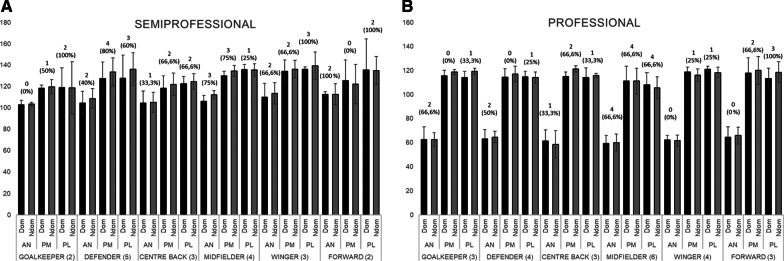
For AN, amateur and semiprofessional obtained the highest values for Dominant and Non-Dominant legs (Range = 101.8-109.4%) and the lowest level in PRO players (mean: 62.0%). Concerning PM-PL, semiprofessional (Range = 126.4-132.7%, dominant and non-Dominant respectively), followed by professional and amateur reported higher scores compared to youth categories. Inter-limb asymmetry showed higher values in lower age categories. The best composite scores were detected in semiprofessionals (Range = 113.3-126.7% for dominant and Range = 113.8-129.7% for non-Dominant leg), compared with the rest of the categories and for each field position evaluated.
Comparisons between field-positions revealed that centre-backs were worse than wingers and forwards. In order to explain variations in dynamic balance between competitive levels within the same age-group, special considerations about training programmes and related co-variables should be considered.
姿势稳定性在足球运动员的身体发育以及与比赛相关的特定任务中似乎很重要。此外,它与受伤风险相关,因此也与 injury prevention and retraining processes(此处英文有误,应是“损伤预防和康复训练过程”)有关。在这种背景下,Y平衡测试(YBT)被视为一种评估动态姿势控制的工具。
本研究旨在探讨足球运动员按类别和场上位置划分,在YBT得分以及前向(ANT)、后内侧(PM)和后外侧(PL)方向的肢体间不对称性方面的差异和可能的相关性。
173名年龄在14至33岁之间的男性足球运动员同意参与。本研究考虑了五个类别和六个场上位置。在多个俱乐部对足球运动员进行季前肌肉骨骼功能评估期间,使用了标准化方案。所有球员都进行了Y平衡测试(YBT)(官方YBT套件),评估三个YBT方向(前向 - AN、后内侧 - PM和后外侧 - PL)的优势腿和非优势腿、肢体间不对称性和综合得分。
对于前向方向(AN),业余和半职业球员的优势腿和非优势腿得分最高(范围 = 101.8 - 109.4%),职业球员得分最低(平均:62.0%)。关于后内侧 - 后外侧(PM - PL),半职业球员(范围分别为优势腿126.4 - 132.7%,非优势腿126.4 - 132.7%),其次是职业和业余球员,与青年类别相比得分更高。肢体间不对称性在年龄较小的类别中值更高。与其他类别以及评估的每个场上位置相比,半职业球员的综合得分最高(优势腿范围 = 113.3 - 126.7%,非优势腿范围 = 113.8 - 129.7%)。
不同场上位置之间的比较表明,中后卫比边锋和前锋表现更差。为了解释同一年龄组内不同竞技水平之间动态平衡的差异,应特别考虑训练计划和相关协变量。