Key Laboratory for Health Informatics Shenzhen Institute of Advanced TechnologyChinese Academy of Sciences Shenzhen China.
University of Chinese Academy of Sciences Beijing China.
J Am Heart Assoc. 2022 Apr 5;11(7):e023555. doi: 10.1161/JAHA.121.023555. Epub 2022 Mar 24.
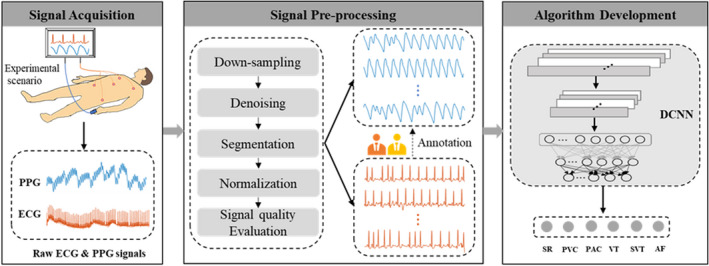
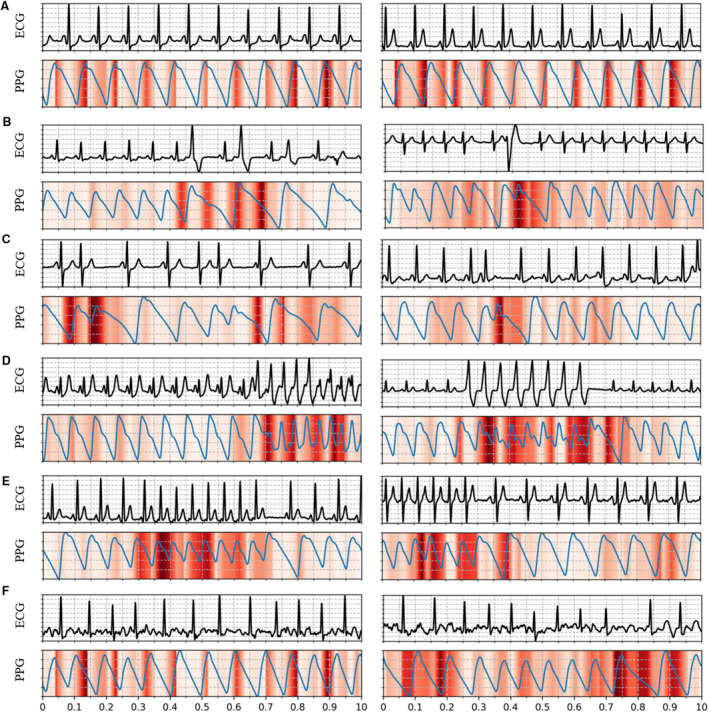
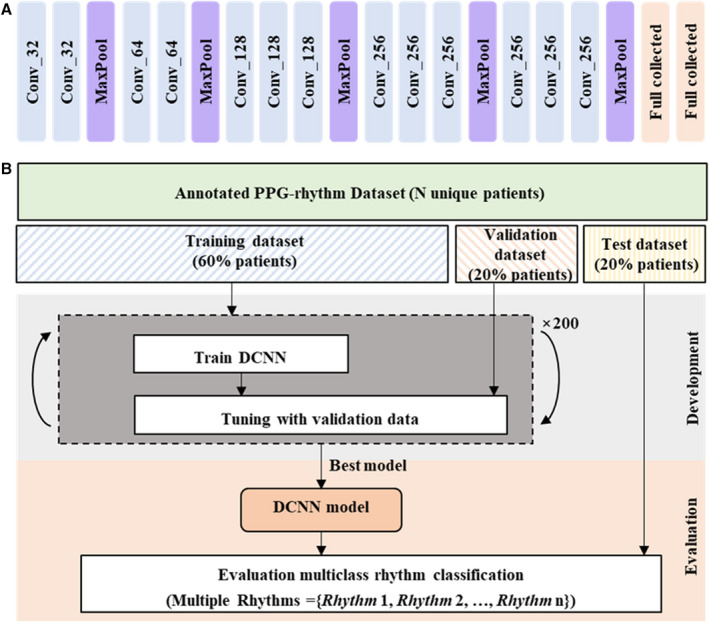
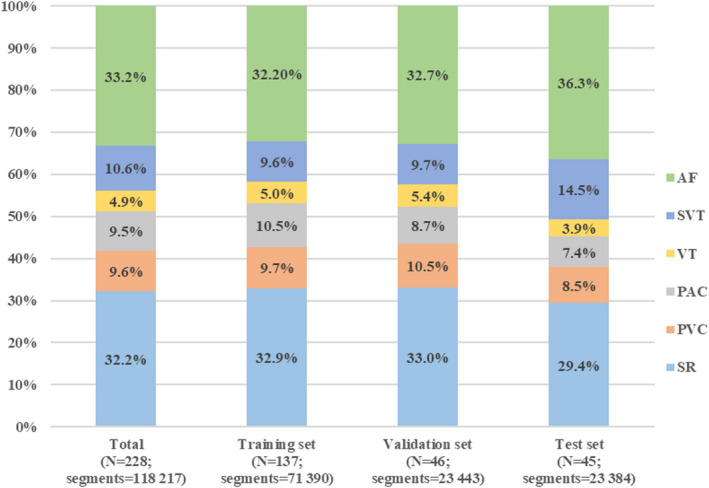
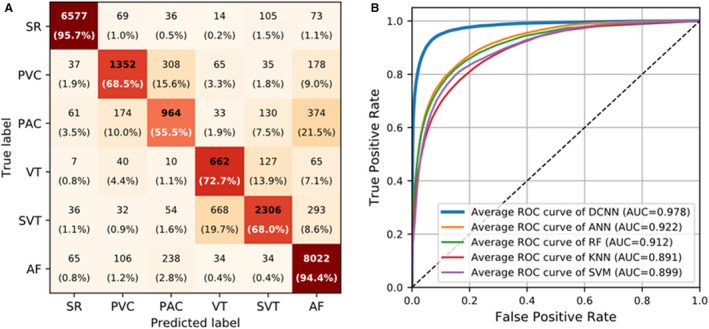
Background Studies have reported the use of photoplethysmography signals to detect atrial fibrillation; however, the use of photoplethysmography signals in classifying multiclass arrhythmias has rarely been reported. Our study investigated the feasibility of using photoplethysmography signals and a deep convolutional neural network to classify multiclass arrhythmia types. Methods and Results ECG and photoplethysmography signals were collected simultaneously from a group of patients who underwent radiofrequency ablation for arrhythmias. A deep convolutional neural network was developed to classify multiple rhythms based on 10-second photoplethysmography waveforms. Classification performance was evaluated by calculating the area under the microaverage receiver operating characteristic curve, overall accuracy, sensitivity, specificity, and positive and negative predictive values against annotations on the rhythm of arrhythmias provided by 2 cardiologists consulting the ECG results. A total of 228 patients were included; 118 217 pairs of 10-second photoplethysmography and ECG waveforms were used. When validated against an independent test data set (23 384 photoplethysmography waveforms from 45 patients), the DCNN achieved an overall accuracy of 85.0% for 6 rhythm types (sinus rhythm, premature ventricular contraction, premature atrial contraction, ventricular tachycardia, supraventricular tachycardia, and atrial fibrillation); the microaverage area under the microaverage receiver operating characteristic curve was 0.978; the average sensitivity, specificity, and positive and negative predictive values were 75.8%, 96.9%, 75.2%, and 97.0%, respectively. Conclusions This study demonstrated the feasibility of classifying multiclass arrhythmias from photoplethysmography signals using deep learning techniques. The approach is attractive for population-based screening and may hold promise for the long-term surveillance and management of arrhythmia. Registration URL: www.chictr.org.cn. Identifier: ChiCTR2000031170.
已有研究报道利用光电容积脉搏波信号来检测心房颤动,但利用光电容积脉搏波信号对多类心律失常进行分类的研究较少。本研究旨在探讨利用光电容积脉搏波信号和深度卷积神经网络对多类心律失常进行分类的可行性。
本研究纳入了一组因心律失常而行射频消融术的患者,同步采集了心电图和光电容积脉搏波信号。基于 10 秒光电容积脉搏波波形,开发了一个深度卷积神经网络来对多种节律进行分类。通过计算微平均受试者工作特征曲线下面积、整体准确性、敏感度、特异度、阳性和阴性预测值来评估分类性能,这些指标均针对由 2 位参考心电图结果的心脏病专家对心律失常节律进行注释的标签。共纳入 228 例患者;使用了 118 217 对 10 秒光电容积脉搏波和心电图波形。在对独立测试数据集(45 例患者的 23 384 个光电容积脉搏波波形)进行验证时,DCNN 对 6 种节律类型(窦性节律、室性期前收缩、房性期前收缩、室性心动过速、室上性心动过速和心房颤动)的整体准确性为 85.0%;微平均受试者工作特征曲线下面积为 0.978;平均敏感度、特异度、阳性和阴性预测值分别为 75.8%、96.9%、75.2%和 97.0%。
本研究表明,使用深度学习技术从光电容积脉搏波信号分类多类心律失常是可行的。该方法适用于人群筛查,可能为心律失常的长期监测和管理提供帮助。