Department of Urology, The First Affiliated Hospital of Anhui Medical University, Hefei, China.
Institute of Urology, Anhui Medical University, Hefei, China.
Cancer Med. 2022 Sep;11(17):3260-3271. doi: 10.1002/cam4.4694. Epub 2022 Mar 23.
The incidence of early-onset prostate cancer (PCa) has increased significantly over the past few decades. It is necessary to develop a prognostic nomogram for the prediction of overall survival (OS) in early-onset PCa patients.
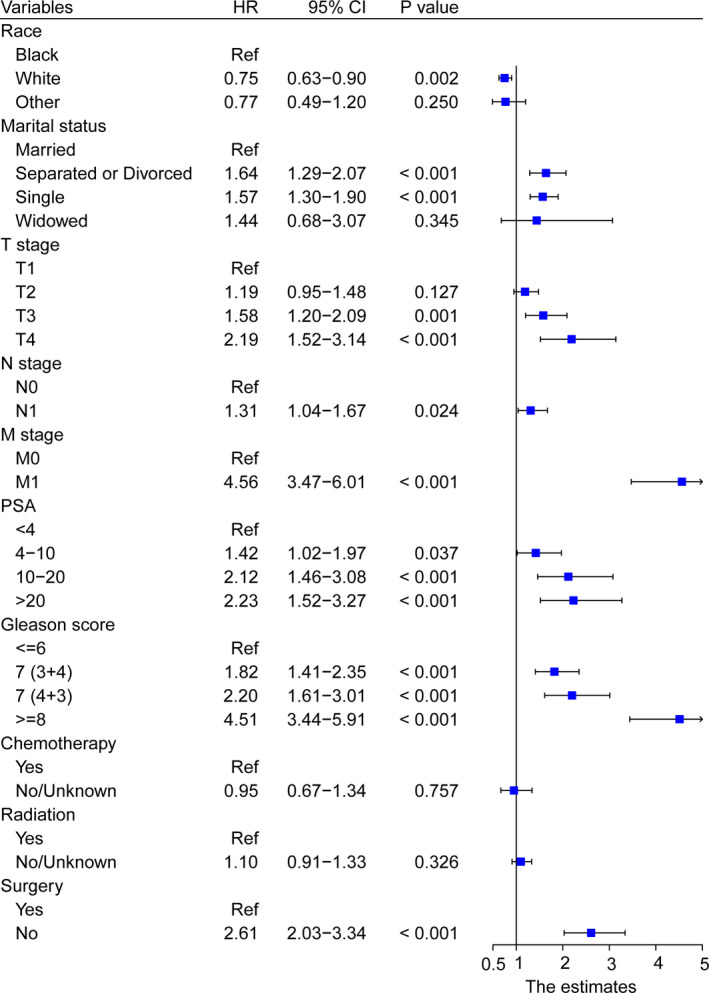
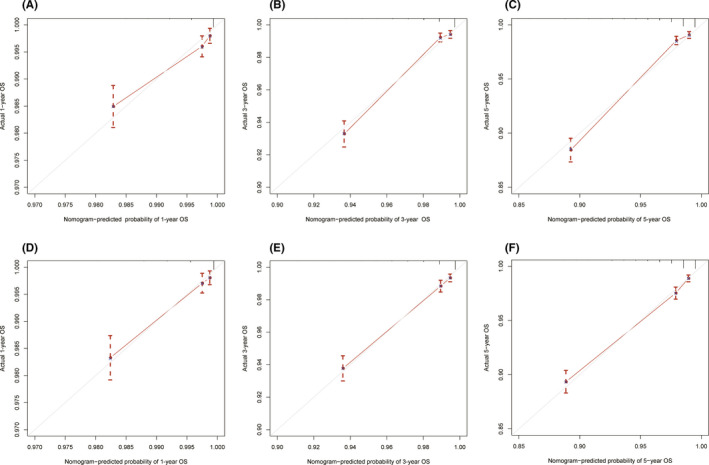
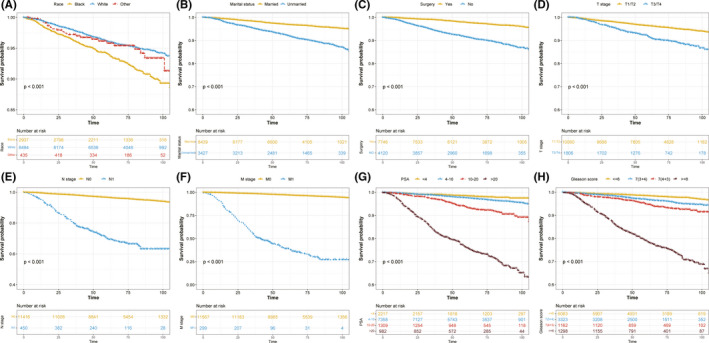
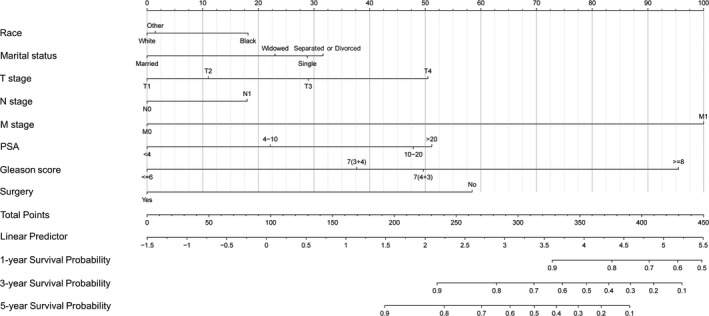
A total of 23,730 early-onset PCa patients (younger than 55 years old) between 2010 and 2015 in the Surveillance, Epidemiology, and End Results (SEER) database were enrolled for the current study, and randomly separated into the training cohort and the validation cohort. 361 eligible early-onset PCa patients from The Cancer Genome Atlas-Prostate Adenocarcinoma (TCGA-PRAD) cohort were obtained as the external validation cohort. Independent predictors were selected by univariate and multivariate Cox regression analysis, and a prognostic nomogram was constructed for 1-, 3-, and 5-year OS. The accurate and discriminative abilities of the nomogram were evaluated by the concordance index (C-index), receiver operating characteristic curve (ROC), calibration plot, net reclassification index (NRI), and integrated discrimination improvement (IDI).
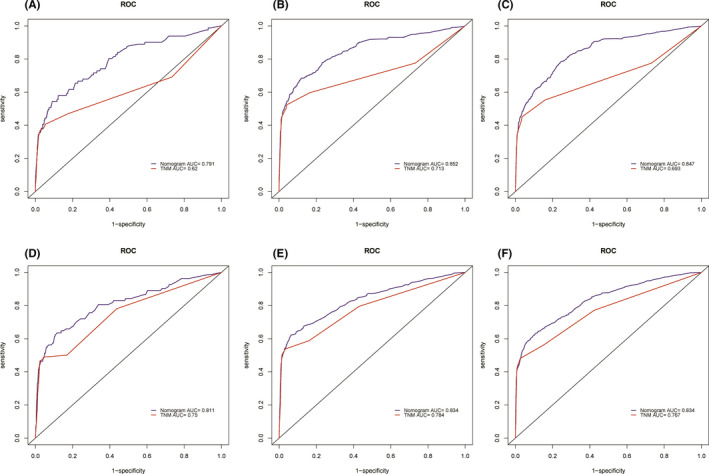
Multivariate Cox analysis showed that race, marital status, TNM stage, prostate-specific antigen, Gleason score, and surgery were significantly associated with poor prognosis of PCa. A nomogram consisting of these variables was established, which had higher C-indexes than the TNM system (training cohort: 0.831 vs. 0.746, validation cohort: 0.817 vs. 0.752). Better AUCs of the nomogram than the TNM system at 1, 3, and 5 years were found in both the training cohort and the validation cohort. The 3-year and 5-year AUCs of the nomogram in the TCGA-PRAD cohort were 0.723 and 0.679, respectively. The calibration diagram, NRI, and IDI also showed promising prognostic value in OS.
We developed an effective prognostic nomogram for OS prediction in early-onset PCa patients, which will further assist both the precise clinical treatment and the assessment of long-term outcomes.
近年来,早发性前列腺癌(PCa)的发病率显著上升。因此,有必要开发一种预测总生存期(OS)的预后列线图,以预测早发性 PCa 患者的预后。
本研究共纳入了 2010 年至 2015 年间 SEER 数据库中 23730 例年龄小于 55 岁的早发性 PCa 患者,将其随机分为训练队列和验证队列。从 TCGA-PRAD 队列中获得了 361 例符合条件的早发性 PCa 患者作为外部验证队列。通过单因素和多因素 Cox 回归分析筛选独立预测因子,并构建用于预测 1、3 和 5 年 OS 的预后列线图。通过一致性指数(C-index)、受试者工作特征曲线(ROC)、校准图、净重新分类指数(NRI)和综合判别改善(IDI)评估列线图的准确性和判别能力。
多因素 Cox 分析显示,种族、婚姻状况、TNM 分期、前列腺特异性抗原、Gleason 评分和手术与 PCa 的不良预后显著相关。建立了一个包含这些变量的列线图,其 C-index 高于 TNM 系统(训练队列:0.831 比 0.746,验证队列:0.817 比 0.752)。在训练队列和验证队列中,列线图在 1、3 和 5 年的 AUC 均优于 TNM 系统。在 TCGA-PRAD 队列中,列线图在 3 年和 5 年的 AUC 分别为 0.723 和 0.679。校准图、NRI 和 IDI 也显示出在 OS 预测方面具有良好的预后价值。
我们开发了一种有效的 OS 预测预后列线图,可进一步辅助早发性 PCa 患者的精确临床治疗和长期预后评估。