• 文献检索
  • 文档翻译
  • 深度研究
  • 学术资讯
  • Suppr Zotero 插件Zotero 插件
  • 邀请有礼
  • 套餐&价格
  • 历史记录
应用&插件
Suppr Zotero 插件Zotero 插件浏览器插件Mac 客户端Windows 客户端微信小程序
定价
高级版会员购买积分包购买API积分包
服务
文献检索文档翻译深度研究API 文档MCP 服务
关于我们
关于 Suppr公司介绍联系我们用户协议隐私条款
关注我们

Suppr 超能文献

核心技术专利:CN118964589B侵权必究
粤ICP备2023148730 号-1Suppr @ 2026

文献检索

告别复杂PubMed语法,用中文像聊天一样搜索,搜遍4000万医学文献。AI智能推荐,让科研检索更轻松。

立即免费搜索

文件翻译

保留排版,准确专业,支持PDF/Word/PPT等文件格式,支持 12+语言互译。

免费翻译文档

深度研究

AI帮你快速写综述,25分钟生成高质量综述,智能提取关键信息,辅助科研写作。

立即免费体验

应用局部表面等离子体共振传感器的机器学习来检测 SARS-CoV-2 颗粒。

Applying Machine Learning with Localized Surface Plasmon Resonance Sensors to Detect SARS-CoV-2 Particles.

机构信息

School of Life Science and Technology, Huazhong University of Science and Technology, Wuhan 430074, China.

出版信息

Biosensors (Basel). 2022 Mar 13;12(3):173. doi: 10.3390/bios12030173.

DOI:10.3390/bios12030173
PMID:35323443
原文链接:https://pmc.ncbi.nlm.nih.gov/articles/PMC8946137/
Abstract

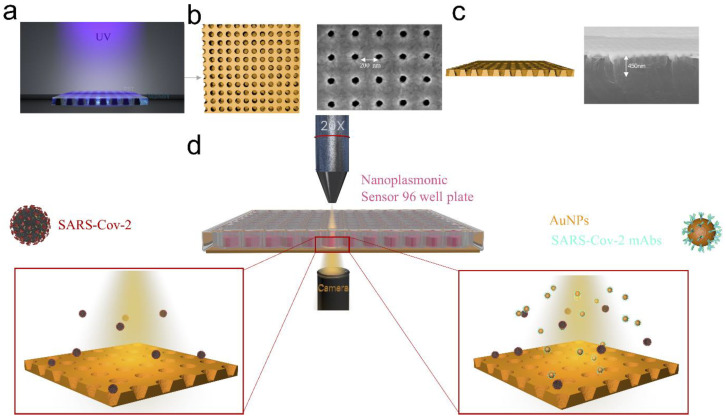
The sudden outbreak of COVID-19 rapidly developed into a global pandemic, which caused tens of millions of infections and millions of deaths. Although SARS-CoV-2 is known to cause COVID-19, effective approaches to detect SARS-CoV-2 using a convenient, rapid, accurate, and low-cost method are lacking. To date, most of the diagnostic methods for patients with early infections are limited to the detection of viral nucleic acids via polymerase chain reaction (PCR), or antigens, using an enzyme-linked immunosorbent assay or a chemiluminescence immunoassay. This study developed a novel method that uses localized surface plasmon resonance (LSPR) sensors, optical imaging, and artificial intelligence methods to directly detect the SARS-CoV-2 virus particles without any sample preparation. The virus concentration can be qualitatively and quantitatively detected in the range of 125.28 to 106 vp/mL through a few steps within 12 min with a limit of detection (LOD) of 100 vp/mL. The accuracy of the SARS-CoV-2 positive or negative assessment was found to be greater than 97%, and this was demonstrated by establishing a regression machine learning model for the virus concentration prediction (R2 > 0.95).

摘要

新冠疫情的突然爆发迅速演变成全球大流行,导致数千万人感染和数百万人死亡。虽然已知 SARS-CoV-2 会导致 COVID-19,但缺乏使用方便、快速、准确和低成本的方法来检测 SARS-CoV-2。迄今为止,大多数针对早期感染患者的诊断方法仅限于通过聚合酶链反应(PCR)检测病毒核酸,或使用酶联免疫吸附试验或化学发光免疫分析检测抗原。本研究开发了一种新方法,使用局域表面等离子体共振(LSPR)传感器、光学成像和人工智能方法,无需任何样品制备即可直接检测 SARS-CoV-2 病毒颗粒。通过在 12 分钟内进行几步操作,该方法可以在 125.28 到 106 vp/mL 的范围内定性和定量检测病毒浓度,检测限(LOD)为 100 vp/mL。通过建立用于病毒浓度预测的回归机器学习模型(R2 > 0.95),发现 SARS-CoV-2 阳性或阴性评估的准确率大于 97%。
https://cdn.ncbi.nlm.nih.gov/pmc/blobs/0040/8946137/7cc1f388bb5b/biosensors-12-00173-g005.jpg
https://cdn.ncbi.nlm.nih.gov/pmc/blobs/0040/8946137/387c3fd0d9e0/biosensors-12-00173-g001.jpg
https://cdn.ncbi.nlm.nih.gov/pmc/blobs/0040/8946137/cb6ee4083e80/biosensors-12-00173-g002.jpg
https://cdn.ncbi.nlm.nih.gov/pmc/blobs/0040/8946137/2af2ffefb57e/biosensors-12-00173-g003.jpg
https://cdn.ncbi.nlm.nih.gov/pmc/blobs/0040/8946137/c176cf44e4db/biosensors-12-00173-g004.jpg
https://cdn.ncbi.nlm.nih.gov/pmc/blobs/0040/8946137/7cc1f388bb5b/biosensors-12-00173-g005.jpg
https://cdn.ncbi.nlm.nih.gov/pmc/blobs/0040/8946137/387c3fd0d9e0/biosensors-12-00173-g001.jpg
https://cdn.ncbi.nlm.nih.gov/pmc/blobs/0040/8946137/cb6ee4083e80/biosensors-12-00173-g002.jpg
https://cdn.ncbi.nlm.nih.gov/pmc/blobs/0040/8946137/2af2ffefb57e/biosensors-12-00173-g003.jpg
https://cdn.ncbi.nlm.nih.gov/pmc/blobs/0040/8946137/c176cf44e4db/biosensors-12-00173-g004.jpg
https://cdn.ncbi.nlm.nih.gov/pmc/blobs/0040/8946137/7cc1f388bb5b/biosensors-12-00173-g005.jpg

相似文献

1
Applying Machine Learning with Localized Surface Plasmon Resonance Sensors to Detect SARS-CoV-2 Particles.应用局部表面等离子体共振传感器的机器学习来检测 SARS-CoV-2 颗粒。
Biosensors (Basel). 2022 Mar 13;12(3):173. doi: 10.3390/bios12030173.
2
Localized surface plasmon resonance biosensor chip surface modification and signal amplifications toward rapid and sensitive detection of COVID-19 infections.用于 COVID-19 感染快速灵敏检测的局域表面等离子体共振生物传感器芯片表面修饰与信号放大。
Biosens Bioelectron. 2023 Sep 15;236:115421. doi: 10.1016/j.bios.2023.115421. Epub 2023 May 23.
3
One-step rapid quantification of SARS-CoV-2 virus particles via low-cost nanoplasmonic sensors in generic microplate reader and point-of-care device.一步法通过低成本纳米等离子体传感器在通用微孔板读数仪和即时检测设备中快速定量 SARS-CoV-2 病毒颗粒。
Biosens Bioelectron. 2021 Jan 1;171:112685. doi: 10.1016/j.bios.2020.112685. Epub 2020 Oct 15.
4
Label-Free LSPR-Vertical Microcavity Biosensor for On-Site SARS-CoV-2 Detection.无标记 LSPR-垂直微腔生物传感器用于现场 SARS-CoV-2 检测。
Biosensors (Basel). 2022 Feb 28;12(3):151. doi: 10.3390/bios12030151.
5
Regenerable and high-throughput surface plasmon resonance assay for rapid screening of anti-SARS-CoV-2 antibody in serum samples.可再生且高通量的表面等离子体共振分析方法,用于快速筛选血清样本中的抗 SARS-CoV-2 抗体。
Anal Chim Acta. 2022 May 22;1208:339830. doi: 10.1016/j.aca.2022.339830. Epub 2022 Apr 13.
6
T-Shaped Aptamer-Based LSPR Biosensor Using Ω-Shaped Fiber Optic for Rapid Detection of SARS-CoV-2.基于T形适体的表面等离子体共振生物传感器,采用Ω形光纤用于快速检测新型冠状病毒。
Anal Chem. 2023 Jan 17;95(2):1599-1607. doi: 10.1021/acs.analchem.2c04709. Epub 2022 Dec 29.
7
Spectral image contrast-based flow digital nanoplasmon-metry for ultrasensitive antibody detection.基于光谱图像对比的流数字纳米等离子体计量术用于超灵敏抗体检测。
J Nanobiotechnology. 2022 Jan 4;20(1):6. doi: 10.1186/s12951-021-01188-6.
8
New, fast, and precise method of COVID-19 detection in nasopharyngeal and tracheal aspirate samples combining optical spectroscopy and machine learning.结合光谱光学和机器学习的新型、快速、精准的鼻咽和气管抽吸样本新冠病毒检测方法。
Braz J Microbiol. 2023 Jun;54(2):769-777. doi: 10.1007/s42770-023-00923-5. Epub 2023 Feb 28.
9
Novel dual multiplex real-time RT-PCR assays for the rapid detection of SARS-CoV-2, influenza A/B, and respiratory syncytial virus using the BD MAX open system.新型双重多重实时 RT-PCR 检测方法可快速检测 SARS-CoV-2、流感 A/B 和呼吸道合胞病毒,使用的是 BD MAX 开放式系统。
Emerg Microbes Infect. 2021 Dec;10(1):161-166. doi: 10.1080/22221751.2021.1873073.
10
A non-invasive ultrasensitive diagnostic approach for COVID-19 infection using salivary label-free SERS fingerprinting and artificial intelligence.使用唾液无标记 SERS 指纹图谱和人工智能的 COVID-19 感染的无创超灵敏诊断方法。
J Photochem Photobiol B. 2022 Sep;234:112545. doi: 10.1016/j.jphotobiol.2022.112545. Epub 2022 Aug 19.

引用本文的文献

1
Using Machine Learning and Optical Microscopy Image Analysis of Immunosensors Made on Plasmonic Substrates: Application to Detect the SARS-CoV-2 Virus.利用机器学习和对基于等离子体基底制作的免疫传感器进行光学显微镜图像分析:应用于检测新型冠状病毒。
ACS Sens. 2025 Feb 28;10(2):1407-1418. doi: 10.1021/acssensors.4c03451. Epub 2025 Feb 17.
2
Surface Plasmon Resonance-Based Biodetection Systems: Principles, Progress and Applications-A Comprehensive Review.基于表面等离子体共振的生物检测系统:原理、进展与应用——综述
Biosensors (Basel). 2025 Jan 9;15(1):35. doi: 10.3390/bios15010035.
3
Towards Point-of-Care Single Biomolecule Detection Using Next Generation Portable Nanoplasmonic Biosensors: A Review.

本文引用的文献

1
Ultrasensitive detection of SARS-CoV-2 nucleocapsid protein using large gold nanoparticle-enhanced surface plasmon resonance.利用大尺寸金纳米粒子增强表面等离子体共振技术超灵敏检测 SARS-CoV-2 核衣壳蛋白
Sci Rep. 2022 Jan 20;12(1):1060. doi: 10.1038/s41598-022-05036-x.
2
Gold nanoparticle based plasmonic sensing for the detection of SARS-CoV-2 nucleocapsid proteins.基于金纳米颗粒的等离子体传感用于检测 SARS-CoV-2 核衣壳蛋白。
Biosens Bioelectron. 2022 Jan 1;195:113669. doi: 10.1016/j.bios.2021.113669. Epub 2021 Sep 28.
3
Multiplexed and High-Throughput Label-Free Detection of RNA/Spike Protein/IgG/IgM Biomarkers of SARS-CoV-2 Infection Utilizing Nanoplasmonic Biosensors.
利用下一代便携式纳米等离子体生物传感器实现即时护理单生物分子检测综述
Biosensors (Basel). 2024 Dec 4;14(12):593. doi: 10.3390/bios14120593.
4
Rapid assays of SARS-CoV-2 virus and noble biosensors by nanomaterials.利用纳米材料对严重急性呼吸综合征冠状病毒2(SARS-CoV-2)病毒和新型生物传感器进行快速检测。
Nano Converg. 2024 Jan 8;11(1):2. doi: 10.1186/s40580-023-00408-z.
5
Impact of nanotechnology on conventional and artificial intelligence-based biosensing strategies for the detection of viruses.纳米技术对基于传统和人工智能的病毒检测生物传感策略的影响。
Discov Nano. 2023 Apr 1;18(1):58. doi: 10.1186/s11671-023-03842-4. eCollection 2023 Dec.
利用纳米等离子体生物传感器对新冠病毒感染的RNA/刺突蛋白/IgG/IgM生物标志物进行多重高通量无标记检测。
Anal Chem. 2021 Jun 29;93(25):8754-8763. doi: 10.1021/acs.analchem.0c05300. Epub 2021 Jun 14.
4
Thermoplasmonic-Assisted Cyclic Cleavage Amplification for Self-Validating Plasmonic Detection of SARS-CoV-2.用于SARS-CoV-2自验证等离子体检测的热等离子体辅助循环切割扩增
ACS Nano. 2021 Apr 27;15(4):7536-7546. doi: 10.1021/acsnano.1c00957. Epub 2021 Mar 16.
5
One-step rapid quantification of SARS-CoV-2 virus particles via low-cost nanoplasmonic sensors in generic microplate reader and point-of-care device.一步法通过低成本纳米等离子体传感器在通用微孔板读数仪和即时检测设备中快速定量 SARS-CoV-2 病毒颗粒。
Biosens Bioelectron. 2021 Jan 1;171:112685. doi: 10.1016/j.bios.2020.112685. Epub 2020 Oct 15.
6
Machine learning for precision medicine.机器学习与精准医学
Genome. 2021 Apr;64(4):416-425. doi: 10.1139/gen-2020-0131. Epub 2020 Oct 22.
7
Magnetic beads combined with carbon black-based screen-printed electrodes for COVID-19: A reliable and miniaturized electrochemical immunosensor for SARS-CoV-2 detection in saliva.磁珠结合基于碳黑的丝网印刷电极用于 COVID-19:一种可靠且微型化的用于唾液中 SARS-CoV-2 检测的电化学免疫传感器。
Biosens Bioelectron. 2021 Jan 1;171:112686. doi: 10.1016/j.bios.2020.112686. Epub 2020 Oct 3.
8
Peroxidase-like Au@Pt nanozyme as an integrated nanosensor for Ag detection by LSPR spectroscopy.过氧化物酶样金@铂纳米酶作为一种用于通过表面等离子体共振光谱法检测银的集成纳米传感器。
Talanta. 2021 Jan 1;221:121627. doi: 10.1016/j.talanta.2020.121627. Epub 2020 Sep 12.
9
SARS-CoV-2 pandemic and research gaps: Understanding SARS-CoV-2 interaction with the ACE2 receptor and implications for therapy.SARS-CoV-2 大流行和研究空白:了解 SARS-CoV-2 与 ACE2 受体的相互作用及其对治疗的影响。
Theranostics. 2020 Jun 12;10(16):7448-7464. doi: 10.7150/thno.48076. eCollection 2020.
10
Real-time RT-PCR in COVID-19 detection: issues affecting the results.实时逆转录聚合酶链反应在新冠病毒检测中的应用:影响结果的因素
Expert Rev Mol Diagn. 2020 May;20(5):453-454. doi: 10.1080/14737159.2020.1757437. Epub 2020 Apr 22.