Kheir-Mataria Wafa Abu El, El-Fawal Hassan, Bhuiyan Shahjahan, Chun Sungsoo
Institute of Global Health and Human Ecology, The American University in Cairo, New Cairo 11835, Egypt.
Department of Public Policy and Administration, School of Global Affairs and Public Policy, The American University in Cairo, New Cairo 11835, Egypt.
Healthcare (Basel). 2022 Mar 15;10(3):540. doi: 10.3390/healthcare10030540.
Health equity is an important aspect of responsible governance. COVID-19 exposed existing shortfalls of Global Health Governance (GHG). A considerable amount of related literature is produced. This scoping review aims at mapping the present knowledge and at identifying research gaps.
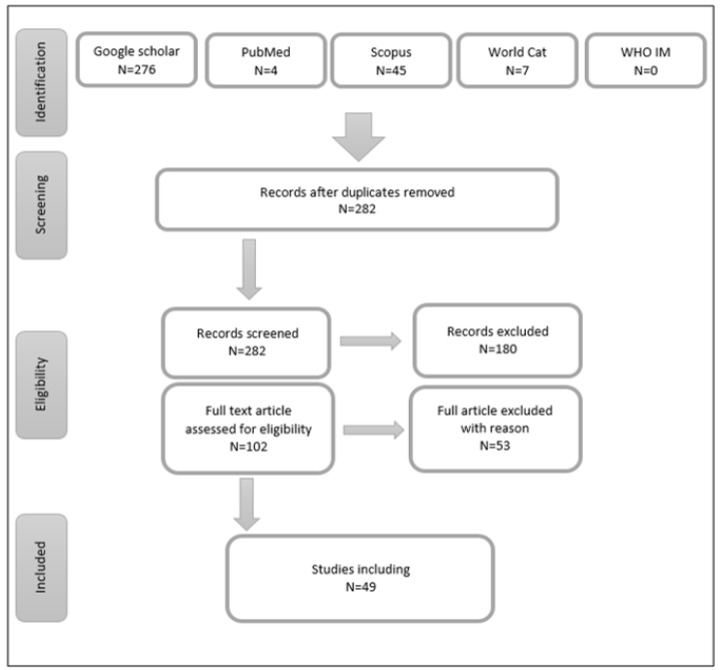
This scoping review is based on the Joanna Briggs Institute's guideline for standardized methods and PRISMA-ScR guidelines for reporting. Documents published from December 2019 to October 2021 were searched using PubMed, Scopus, Google Scholar, World cat, and WHO-Global Index Medicus. Two reviewers screened and reviewed eligible studies in three stages: duplicates identification and elimination, title and abstract screening, and full-text assessment. Data was charted and results were classified into conceptual categories. Analysis was done in three stages: open descriptive coding, focused thematic analysis, and frequency, commonality and significance analysis.
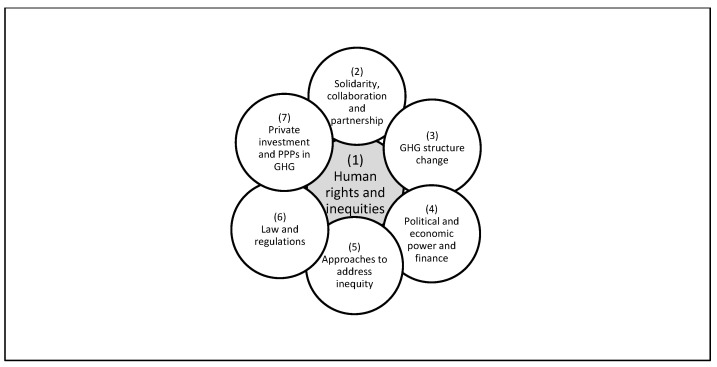
forty-nine studies met the inclusion criteria. Areas of research were grouped into seven themes: "human rights and inequities", "solidarity, collaboration and partnership", "GHG structure change", "political and economic power and finance", "approaches to address inequity", "law and regulations", and "private investment and public-private partnerships (PPPs) in GHG". The highest number of papers were in the first theme, "human rights and inequities". However, the themes are interrelated. Authors who contributed to research were mostly affiliated to developed countries indicating a gap in knowledge and expertise in developing countries.
Through this scoping review we found that the seven themes are interconnected. Disciplinary collaboration in research relating GHG to health inequities is solicited. Collaboration in research, information sharing, and research capacity development are in needed in developing countries.
健康公平是负责任治理的一个重要方面。新冠疫情暴露了全球卫生治理(GHG)现有的不足。大量相关文献得以产出。本范围综述旨在梳理当前知识并识别研究空白。
本范围综述基于乔安娜·布里格斯研究所的标准化方法指南以及PRISMA-ScR报告指南。使用PubMed、Scopus、谷歌学术、World cat和世界卫生组织全球医学索引检索了2019年12月至2021年10月发表的文献。两名评审员分三个阶段筛选和评审符合条件的研究:重复文献识别与剔除、标题和摘要筛选以及全文评估。对数据进行图表整理,并将结果分类为概念类别。分析分三个阶段进行:开放式描述编码、聚焦主题分析以及频率、共性和显著性分析。
49项研究符合纳入标准。研究领域分为七个主题:“人权与不平等”、“团结、协作与伙伴关系”、“全球卫生治理结构变革”、“政治和经济权力与财政”、“解决不平等的方法”、“法律法规”以及“全球卫生治理中的私人投资与公私伙伴关系(PPP)”。论文数量最多的是第一个主题“人权与不平等”。然而,这些主题相互关联。参与研究的作者大多隶属于发达国家,这表明发展中国家在知识和专业技能方面存在差距。
通过本范围综述,我们发现这七个主题相互关联。我们呼吁在将全球卫生治理与健康不平等相关的研究中开展学科合作。发展中国家需要在研究、信息共享和研究能力发展方面进行合作。