Nautiyal Himani, Imam Syed Sarim, Alshehri Sultan, Ghoneim Mohammed M, Afzal Muhammad, Alzarea Sami I, Güven Emine, Al-Abbasi Fahad A, Kazmi Imran
Siddhartha Institute of Pharmacy, Near IT-Park, Sahastradhara Road, Dehradun 248001, India.
Department of Pharmaceutics, College of Pharmacy, King Saud University, Riyadh 11451, Saudi Arabia.
Biomedicines. 2022 Feb 24;10(3):540. doi: 10.3390/biomedicines10030540.
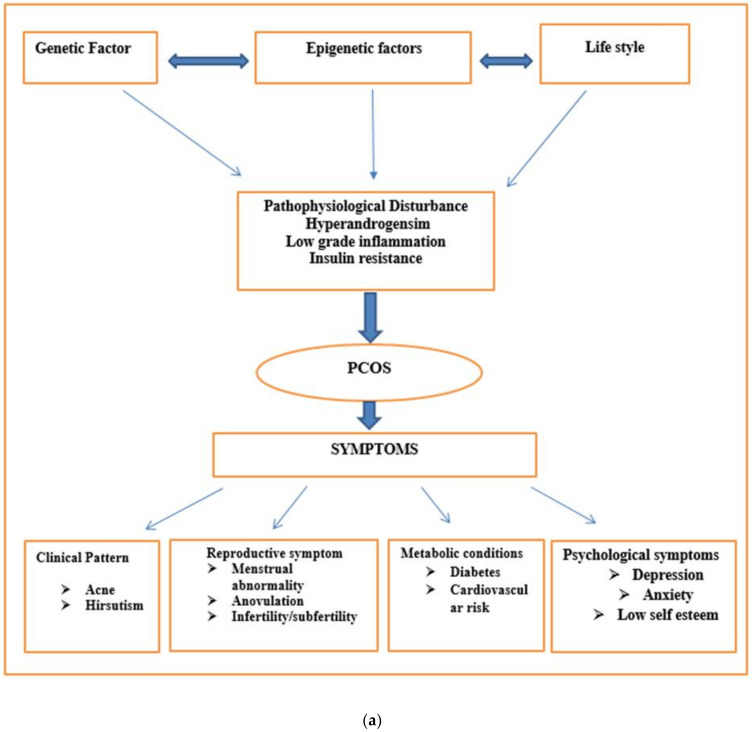
Polycystic ovarian syndrome (PCOS) is a complex endocrine disorder affecting females in their reproductive age. The early diagnosis of PCOS is complicated and complex due to overlapping symptoms of this disease. The most accepted diagnostic approach today is the Rotterdam Consensus (2003), which supports the positive diagnosis of PCOS when patients present two out of the following three symptoms: biochemical and clinical signs of hyperandrogenism, oligo, and anovulation, also polycystic ovarian morphology on sonography. Genetic variance, epigenetic changes, and disturbed lifestyle lead to the development of pathophysiological disturbances, which include hyperandrogenism, insulin resistance, and chronic inflammation in PCOS females. At the molecular level, different proteins and molecular and signaling pathways are involved in disease progression, which leads to the failure of a single genetic diagnostic approach. The genetic approach to elucidate the mechanism of pathogenesis of PCOS was recently developed, whereby four phenotypic variances of PCOS categorize PCOS patients into classic, ovulatory, and non-hyperandrogenic types. Genetic studies help to identify the root cause for the development of this PCOS. PCOS genetic inheritance is autosomal dominant but the latest investigations revealed it as a multigene origin disease. Different genetic loci and specific genes have been identified so far as being associated with this disease. Genome-wide association studies (GWAS) and related genetic studies have changed the scenario for the diagnosis and treatment of this reproductive and metabolic condition known as PCOS. This review article briefly discusses different genes associated directly or indirectly with disease development and progression.
多囊卵巢综合征(PCOS)是一种影响育龄女性的复杂内分泌紊乱疾病。由于该疾病症状重叠,PCOS的早期诊断复杂且困难。目前最被广泛接受的诊断方法是鹿特丹共识(2003年),该共识支持当患者出现以下三种症状中的两种时对PCOS进行阳性诊断:高雄激素血症的生化和临床体征、少排卵和无排卵,以及超声检查显示的多囊卵巢形态。遗传变异、表观遗传变化和不良生活方式导致病理生理紊乱的发生,其中包括PCOS女性的高雄激素血症、胰岛素抵抗和慢性炎症。在分子水平上,不同的蛋白质以及分子和信号通路参与疾病进展,这导致单一基因诊断方法的失败。最近开发了一种遗传方法来阐明PCOS的发病机制,据此PCOS的四种表型变异将PCOS患者分为经典型、排卵型和非高雄激素型。遗传研究有助于确定这种PCOS发病的根本原因。PCOS的遗传方式是常染色体显性遗传,但最新研究表明它是一种多基因起源的疾病。迄今为止,已确定了与该疾病相关的不同基因位点和特定基因。全基因组关联研究(GWAS)及相关遗传研究改变了这种被称为PCOS的生殖和代谢疾病的诊断和治疗局面。这篇综述文章简要讨论了与疾病发生和进展直接或间接相关的不同基因。