Australian Centre for Oral Oncology Research & Education, P.O. Box 285, Nedlands, WA 6909, Australia.
Australian eHealth Research Centre, The Commonwealth Scientific & Industrial Research Organisation, Floreat, WA 6104, Australia.
Biomolecules. 2022 Mar 17;12(3):464. doi: 10.3390/biom12030464.
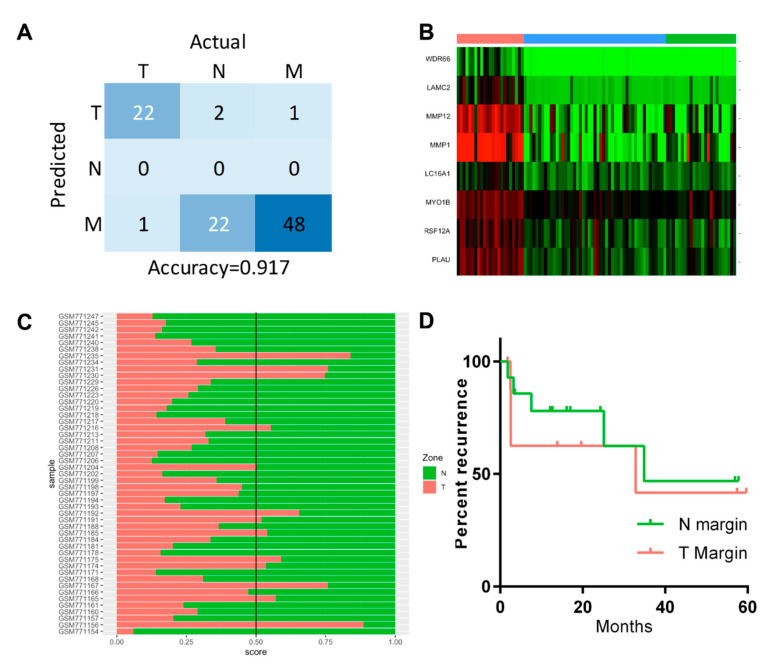
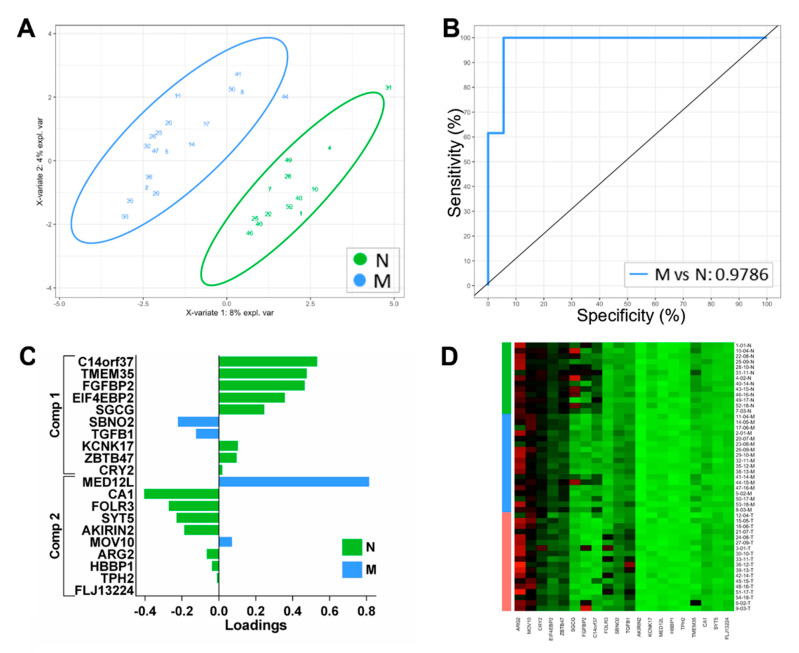
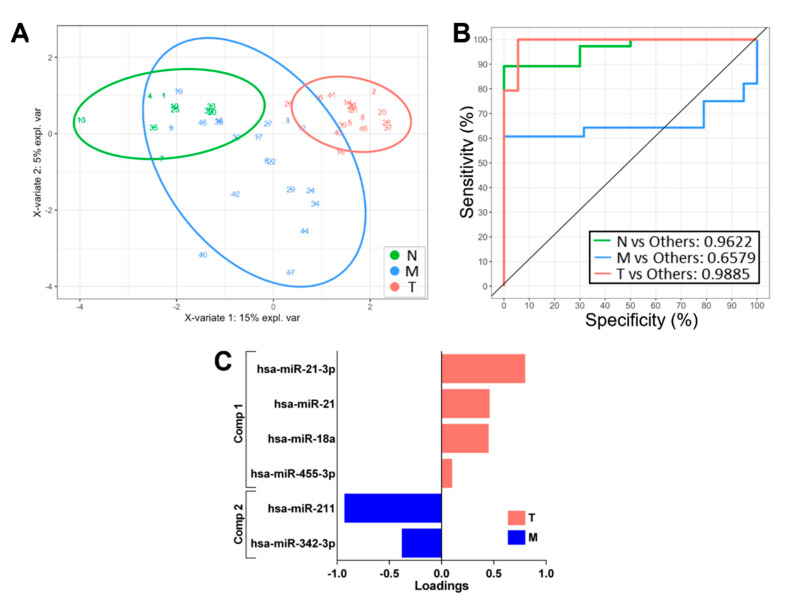
Relapse after surgery for oral squamous cell carcinoma (OSCC) contributes significantly to morbidity, mortality and poor outcomes. The current histopathological diagnostic techniques are insufficiently sensitive for the detection of oral cancer and minimal residual disease in surgical margins. We used whole-transcriptome gene expression and small noncoding RNA profiles from tumour, close margin and distant margin biopsies from 18 patients undergoing surgical resection for OSCC. By applying multivariate regression algorithms (sPLS-DA) suitable for higher dimension data, we objectively identified biomarker signatures for tumour and marginal tissue zones. We were able to define molecular signatures that discriminated tumours from the marginal zones and between the close and distant margins. These signatures included genes not previously associated with OSCC, such as , and For discrimination of the normal and tumour sampling zones, we were able to derive an effective gene-based classifying model for molecular abnormality based on a panel of eight genes (, , , , , , and ). We demonstrated the classification performance of these gene signatures in an independent validation dataset of OSCC tumour and marginal gene expression profiles. These biomarker signatures may contribute to the earlier detection of tumour cells and complement existing surgical and histopathological techniques used to determine clear surgical margins.
口腔鳞状细胞癌 (OSCC) 手术后的复发极大地导致发病率、死亡率和不良预后。目前的组织病理学诊断技术对于检测口腔癌和手术切缘的微小残留疾病不够敏感。我们使用来自 18 名接受 OSCC 手术切除的患者的肿瘤、近切缘和远切缘活检的全转录组基因表达和小非编码 RNA 谱。通过应用适用于高维数据的多变量回归算法 (sPLS-DA),我们客观地确定了肿瘤和边缘组织区域的生物标志物特征。我们能够定义区分肿瘤与边缘区域以及近切缘和远切缘的分子特征。这些特征包括以前与 OSCC 无关的基因,如 、 和 。为了区分正常和肿瘤采样区域,我们能够基于一组八个基因( 、 、 、 、 、 和 )推导出一个有效的基于基因的分子异常分类模型。我们在独立的 OSCC 肿瘤和边缘基因表达谱验证数据集中证明了这些基因特征的分类性能。这些生物标志物特征可能有助于更早地检测肿瘤细胞,并补充用于确定明确手术切缘的现有手术和组织病理学技术。