Veeraiyan Deepak Nallaswamy, Varghese Sheeja S, Rajasekar Arvina, Karobari Mohmed Isaqali, Thangavelu Lakshmi, Marya Anand, Messina Pietro, Scardina Giuseppe Alessandro
Department of Prosthodontics, Saveetha Dental College and Hospitals, Saveetha Institute of Medical and Technical Sciences, Chennai 600077, India.
Department of Periodontology, Saveetha Dental College and Hospitals, Saveetha Institute of Medical and Technical Sciences, Chennai 600077, India.
Int J Environ Res Public Health. 2022 Mar 8;19(6):3170. doi: 10.3390/ijerph19063170.
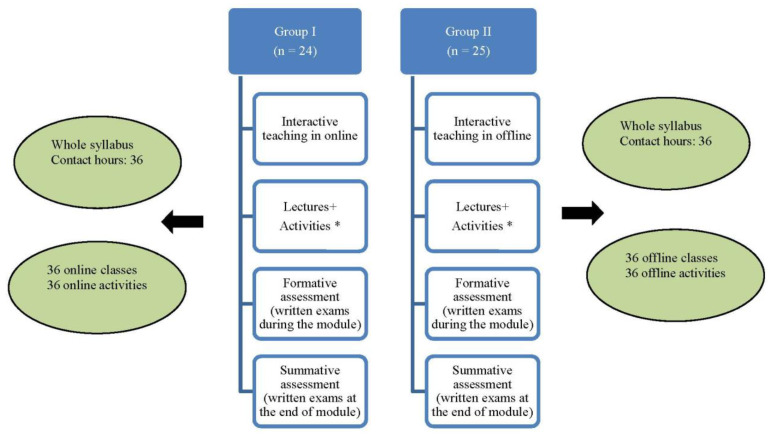
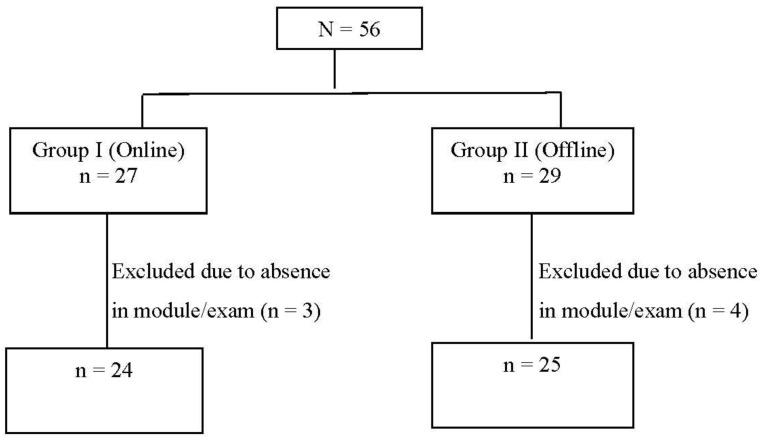
In recent years, the educational system has focused more on the holistic development of an individual. Modern technology has changed the educational environment to provide students with better academic opportunities. Along with the education system, teaching techniques and learning tools have also changed with digital evolution. This research was undertaken to assess the academic performance of interactive teaching methods in offline and online platforms in Periodontics among BDS undergraduates at a dental college in India. This prospective study was conducted among 49 students: Group I (n = 24, online class through Zoom) and Group II (n = 25, offline classes). The subject was divided into three modules and was covered in one week. The topics covered, teaching methods, lectures, and activities were similar for both groups. A formative assessment mark was obtained from written tests during the module, whereas the summative assessment mark was recorded from exams conducted towards the end of the module. In the results, a statistically significant difference was not observed in terms of formative assessment between Group I (77.88 ± 12.89) and Group II (77.80 ± 16.09) ( = 0.98). In addition, a statistically significant difference was not observed in terms of summative assessment between Group I (80.54 ± 8.39) and Group II (80.28 ± 11.57) ( = 0.93). Overall, this study suggests that interactive teaching methods in both offline and online platforms in Periodontics showed equivalent performance by the undergraduate dental students.
近年来,教育系统更加注重个人的全面发展。现代技术改变了教育环境,为学生提供了更好的学术机会。随着教育系统的发展,教学技术和学习工具也随着数字技术的演变而发生了变化。本研究旨在评估印度一所牙科学院的口腔医学本科学生在牙周病学线下和线上平台上采用互动教学方法后的学业表现。这项前瞻性研究在49名学生中进行:第一组(n = 24,通过Zoom进行在线课程)和第二组(n = 25,线下课程)。该课程分为三个模块,在一周内完成。两组的授课主题、教学方法、讲座和活动均相似。在模块学习期间,通过笔试获得形成性评估分数,而总结性评估分数则记录在模块结束时进行的考试中。结果显示,第一组(77.88 ± 12.89)和第二组(77.80 ± 16.09)在形成性评估方面未观察到统计学上的显著差异(P = 0.98)。此外,第一组(80.54 ± 8.39)和第二组(80.28 ± 11.57)在总结性评估方面也未观察到统计学上的显著差异(P = 0.93)。总体而言,本研究表明,牙周病学线下和线上平台的互动教学方法在口腔医学本科学生中表现相当。