Tobacco and Volatiles Branch, Division of Laboratory Sciences, National Center for Environmental Health, Centers for Disease Control and Prevention, Atlanta, GA 30341, USA.
Oak Ridge Institute for Science and Education (ORISE), Oak Ridge, TN 37830, USA.
Int J Environ Res Public Health. 2022 Mar 19;19(6):3660. doi: 10.3390/ijerph19063660.
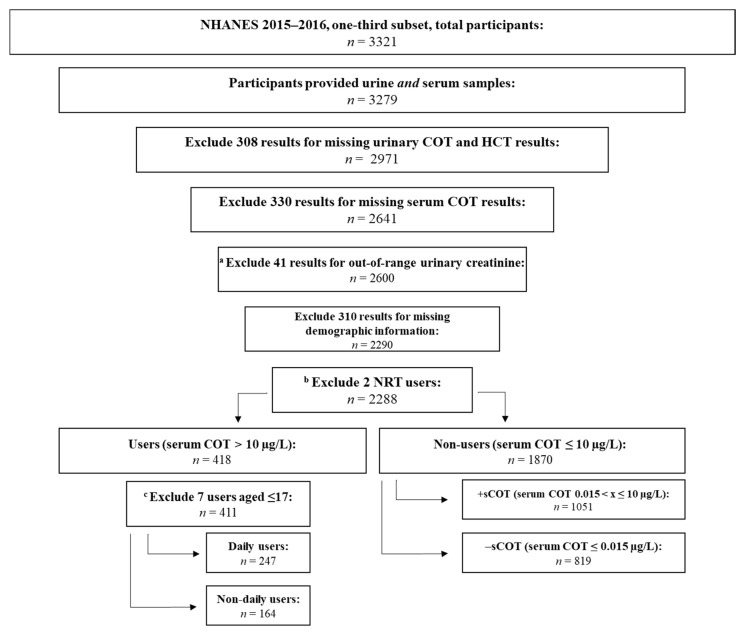
We characterize nicotine exposure in the U.S. population by measuring urinary nicotine and its major (cotinine, trans-3′-hydroxycotinine) and minor (nicotine 1′-oxide, cotinine N-oxide, and 1-(3-pyridyl)-1-butanol-4-carboxylic acid, nornicotine) metabolites in participants from the 2015−2016 National Health and Nutrition Examination Survey. This is one of the first U.S. population-based urinary nicotine biomarker reports using the derived total nicotine equivalents (i.e., TNEs) to characterize exposure. Serum cotinine data is used to stratify tobacco non-users with no detectable serum cotinine (−sCOT), non-users with detectable serum cotinine (+sCOT), and individuals who use tobacco (users). The molar concentration sum of cotinine and trans-3′-hydroxycotinine was calculated to derive the TNE2 for non-users. Additionally, for users, the molar concentration sum of nicotine and TNE2 was calculated to derive the TNE3, and the molar concentration sum of the minor metabolites and TNE3 was calculated to derive the TNE7. Sample-weighted summary statistics are reported. We also generated multiple linear regression models to analyze the association between biomarker concentrations and tobacco use status, after adjusting for select demographic factors. We found TNE7 is positively correlated with TNE3 and TNE2 (r = 0.99 and 0.98, respectively), and TNE3 is positively correlated with TNE2 (r = 0.98). The mean TNE2 concentration was elevated for the +sCOT compared with the −sCOT group (0.0143 [0.0120, 0.0172] µmol/g creatinine and 0.00188 [0.00172, 0.00205] µmol/g creatinine, respectively), and highest among users (33.5 [29.6, 37.9] µmol/g creatinine). Non-daily tobacco use was associated with 50% lower TNE7 concentrations (p < 0.0001) compared with daily use. In this report, we show tobacco use frequency and passive exposure to nicotine are important sources of nicotine exposure. Furthermore, this report provides more information on non-users than a serum biomarker report, which underscores the value of urinary nicotine biomarkers in extending the range of trace-level exposures that can be characterized.
我们通过测量美国人群尿液中的尼古丁及其主要代谢物(可替宁、反式-3'-羟基可替宁)和次要代谢物(尼古丁 1'-氧化物、可替宁 N-氧化物和 1-(3-吡啶基)-1-丁醇-4-羧酸、去甲烟碱)来描述尼古丁暴露情况。这是首次使用衍生的总尼古丁等效物(即 TNE)来描述美国人群尿液尼古丁生物标志物暴露情况的报告之一。使用血清可替宁数据对非吸烟者进行分层,将没有检测到血清可替宁(-sCOT)的非吸烟者、检测到血清可替宁(+sCOT)的非吸烟者和使用烟草的个体(使用者)区分开来。计算可替宁和反式-3'-羟基可替宁的摩尔浓度总和,以得出非使用者的 TNE2。此外,对于使用者,计算尼古丁和 TNE2 的摩尔浓度总和以得出 TNE3,计算次要代谢物和 TNE3 的摩尔浓度总和以得出 TNE7。报告了样本加权汇总统计数据。我们还生成了多元线性回归模型,以在调整了选定的人口统计学因素后,分析生物标志物浓度与烟草使用状况之间的关联。我们发现 TNE7 与 TNE3 和 TNE2 呈正相关(r 值分别为 0.99 和 0.98),而 TNE3 与 TNE2 呈正相关(r 值为 0.98)。与-sCOT 组相比,+sCOT 组的 TNE2 浓度更高(0.0143[0.0120,0.0172]µmol/g 肌酐和 0.00188[0.00172,0.00205]µmol/g 肌酐),而使用者的浓度最高(33.5[29.6,37.9]µmol/g 肌酐)。与每日使用相比,非每日吸烟与 TNE7 浓度降低 50%相关(p<0.0001)。在本报告中,我们表明吸烟频率和被动接触尼古丁是尼古丁暴露的重要来源。此外,本报告提供了比血清生物标志物报告更多的非使用者信息,这突出了尿液尼古丁生物标志物在扩展可描述的痕量暴露范围方面的价值。