Office on Smoking and Health, National Center for Chronic Disease Prevention and Health Promotion, Centers for Disease Control and Prevention, 4770 Buford Highway, MS S107-7, Atlanta, GA, 30341. E-mail:
Office on Smoking and Health, National Center for Chronic Disease Prevention and Health Promotion, Centers for Disease Control and Prevention, Atlanta, Georgia.
Prev Chronic Dis. 2019 Apr 4;16:E42. doi: 10.5888/pcd16.180531.
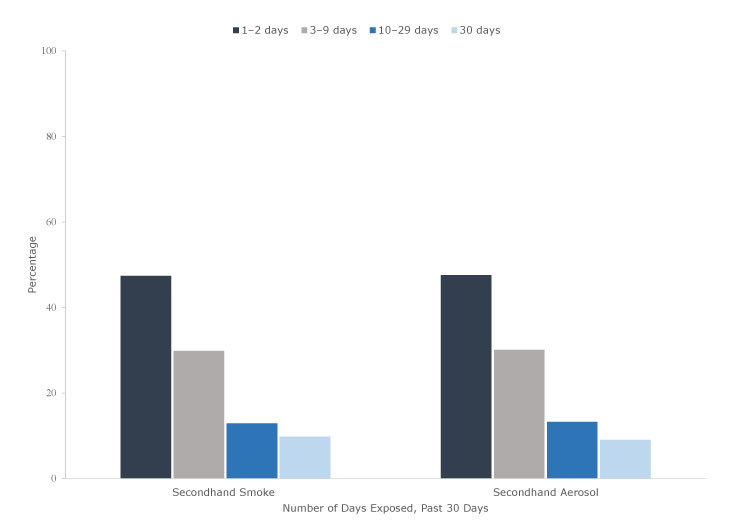
Youth exposure to secondhand smoke (SHS) and secondhand aerosol from e-cigarettes (SHA) may contribute to the renormalization of tobacco product use behaviors. Our study assessed self-reported SHS or SHA exposures in indoor or outdoor public places among US students.
Data came from the 2015 and 2017 National Youth Tobacco Survey, a school-based survey of US students in grades 6 through 12. Past 30-day exposure to SHS and SHA in indoor and outdoor public places was assessed. The prevalence of exposure was assessed overall and by covariates for each year. We used adjusted prevalence ratios (aPRs) to assess determinants of exposure.
We observed no significant change from 2015 through 2017 in exposure to SHS (52.6% to 50.5%), SHA (25.2% to 25.6%), or either SHS or SHA (56.7% to 55.1%). Following multivariable adjustment, in 2017, exposure to either SHS or SHA in public was higher among female students versus male students (aPR = 1.29), high school students versus middle school students (aPR = 1.15), current e-cigarette users versus nonusers (aPR = 2.89), and current users of other tobacco product versus nonusers (aPR = 1.21). Exposure was higher for students who reported that a household member used tobacco products.
In 2017, more than half (55.1%, 14.3 million) of US middle and high school students reported exposure to secondhand tobacco product emissions in indoor or outdoor public places. E-cigarette use may complicate the enforcement of existing smoke-free policies and contribute to the renormalization of tobacco use behaviors. Continued efforts are warranted to reduce the social acceptability of tobacco product use and protect bystanders from all tobacco product emissions.
青少年接触二手烟(SHS)和电子烟二手气溶胶(SHA)可能会导致烟草制品使用行为的正常化。我们的研究评估了美国学生在室内或室外公共场所报告的 SHS 或 SHA 暴露情况。
数据来自于 2015 年和 2017 年的全国青少年烟草调查,这是一项对美国 6 至 12 年级学生进行的基于学校的调查。评估了过去 30 天在室内和室外公共场所接触 SHS 和 SHA 的情况。总体上评估了暴露的流行率,并按每年的协变量进行了评估。我们使用调整后的患病率比(aPR)来评估暴露的决定因素。
我们没有观察到 2015 年至 2017 年 SHS(52.6%至 50.5%)、SHA(25.2%至 25.6%)或 SHS 和 SHA (56.7%至 55.1%)暴露率的显著变化。经过多变量调整后,2017 年,与男性学生相比,女性学生(aPR = 1.29)、高中生(aPR = 1.15)、当前电子烟使用者(aPR = 2.89)和当前使用其他烟草制品者(aPR = 1.21)在公共场所接触 SHS 或 SHA 的比例更高。报告有家庭成员使用烟草制品的学生暴露率更高。
2017 年,超过一半(55.1%,1430 万)的美国中学生和高中生报告在室内或室外公共场所接触二手烟草制品排放物。电子烟的使用可能会使现有的禁烟政策难以执行,并导致烟草使用行为的正常化。需要继续努力减少对烟草制品使用的社会接受度,并保护旁观者免受所有烟草制品排放物的侵害。