Spies Monika, Geyer Kristina, Raab Roxana, Brandt Stephanie, Meyer Dorothy, Günther Julia, Hoffmann Julia, Hauner Hans
Institute of Nutritional Medicine, Else Kröner-Fresenius-Centre for Nutritional Medicine, School of Medicine, Technical University of Munich, Georg-Brauchle-Ring 62, 80992 Munich, Germany.
Centre for Hormonal Disorders in Children and Adolescents, Division of Paediatric Endocrinology and Diabetes, Department of Paediatrics and Adolescent Medicine, Ulm University Medical Centre, Eythstraße 24, 89075 Ulm, Germany.
J Clin Med. 2022 Mar 18;11(6):1688. doi: 10.3390/jcm11061688.
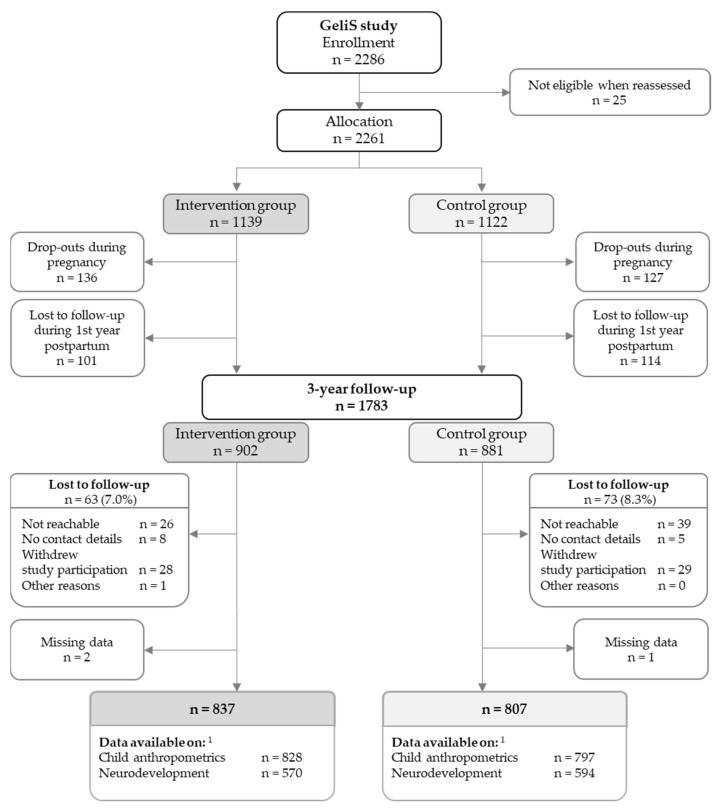
Maternal characteristics around pregnancy may influence obesity risk and neurodevelopment in children. To date, the effect of antenatal lifestyle interventions on long-term child development is unclear. The objective was to investigate the potential long-term effects of an antenatal lifestyle intervention programme conducted alongside routine care on child anthropometrics and neurodevelopment up to 3 years of age. Mother-child pairs from the cluster-randomised GeliS trial were followed up to 3 years of age. Data on child anthropometrics in both groups were collected from routine health examinations. Neurodevelopment was assessed via questionnaire. Of the 2286 study participants, 1644 mother-child pairs were included in the analysis. Children from the intervention group were less likely to score below the cut-off in Fine motor (p = 0.002), and more likely to have a score below the cut-off in Problem-solving (p < 0.001) compared to the control group at 3 years of age. Mean weight, height, head circumference, body mass index, and the respective z-scores and percentiles were comparable between the groups at 2 and 3 years of age. We found no evidence that the lifestyle intervention affected offspring development up to 3 years of age. Further innovative intervention approaches are required to improve child health in the long-term.
孕期前后的母体特征可能会影响儿童肥胖风险和神经发育。迄今为止,产前生活方式干预对儿童长期发育的影响尚不清楚。本研究的目的是调查在常规护理基础上开展的产前生活方式干预项目对3岁以下儿童人体测量学指标和神经发育的潜在长期影响。对整群随机分组的GeliS试验中的母婴对随访至3岁。两组儿童的人体测量学数据均来自常规健康检查。通过问卷调查评估神经发育情况。在2286名研究参与者中,1644对母婴被纳入分析。与对照组相比,干预组儿童在3岁时精细运动得分低于临界值的可能性较小(p = 0.002),而解决问题得分低于临界值的可能性较大(p < 0.001)。在2岁和3岁时,两组儿童的平均体重、身高、头围、体重指数以及各自的z评分和百分位数相当。我们没有发现证据表明生活方式干预会影响3岁以下后代的发育。需要进一步创新干预方法以长期改善儿童健康。