The Robinson Research Institute, Discipline of Obstetrics and Gynaecology, The University of Adelaide, Adelaide, South Australia, Australia.
Women's and Babies Division, Department of Perinatal Medicine, The Women's and Children's Hospital, 72 King William Road, Adelaide, South Australia, 5006, Australia.
BMC Med. 2021 Jun 2;19(1):128. doi: 10.1186/s12916-021-01995-6.
The impact of maternal obesity extends beyond birth, being independently associated with an increased risk of child obesity. Current evidence demonstrates that women provided with a dietary intervention during pregnancy improve their dietary quality and have a modest reduction in gestational weight gain. However, the effect of this on longer-term childhood obesity-related outcomes is unknown.
We conducted an individual participant data meta-analysis from RCTs in which women with a singleton, live gestation between 10 and 20 weeks and body mass index (BMI) ≥ 25 kg/m in early pregnancy were randomised to a diet and/or lifestyle intervention or continued standard antenatal care and in which longer-term maternal and child follow-up at 3-5 years of age had been undertaken. The primary childhood outcome was BMI z-score above the 90th percentile. Secondary childhood outcomes included skinfold thickness measurements and body circumferences, fat-free mass, dietary and physical activity patterns, blood pressure, and neurodevelopment.
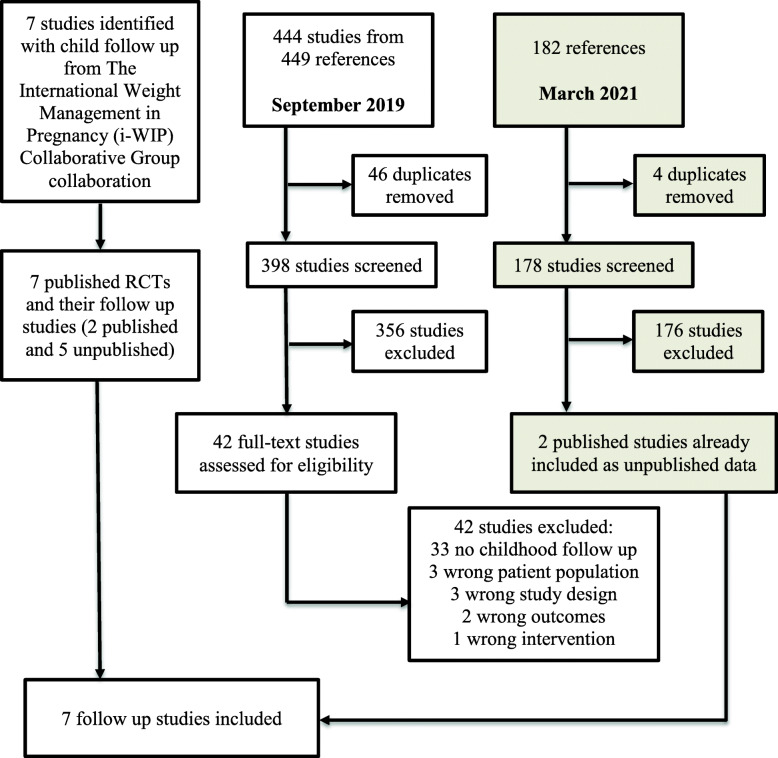
Seven primary trials where follow-up of participants occurred were identified by a systematic literature search within the International Weight Management in Pregnancy (i-WIP) Collaborative Group collaboration, with six providing individual participant data. No additional studies were identified after a systematic literature search. A total of 2529 children and 2383 women contributed data. Approximately 30% of all child participants had a BMI z-score above the 90th percentile, with no significant difference between the intervention and control groups (aRR 0.97; 95% CI 0.87, 1.08; p=0.610). There were no statistically significant differences identified for any of the secondary outcome measures.
In overweight and obese pregnant women, we found no evidence that maternal dietary and/or lifestyle intervention during pregnancy modifies the risk of early childhood obesity. Future research may need to target the pre-conception period in women and early childhood interventions.
PROSPERO, CRD42016047165.
母亲肥胖的影响不仅限于出生时,还与儿童肥胖的风险增加独立相关。目前的证据表明,在怀孕期间接受饮食干预的女性可以改善其饮食质量,并适度减少妊娠体重增加。然而,这种干预对长期儿童肥胖相关结果的影响尚不清楚。
我们对国际妊娠体重管理(i-WIP)协作组的随机对照试验进行了个体参与者数据荟萃分析,其中 10 至 20 周单胎、活产且孕早期 BMI(体重指数)≥25kg/m2 的女性被随机分配到饮食和/或生活方式干预组或继续接受标准产前护理组,并且对这些女性及其子女进行了 3-5 岁的长期随访。主要儿童结局是 BMI 超过第 90 百分位的 z 分数。次要儿童结局包括皮褶厚度测量和身体围度、去脂体重、饮食和体力活动模式、血压和神经发育。
通过国际妊娠体重管理(i-WIP)协作组的系统文献搜索,确定了 7 项进行了参与者随访的主要试验,其中 6 项提供了个体参与者数据。在系统文献搜索后,没有发现其他研究。共有 2529 名儿童和 2383 名妇女提供了数据。大约 30%的所有儿童参与者的 BMI z 分数超过第 90 百分位,干预组和对照组之间没有显著差异(aRR 0.97;95%CI 0.87,1.08;p=0.610)。对于任何次要结局测量,都没有发现统计学上的显著差异。
在超重和肥胖的孕妇中,我们没有发现证据表明,怀孕期间的母亲饮食和/或生活方式干预可以改变儿童早期肥胖的风险。未来的研究可能需要针对女性的受孕前阶段和儿童早期干预。
PROSPERO,CRD42016047165。