Vaidya Milind, Dmello Crismita, Mogre Saie
Vaidya Laboratory, Advanced Centre for Treatment, Research and Education in Cancer (ACTREC), Tata Memorial Centre (TMC), Kharghar, Navi Mumbai 410210, India.
Department of Neurological Surgery, Northwestern Medicine Lou and Jean Malnati Brain Tumor Institute, Robert H. Lurie Comprehensive Cancer Center, Feinberg School of Medicine, Northwestern University, Chicago, IL 60611, USA.
Life (Basel). 2022 Feb 25;12(3):343. doi: 10.3390/life12030343.
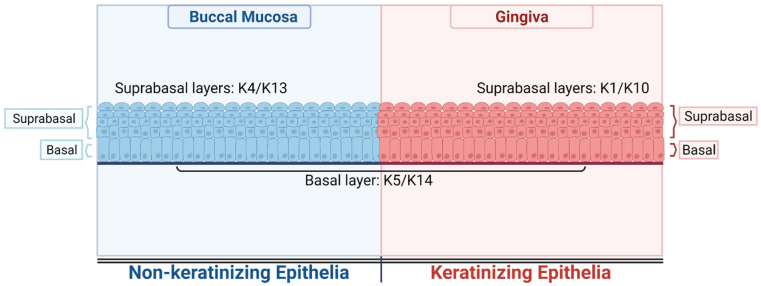
Human oral cancer is the single largest group of malignancies in the Indian subcontinent and the sixth largest group of malignancies worldwide. Squamous cell carcinomas (SCC) are the most common epithelial malignancy of the oral cavity, constituting over 90% of oral cancers. About 90% of OSCCs arise from pre-existing, potentially malignant lesions. According to WHO, OSCC has a 5-year survival rate of 45-60%. Late diagnosis, recurrence, and regional or lymph nodal metastases could be the main causes of the high mortality rates. Biomarkers may help categorize and predict premalignant lesions as high risk of developing malignancy, local recurrence, and lymph nodal metastasis. However, at present, there is a dearth of such markers, and this is an area of ongoing research. Keratins (K) or cytokeratins are a group of intermediate filament proteins that show paired and differentiation dependent expression. Our laboratory and others have shown consistent alterations in the expression patterns of keratins in both oral precancerous lesions and tumors. The correlation of these changes with clinicopathological parameters has also been demonstrated. Furthermore, the functional significance of aberrant keratins 8/18 expression in the malignant transformation and progression of oral tumors has also been documented. This article reviews the literature that emphasizes the value of keratins as biomarkers for the prognostication of human oral precancers and cancers.
口腔癌是印度次大陆最大的恶性肿瘤群体,也是全球第六大恶性肿瘤群体。鳞状细胞癌(SCC)是口腔最常见的上皮性恶性肿瘤,占口腔癌的90%以上。约90%的口腔鳞状细胞癌起源于先前存在的潜在恶性病变。根据世界卫生组织的数据,口腔鳞状细胞癌的5年生存率为45%-60%。诊断延迟、复发以及局部或淋巴结转移可能是高死亡率的主要原因。生物标志物可能有助于将癌前病变分类并预测其发展为恶性肿瘤、局部复发和淋巴结转移的高风险。然而,目前缺乏此类标志物,这是一个正在进行研究的领域。角蛋白(K)或细胞角蛋白是一组中间丝蛋白,其表达呈配对且依赖分化。我们实验室和其他研究表明,口腔癌前病变和肿瘤中角蛋白的表达模式存在一致的改变。这些变化与临床病理参数的相关性也已得到证实。此外,异常角蛋白8/18表达在口腔肿瘤恶性转化和进展中的功能意义也有文献记载。本文综述了强调角蛋白作为人类口腔癌前病变和癌症预后生物标志物价值的文献。