Chagas Oscar José, Nagatomo Priscila Paiva, Pereira-Chioccola Vera Lucia, Gava Ricardo, Buccheri Renata, Del Negro Gilda Maria Barbaro, Benard Gil
Laboratório de Investigação Médica em Micologia LIM53, Instituto de Medicina Tropical e Hospital das Clínicas, Faculdade de Medicina da Universidade de São Paulo, São Paulo 05403-000, Brazil.
Laboratório de Biologia Molecular de Parasitas e Fungos do Centro de Parasitologia e Micologia, Instituto Adolfo Lutz, São Paulo 01246-000, Brazil.
J Fungi (Basel). 2022 Feb 24;8(3):222. doi: 10.3390/jof8030222.
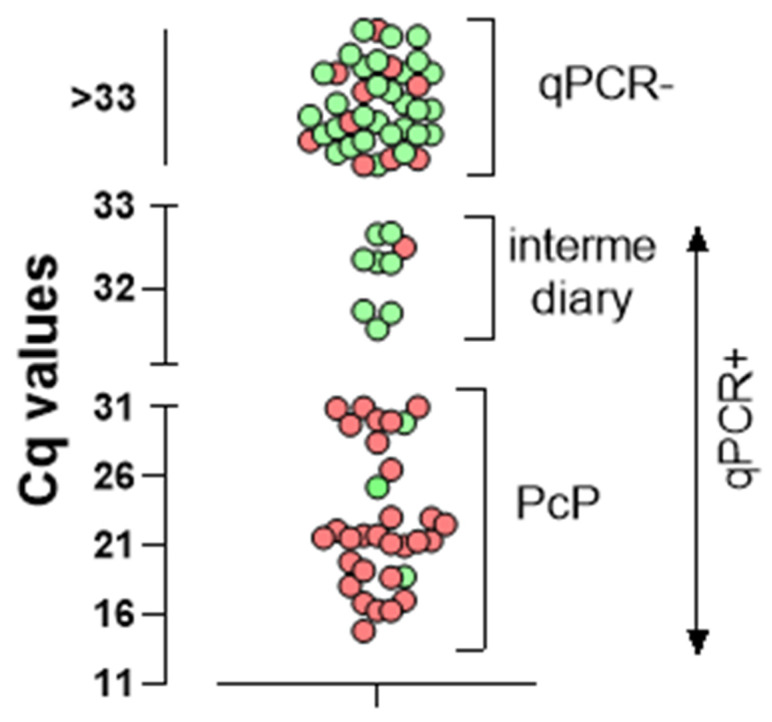
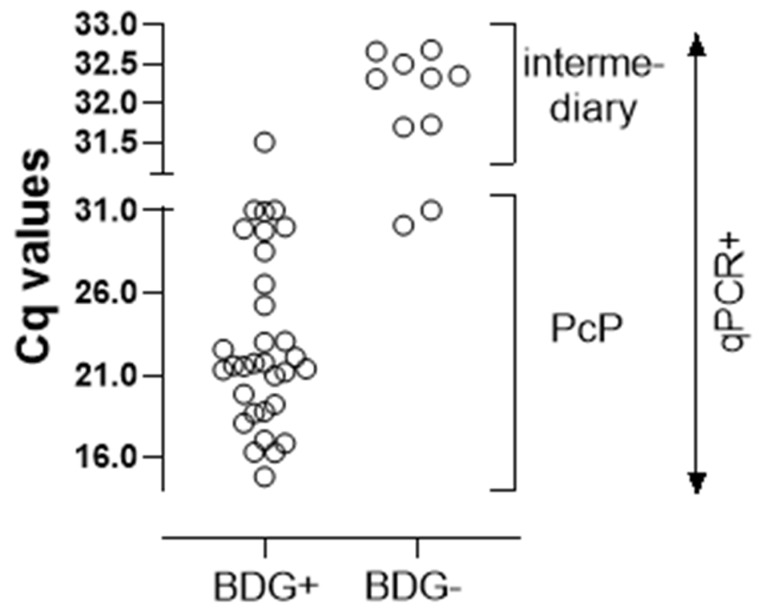
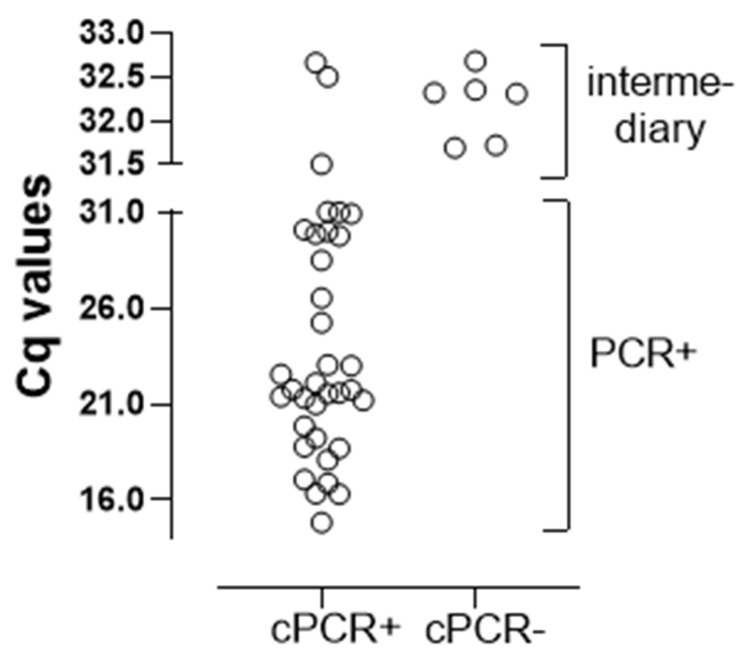
pneumonia (PcP) remains an important cause of morbimortality worldwide and a diagnostic challenge. Conventional methods have low accuracy, hardly discriminating colonization from infection, while some new high-cost or broncho-alveolar lavage-based methods have limited usefulness in developing countries. Quantitative PCR (qPCR) tests may overcome these limitations due to their high accuracy, possibility of automation, and decreasing cost. We evaluated an in-house qPCR targeting the fungus mtSSU gene using induced sputum. Sensitivity of the assay (ten target gene copies/assay) was determined using recombinant plasmids. We prospectively studied 86 AIDS patients with subacute respiratory symptoms in whom PcP was suspected. qPCR results were determined as quantification cycles (Cq) and compared with a qualitative PCR performed in the same IS, serum 1,3-β-D-Glucan assay, and a clinical/laboratory/radiology index for PcP. The qPCR clustered the patients in three groups: 32 with Cq ≤ 31 (qPCR+), 45 with Cq ≥ 33 (qPCR-), and nine with Cq between 31-33 (intermediary), which, combined with the other three analyses, enabled us to classify the groups as having PcP, not -infected, and -colonized, respectively. This molecular assay may contribute to improve PcP management, avoiding unnecessary treatments, and our knowledge of the natural history of this infection.
肺孢子菌肺炎(PcP)仍是全球发病和死亡的重要原因,也是一项诊断挑战。传统方法准确性低,难以区分定植与感染,而一些新的高成本或基于支气管肺泡灌洗的方法在发展中国家的实用性有限。定量聚合酶链反应(qPCR)检测可能因其高准确性、自动化可能性和成本降低而克服这些局限性。我们使用诱导痰评估了一种针对真菌线粒体小亚基(mtSSU)基因的内部qPCR检测方法。使用重组质粒确定该检测方法的灵敏度(每个检测10个靶基因拷贝)。我们前瞻性地研究了86例疑似PcP的亚急性呼吸道症状的艾滋病患者。qPCR结果以定量循环数(Cq)表示,并与在同一诱导痰、血清1,3-β-D-葡聚糖检测以及PcP的临床/实验室/放射学指标中进行的定性PCR结果进行比较。qPCR将患者分为三组:32例Cq≤31(qPCR阳性),45例Cq≥33(qPCR阴性),9例Cq在31-33之间(中间型),结合其他三项分析,我们能够分别将这些组分类为患有PcP、未感染和定植。这种分子检测方法可能有助于改善PcP的管理,避免不必要的治疗,并增进我们对这种感染自然史的了解。