Campain Anna, Hockham Carinna, Sukkar Louisa, Rogers Kris, Chow Clara K, Lung Thomas, Jun Min, Pollock Carol, Cass Alan, Sullivan David, Comino Elizabeth, Peiris David, Jardine Meg
The George Institute for Global Heath, UNSW, Sydney, NSW, Australia.
Faculty of Medicine, University of New South Wales, Sydney, NSW, Australia.
Front Pharmacol. 2022 Mar 7;13:834898. doi: 10.3389/fphar.2022.834898. eCollection 2022.
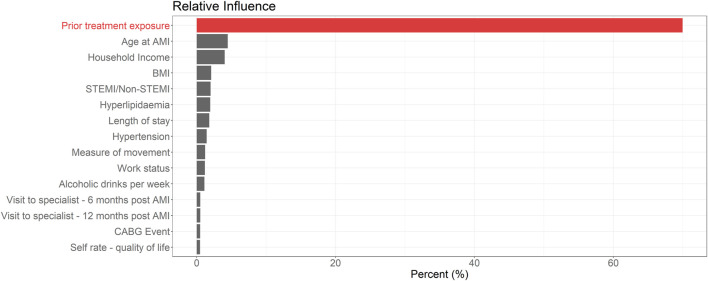
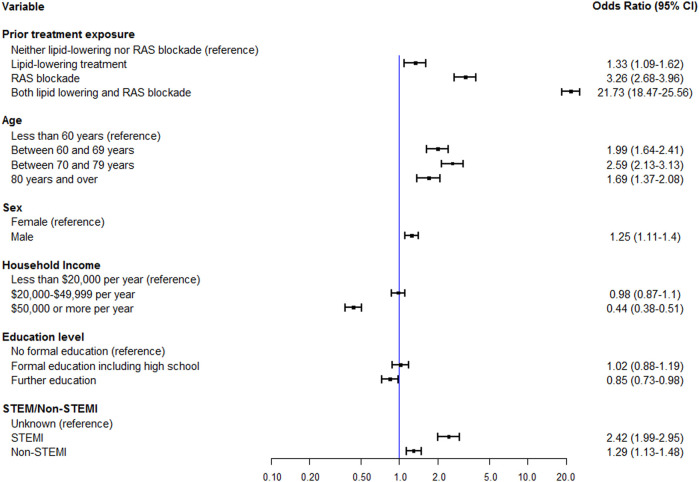
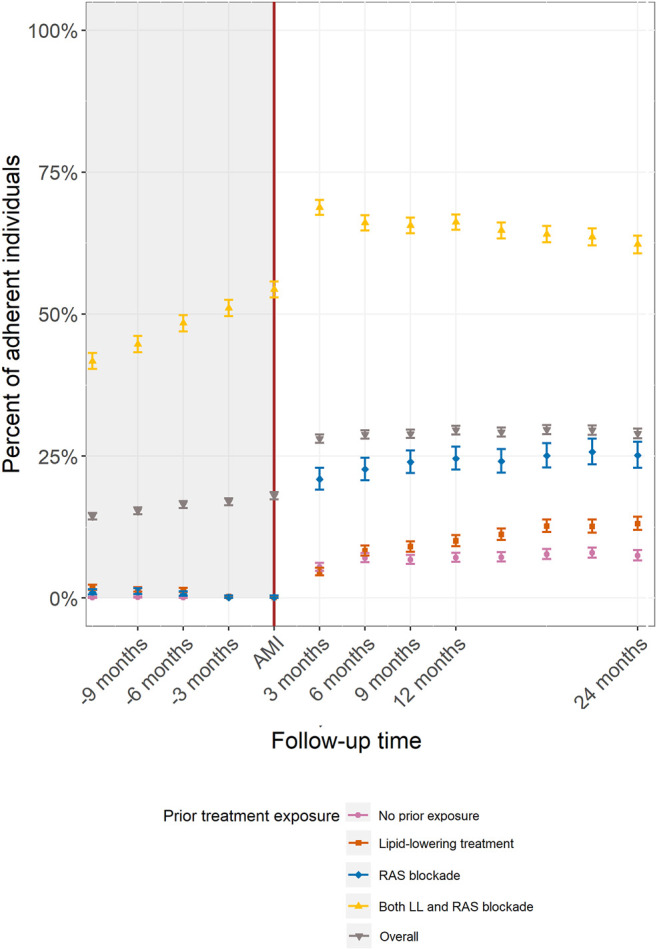
To investigate long-term adherence to guideline-recommended cardioprotective medications following hospitalization for an acute myocardial infarction (AMI), and identify characteristics associated with adherence. An Australian population-based cohort study was used to identify participants who had their first AMI between 2006 and 2014 and were alive after 12 months. Linked routinely collected hospital, and prescription medication claims data was used to study adherence over time. Predictors and rates of adherence to both lipid-lowering medication and renin-angiotensin system blockade at 12 months post-AMI was assessed. 14,200 people (mean age 69.9 years, 38.7% female) were included in our analysis. At 12 months post-AMI, 29.5% (95% CI: 28.8-30.3%) of people were adherent to both classes of medication. Individuals receiving treatment with both lipid-lowering medication and renin-angiotensin system blockade during the 6 months prior to their AMI were over 9 times more likely to be adherent to both medications at 12 months post-AMI (66.2% 95% CI: 64.8-67.5%) compared to those with no prior medication use (treatment naïve) (7.1%, 95% CI: 6.4-7.9%). Prior cardiovascular treatment was the strongest predictor of long-term adherence even after adjusting for age, sex, education and income. Despite efforts to improve long-term medication adherence in patients who have experienced an acute coronary event, considerable gaps remain. Of particular concern are people who are commencing guideline-recommended cardioprotective medication at the time of their AMI. The relationship between prior cardiovascular treatments and post AMI adherence offers insight into the support needs for the patient. Health care intervention strategies, strengthened by enabling policies, are needed to provide support to patients through the initial months following their AMI.
为调查急性心肌梗死(AMI)住院后对指南推荐的心脏保护药物的长期依从性,并确定与依从性相关的特征。采用一项基于澳大利亚人群的队列研究来确定在2006年至2014年间首次发生AMI且12个月后仍存活的参与者。利用常规收集的医院和处方药报销数据来研究随时间的依从性。评估AMI后12个月时降脂药物和肾素-血管紧张素系统阻滞剂的依从性预测因素和依从率。我们的分析纳入了14200人(平均年龄69.9岁,女性占38.7%)。AMI后12个月时,29.5%(95%CI:28.8 - 30.3%)的人同时坚持服用这两类药物。在AMI前6个月接受降脂药物和肾素-血管紧张素系统阻滞剂治疗的个体,与未使用过药物(初治)的个体相比,在AMI后12个月时同时坚持服用这两种药物的可能性高出9倍多(66.2%,95%CI:64.8 - 67.5%)(7.1%,95%CI:6.4 - 7.9%)。即使在调整年龄、性别、教育程度和收入后,先前的心血管治疗仍是长期依从性的最强预测因素。尽管努力提高急性冠脉事件患者的长期药物依从性,但仍存在相当大的差距。特别令人担忧的是在AMI时开始使用指南推荐的心脏保护药物的人群。先前心血管治疗与AMI后依从性之间的关系为了解患者的支持需求提供了线索。需要通过有利政策加强的医疗保健干预策略,在AMI后的最初几个月为患者提供支持。