Centre for Cellular and Molecular Research, Saveetha Dental College and Hospitals, Saveetha Institute of Medical and Technical Sciences (SIMATS), Saveetha University, Chennai, Tamil Nadu, 600077, India.
School of Pharmacy and Biomolecular Sciences, Liverpool John Moores University, Liverpool, UK.
Mol Cancer. 2022 Mar 24;21(1):83. doi: 10.1186/s12943-022-01565-1.
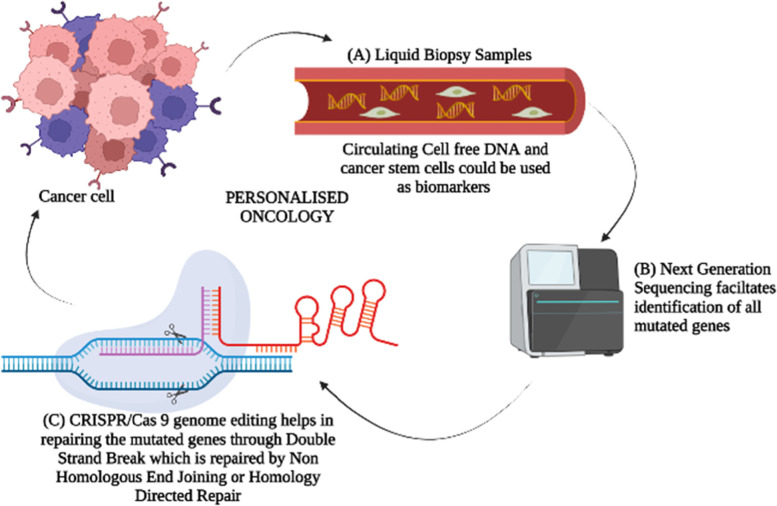
Cancer is caused by a combination of genetic and epigenetic abnormalities. Current cancer therapies are limited due to the complexity of their mechanism, underlining the need for alternative therapeutic approaches. Interestingly, combining the Clustered Regularly Interspaced Short Palindromic Repeats (CRISPR/Cas9) system with next-generation sequencing (NGS) has the potential to speed up the identification, validation, and targeting of high-value targets.
Personalized or precision medicine combines genetic information with phenotypic and environmental characteristics to produce healthcare tailored to the individual and eliminates the constraints of "one-size-fits-all" therapy. Precision medicine is now possible thanks to cancer genome sequencing. Having advantages over limited sample requirements and the recent development of biomarkers have made the use of NGS a major leap in personalized medicine. Tumor and cell-free DNA profiling using NGS, proteome and RNA analyses, and a better understanding of immunological systems, are all helping to improve cancer treatment choices. Finally, direct targeting of tumor genes in cancer cells with CRISPR/Cas9 may be achievable, allowing for eliminating genetic changes that lead to tumor growth and metastatic capability.
With NGS and CRISPR/Cas9, the goal is no longer to match the treatment for the diagnosed tumor but rather to build a treatment method that fits the tumor exactly. Hence, in this review, we have discussed the potential role of CRISPR/Cas9 and NGS in advancing personalized medicine.
癌症是由遗传和表观遗传异常共同引起的。由于其机制复杂,目前的癌症疗法受到限制,这突显了需要替代的治疗方法。有趣的是,将 Clustered Regularly Interspaced Short Palindromic Repeats(CRISPR/Cas9)系统与下一代测序(NGS)相结合,有可能加快有价值靶点的鉴定、验证和靶向。
个性化或精准医学将遗传信息与表型和环境特征相结合,为个体量身定制医疗保健,消除了“一刀切”治疗的限制。由于癌症基因组测序,现在可以实现精准医学。与有限的样本要求相比具有优势,并且最近生物标志物的发展,使得 NGS 的使用成为个性化医学的重大飞跃。使用 NGS 进行肿瘤和无细胞 DNA 分析、蛋白质组和 RNA 分析,以及更好地了解免疫系统,都有助于改善癌症治疗选择。最后,使用 CRISPR/Cas9 直接靶向癌细胞中的肿瘤基因,可能能够消除导致肿瘤生长和转移能力的遗传变化。
通过 NGS 和 CRISPR/Cas9,目标不再是匹配诊断出的肿瘤的治疗方法,而是构建一种完全适合肿瘤的治疗方法。因此,在这篇综述中,我们讨论了 CRISPR/Cas9 和 NGS 在推进个性化医学中的潜在作用。