• 文献检索
  • 文档翻译
  • 深度研究
  • 学术资讯
  • Suppr Zotero 插件Zotero 插件
  • 邀请有礼
  • 套餐&价格
  • 历史记录
应用&插件
Suppr Zotero 插件Zotero 插件浏览器插件Mac 客户端Windows 客户端微信小程序
定价
高级版会员购买积分包购买API积分包
服务
文献检索文档翻译深度研究API 文档MCP 服务
关于我们
关于 Suppr公司介绍联系我们用户协议隐私条款
关注我们

Suppr 超能文献

核心技术专利:CN118964589B侵权必究
粤ICP备2023148730 号-1Suppr @ 2026

文献检索

告别复杂PubMed语法,用中文像聊天一样搜索,搜遍4000万医学文献。AI智能推荐,让科研检索更轻松。

立即免费搜索

文件翻译

保留排版,准确专业,支持PDF/Word/PPT等文件格式,支持 12+语言互译。

免费翻译文档

深度研究

AI帮你快速写综述,25分钟生成高质量综述,智能提取关键信息,辅助科研写作。

立即免费体验

从目标结构设计蛋白质结合蛋白。

Design of protein-binding proteins from the target structure alone.

机构信息

Department of Biochemistry, University of Washington, Seattle, WA, USA.

Institute for Protein Design, University of Washington, Seattle, WA, USA.

出版信息

Nature. 2022 May;605(7910):551-560. doi: 10.1038/s41586-022-04654-9. Epub 2022 Mar 24.

DOI:10.1038/s41586-022-04654-9
PMID:35332283
原文链接:
https://pmc.ncbi.nlm.nih.gov/articles/PMC9117152/
Abstract

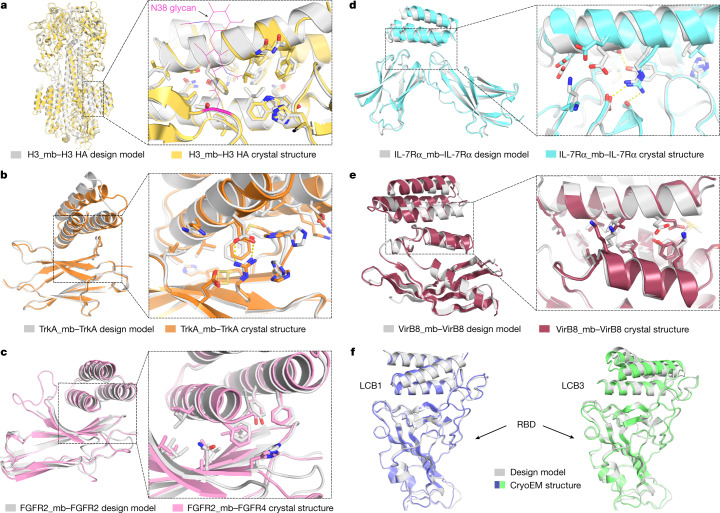
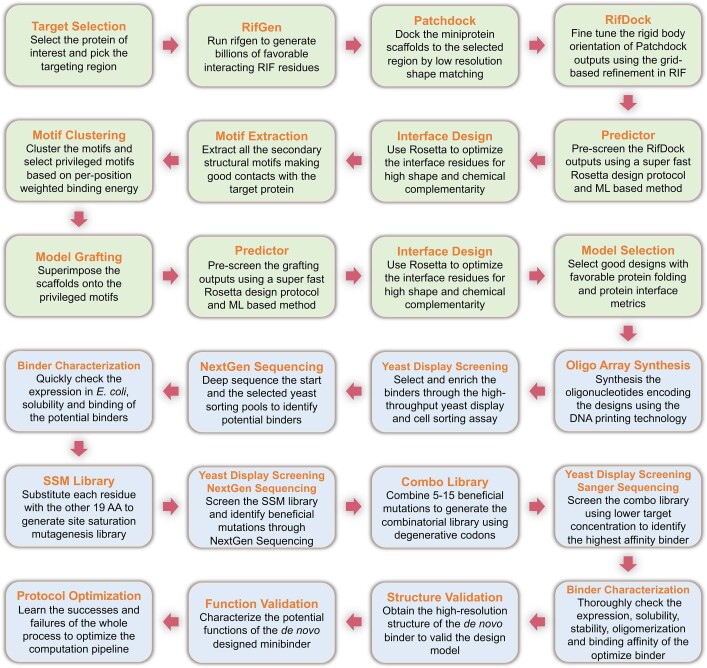
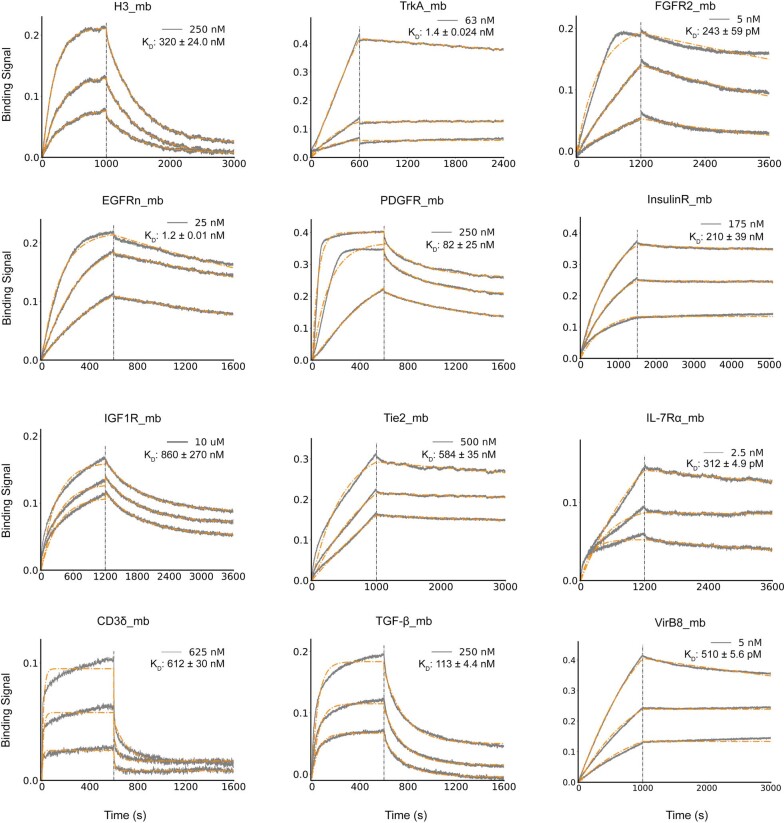
The design of proteins that bind to a specific site on the surface of a target protein using no information other than the three-dimensional structure of the target remains a challenge. Here we describe a general solution to this problem that starts with a broad exploration of the vast space of possible binding modes to a selected region of a protein surface, and then intensifies the search in the vicinity of the most promising binding modes. We demonstrate the broad applicability of this approach through the de novo design of binding proteins to 12 diverse protein targets with different shapes and surface properties. Biophysical characterization shows that the binders, which are all smaller than 65 amino acids, are hyperstable and, following experimental optimization, bind their targets with nanomolar to picomolar affinities. We succeeded in solving crystal structures of five of the binder-target complexes, and all five closely match the corresponding computational design models. Experimental data on nearly half a million computational designs and hundreds of thousands of point mutants provide detailed feedback on the strengths and limitations of the method and of our current understanding of protein-protein interactions, and should guide improvements of both. Our approach enables the targeted design of binders to sites of interest on a wide variety of proteins for therapeutic and diagnostic applications.

摘要

使用除目标蛋白质表面的三维结构之外的任何信息来设计与目标蛋白质表面的特定部位结合的蛋白质仍然是一个挑战。在这里,我们描述了一个通用的解决方案,该方案从对蛋白质表面选定区域的各种可能结合模式的广泛探索开始,然后在最有希望的结合模式附近加强搜索。我们通过从头设计与 12 种具有不同形状和表面特性的蛋白质靶标的结合蛋白来证明该方法的广泛适用性。生物物理特性表明,这些结合物均小于 65 个氨基酸,其稳定性很高,经过实验优化后,其对靶标的亲和力达到纳摩尔到皮摩尔级。我们成功地解决了其中五个结合物-靶标复合物的晶体结构,并且这五个结构都与相应的计算设计模型非常吻合。将近 50 万个计算设计和数十万个点突变的实验数据为该方法的优缺点以及我们目前对蛋白质-蛋白质相互作用的理解提供了详细的反馈,并且应该指导两者的改进。我们的方法能够针对各种蛋白质上的感兴趣的部位进行靶向设计结合物,用于治疗和诊断应用。
https://cdn.ncbi.nlm.nih.gov/pmc/blobs/5127/9117152/029e8a70ebc6/41586_2022_4654_Fig18_ESM.jpg
https://cdn.ncbi.nlm.nih.gov/pmc/blobs/5127/9117152/093c3650bc60/41586_2022_4654_Fig1_HTML.jpg
https://cdn.ncbi.nlm.nih.gov/pmc/blobs/5127/9117152/fb247d442ad2/41586_2022_4654_Fig2_HTML.jpg
https://cdn.ncbi.nlm.nih.gov/pmc/blobs/5127/9117152/c219dd307c16/41586_2022_4654_Fig3_HTML.jpg
https://cdn.ncbi.nlm.nih.gov/pmc/blobs/5127/9117152/2c903ee26243/41586_2022_4654_Fig4_HTML.jpg
https://cdn.ncbi.nlm.nih.gov/pmc/blobs/5127/9117152/71883a0c45ec/41586_2022_4654_Fig5_HTML.jpg
https://cdn.ncbi.nlm.nih.gov/pmc/blobs/5127/9117152/724507fdf065/41586_2022_4654_Fig6_ESM.jpg
https://cdn.ncbi.nlm.nih.gov/pmc/blobs/5127/9117152/0234cc5a5f1b/41586_2022_4654_Fig7_ESM.jpg
https://cdn.ncbi.nlm.nih.gov/pmc/blobs/5127/9117152/940777e38382/41586_2022_4654_Fig8_ESM.jpg
https://cdn.ncbi.nlm.nih.gov/pmc/blobs/5127/9117152/06516539df01/41586_2022_4654_Fig9_ESM.jpg
https://cdn.ncbi.nlm.nih.gov/pmc/blobs/5127/9117152/a539660a64d2/41586_2022_4654_Fig10_ESM.jpg
https://cdn.ncbi.nlm.nih.gov/pmc/blobs/5127/9117152/a725147db91c/41586_2022_4654_Fig11_ESM.jpg
https://cdn.ncbi.nlm.nih.gov/pmc/blobs/5127/9117152/f78b35b9b2c6/41586_2022_4654_Fig12_ESM.jpg
https://cdn.ncbi.nlm.nih.gov/pmc/blobs/5127/9117152/698ed35f7de6/41586_2022_4654_Fig13_ESM.jpg
https://cdn.ncbi.nlm.nih.gov/pmc/blobs/5127/9117152/a59fdf8fb2e1/41586_2022_4654_Fig14_ESM.jpg
https://cdn.ncbi.nlm.nih.gov/pmc/blobs/5127/9117152/20713155339b/41586_2022_4654_Fig15_ESM.jpg
https://cdn.ncbi.nlm.nih.gov/pmc/blobs/5127/9117152/cf4b52518d95/41586_2022_4654_Fig16_ESM.jpg
https://cdn.ncbi.nlm.nih.gov/pmc/blobs/5127/9117152/c3c517d60870/41586_2022_4654_Fig17_ESM.jpg
https://cdn.ncbi.nlm.nih.gov/pmc/blobs/5127/9117152/029e8a70ebc6/41586_2022_4654_Fig18_ESM.jpg
https://cdn.ncbi.nlm.nih.gov/pmc/blobs/5127/9117152/093c3650bc60/41586_2022_4654_Fig1_HTML.jpg
https://cdn.ncbi.nlm.nih.gov/pmc/blobs/5127/9117152/fb247d442ad2/41586_2022_4654_Fig2_HTML.jpg
https://cdn.ncbi.nlm.nih.gov/pmc/blobs/5127/9117152/c219dd307c16/41586_2022_4654_Fig3_HTML.jpg
https://cdn.ncbi.nlm.nih.gov/pmc/blobs/5127/9117152/2c903ee26243/41586_2022_4654_Fig4_HTML.jpg
https://cdn.ncbi.nlm.nih.gov/pmc/blobs/5127/9117152/71883a0c45ec/41586_2022_4654_Fig5_HTML.jpg
https://cdn.ncbi.nlm.nih.gov/pmc/blobs/5127/9117152/724507fdf065/41586_2022_4654_Fig6_ESM.jpg
https://cdn.ncbi.nlm.nih.gov/pmc/blobs/5127/9117152/0234cc5a5f1b/41586_2022_4654_Fig7_ESM.jpg
https://cdn.ncbi.nlm.nih.gov/pmc/blobs/5127/9117152/940777e38382/41586_2022_4654_Fig8_ESM.jpg
https://cdn.ncbi.nlm.nih.gov/pmc/blobs/5127/9117152/06516539df01/41586_2022_4654_Fig9_ESM.jpg
https://cdn.ncbi.nlm.nih.gov/pmc/blobs/5127/9117152/a539660a64d2/41586_2022_4654_Fig10_ESM.jpg
https://cdn.ncbi.nlm.nih.gov/pmc/blobs/5127/9117152/a725147db91c/41586_2022_4654_Fig11_ESM.jpg
https://cdn.ncbi.nlm.nih.gov/pmc/blobs/5127/9117152/f78b35b9b2c6/41586_2022_4654_Fig12_ESM.jpg
https://cdn.ncbi.nlm.nih.gov/pmc/blobs/5127/9117152/698ed35f7de6/41586_2022_4654_Fig13_ESM.jpg
https://cdn.ncbi.nlm.nih.gov/pmc/blobs/5127/9117152/a59fdf8fb2e1/41586_2022_4654_Fig14_ESM.jpg
https://cdn.ncbi.nlm.nih.gov/pmc/blobs/5127/9117152/20713155339b/41586_2022_4654_Fig15_ESM.jpg
https://cdn.ncbi.nlm.nih.gov/pmc/blobs/5127/9117152/cf4b52518d95/41586_2022_4654_Fig16_ESM.jpg
https://cdn.ncbi.nlm.nih.gov/pmc/blobs/5127/9117152/c3c517d60870/41586_2022_4654_Fig17_ESM.jpg
https://cdn.ncbi.nlm.nih.gov/pmc/blobs/5127/9117152/029e8a70ebc6/41586_2022_4654_Fig18_ESM.jpg

相似文献

1
Design of protein-binding proteins from the target structure alone.从目标结构设计蛋白质结合蛋白。
Nature. 2022 May;605(7910):551-560. doi: 10.1038/s41586-022-04654-9. Epub 2022 Mar 24.
2
Design of High Affinity Binders to Convex Protein Target Sites.针对凸面蛋白质靶点的高亲和力结合剂的设计。
bioRxiv. 2024 May 2:2024.05.01.592114. doi: 10.1101/2024.05.01.592114.
3
Design of intrinsically disordered region binding proteins.内在无序区域结合蛋白的设计
bioRxiv. 2025 Feb 8:2024.07.15.603480. doi: 10.1101/2024.07.15.603480.
4
Tertiary motifs as building blocks for the design of protein-binding peptides.三级模体作为设计与蛋白质结合的肽的结构模块。
Protein Sci. 2022 Jun;31(6):e4322. doi: 10.1002/pro.4322.
5
Computational design of ligand-binding proteins with high affinity and selectivity.具有高亲和力和选择性的配体结合蛋白的计算设计。
Nature. 2013 Sep 12;501(7466):212-216. doi: 10.1038/nature12443. Epub 2013 Sep 4.
6
Grafting of functional motifs onto protein scaffolds identified by PDB screening--an efficient route to design optimizable protein binders.通过 PDB 筛选鉴定的蛋白质支架上的功能基序的嫁接——设计可优化的蛋白质结合物的有效途径。
FEBS J. 2013 Jan;280(1):139-59. doi: 10.1111/febs.12056. Epub 2012 Nov 29.
7
Structures and disulfide cross-linking of de novo designed therapeutic mini-proteins.从头设计的治疗性小蛋白的结构和二硫键交联。
FEBS J. 2018 May;285(10):1783-1785. doi: 10.1111/febs.14394. Epub 2018 Mar 6.
8
Improving Binding Affinity and Selectivity of Computationally Designed Ligand-Binding Proteins Using Experiments.通过实验提高计算设计的配体结合蛋白的结合亲和力和选择性。
Methods Mol Biol. 2016;1414:155-71. doi: 10.1007/978-1-4939-3569-7_9.
9
MAGPIE: An interactive tool for visualizing and analyzing protein-ligand interactions.MAGPIE:用于可视化和分析蛋白质-配体相互作用的交互式工具。
Protein Sci. 2024 Aug;33(8):e5027. doi: 10.1002/pro.5027.
10
Macromolecular crowding: chemistry and physics meet biology (Ascona, Switzerland, 10-14 June 2012).大分子拥挤现象:化学与物理邂逅生物学(瑞士阿斯科纳,2012年6月10日至14日)
Phys Biol. 2013 Aug;10(4):040301. doi: 10.1088/1478-3975/10/4/040301. Epub 2013 Aug 2.

引用本文的文献

1
Delaying pyroptosis with an AI-screened gasdermin D pore blocker mitigates inflammatory response.通过人工智能筛选的gasdermin D孔道阻滞剂延缓细胞焦亡可减轻炎症反应。
Nat Immunol. 2025 Sep 15. doi: 10.1038/s41590-025-02280-x.
2
Computational design of sequence-specific DNA-binding proteins.序列特异性DNA结合蛋白的计算设计
Nat Struct Mol Biol. 2025 Sep 12. doi: 10.1038/s41594-025-01669-4.
3
De novo design of protein binders to stabilize monomeric TDP-43 and inhibit its pathological aggregation.从头设计蛋白质结合剂以稳定单体TDP-43并抑制其病理性聚集。

本文引用的文献

1
Highly accurate protein structure prediction with AlphaFold.利用 AlphaFold 进行高精度蛋白质结构预测。
Nature. 2021 Aug;596(7873):583-589. doi: 10.1038/s41586-021-03819-2. Epub 2021 Jul 15.
2
Ultrapotent miniproteins targeting the SARS-CoV-2 receptor-binding domain protect against infection and disease.靶向严重急性呼吸综合征冠状病毒2(SARS-CoV-2)受体结合域的超强微型蛋白可预防感染和疾病。
Cell Host Microbe. 2021 Jul 14;29(7):1151-1161.e5. doi: 10.1016/j.chom.2021.06.008. Epub 2021 Jun 24.
3
Designed proteins assemble antibodies into modular nanocages.
Proc Natl Acad Sci U S A. 2025 Sep 9;122(36):e2505320122. doi: 10.1073/pnas.2505320122. Epub 2025 Sep 3.
4
Design of Miniprotein Inhibitors of Bacterial Adhesins.细菌粘附素微型蛋白抑制剂的设计
bioRxiv. 2025 Aug 18:2025.08.18.670751. doi: 10.1101/2025.08.18.670751.
5
Conditional Protein Structure Generation with Protpardelle-1c.使用Protpardelle-1c进行条件蛋白质结构生成。
bioRxiv. 2025 Aug 18:2025.08.18.670959. doi: 10.1101/2025.08.18.670959.
6
De novo design of light-responsive protein-protein interactions enables reversible formation of protein assemblies.光响应蛋白-蛋白相互作用的从头设计能够实现蛋白质组装体的可逆形成。
Nat Chem. 2025 Aug 28. doi: 10.1038/s41557-025-01929-2.
7
One-shot design of functional protein binders with BindCraft.利用BindCraft进行功能性蛋白质结合剂的一次性设计。
Nature. 2025 Aug 27. doi: 10.1038/s41586-025-09429-6.
8
PANCS-Binders: a rapid, high-throughput binder discovery platform.PANCS 结合物:一个快速、高通量的结合物发现平台。
Nat Methods. 2025 Aug;22(8):1720-1730. doi: 10.1038/s41592-025-02740-0. Epub 2025 Aug 6.
9
Applications of Artificial Intelligence in Biotech Drug Discovery and Product Development.人工智能在生物技术药物发现与产品开发中的应用。
MedComm (2020). 2025 Jul 30;6(8):e70317. doi: 10.1002/mco2.70317. eCollection 2025 Aug.
10
Diffusing protein binders to intrinsically disordered proteins.向内在无序蛋白质扩散的蛋白质结合剂。
Nature. 2025 Jul 30. doi: 10.1038/s41586-025-09248-9.
设计蛋白将抗体组装成模块化纳米笼。
Science. 2021 Apr 2;372(6537). doi: 10.1126/science.abd9994.
4
Protein sequence optimization with a pairwise decomposable penalty for buried unsatisfied hydrogen bonds.使用可分解成对的罚分优化埋入不满足氢键的蛋白质序列。
PLoS Comput Biol. 2021 Mar 8;17(3):e1008061. doi: 10.1371/journal.pcbi.1008061. eCollection 2021 Mar.
5
De novo design of modular and tunable protein biosensors.从头设计模块化和可调谐的蛋白质生物传感器。
Nature. 2021 Mar;591(7850):482-487. doi: 10.1038/s41586-021-03258-z. Epub 2021 Jan 27.
6
Perturbing the energy landscape for improved packing during computational protein design.通过计算蛋白质设计中改善堆积时的能量景观来进行干扰。
Proteins. 2021 Apr;89(4):436-449. doi: 10.1002/prot.26030. Epub 2020 Dec 11.
7
De novo design of picomolar SARS-CoV-2 miniprotein inhibitors.从头设计皮摩尔级 SARS-CoV-2 小蛋白抑制剂。
Science. 2020 Oct 23;370(6515):426-431. doi: 10.1126/science.abd9909. Epub 2020 Sep 9.
8
Modulation of Signaling Mediated by TSLP and IL-7 in Inflammation, Autoimmune Diseases, and Cancer.TSLP 和 IL-7 介导的信号转导在炎症、自身免疫性疾病和癌症中的调节作用。
Front Immunol. 2020 Jul 21;11:1557. doi: 10.3389/fimmu.2020.01557. eCollection 2020.
9
Modular repeat protein sculpting using rigid helical junctions.使用刚性螺旋连接进行模块化重复蛋白塑造。
Proc Natl Acad Sci U S A. 2020 Apr 21;117(16):8870-8875. doi: 10.1073/pnas.1908768117. Epub 2020 Apr 3.
10
The Integrated Resource for Reproducibility in Macromolecular Crystallography: Experiences of the first four years.大分子晶体学重现性综合资源:前四年的经验
Struct Dyn. 2019 Nov 22;6(6):064301. doi: 10.1063/1.5128672. eCollection 2019 Nov.