School of Public Health, Wuhan University, No. 115 Donghu Road, Wuhan, 430071, Hubei, China.
Wuhan Information Center of Health and Family Planning, Wuhan, China.
World J Pediatr. 2022 May;18(5):333-342. doi: 10.1007/s12519-022-00533-5. Epub 2022 Mar 25.
The high risks for childhood respiratory diseases are associated with exposure to ambient air pollution. However, there are few studies that have explored the association between air pollution exposure and respiratory diseases among young children (particularly aged 0-2 years) based on the entire population in a megalopolis.
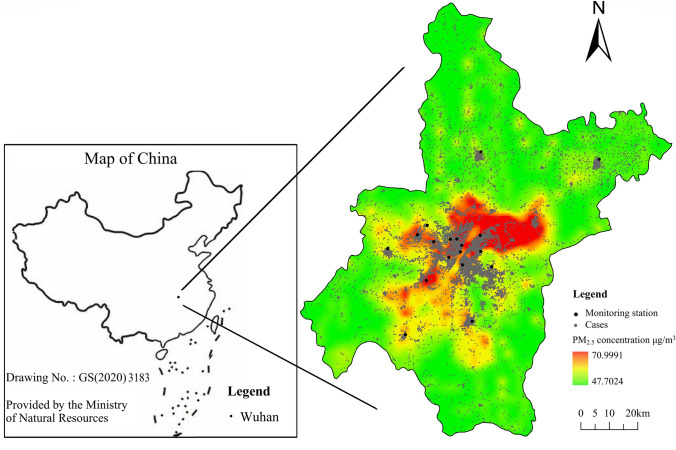
Daily hospital admission records were obtained from 54 municipal hospitals in Wuhan city, China. We included all children (aged 0-2 years) hospitalized with respiratory diseases between January 2017 and December 2018. Individual air pollution exposure assessment was used in Land Use Regression model and inverse distance weighted. Case-crossover design and conditional logistic regression models were adopted to estimate the hospitalization risk associated with air pollutants.
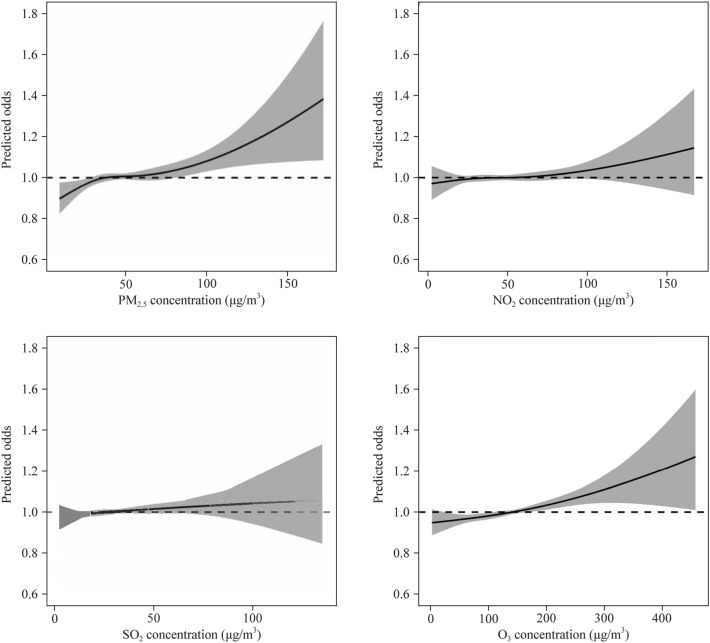
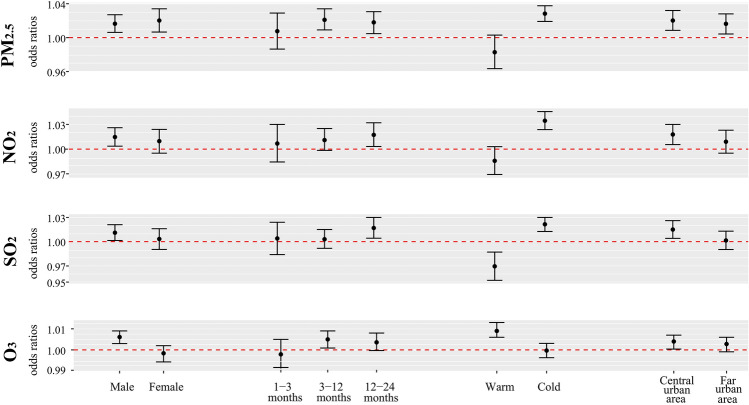
We identified 62,425 hospitalizations due to respiratory diseases, of which 36,295 were pneumonia. Particulate matter with an aerodynamic diameter less than 2.5 μm (PM) and nitrogen dioxide (NO) were significantly associated with respiratory diseases and pneumonia. ORs of pneumonia were 1.0179 (95% CI 1.0097-1.0260) for PM and 1.0131 (95% CI 1.0042-1.0220) for NO at lag 0-7 days. Subgroup analysis suggested that NO, Ozone (O) and sulfur dioxide (SO) only showed effects on pneumonia hospitalizations on male patients, but PM had effects on patients of both genders. Except O, all pollutants were strongly associated with pneumonia in cold season. In addition, children who aged elder months and who were in central urban areas had a higher hospitalization risk.
Air pollution is associated with higher hospitalization risk for respiratory diseases, especially pneumonia, among young children, and the risk is related to gender, month age, season and residential location.
儿童患呼吸道疾病的风险较高,与暴露于环境空气污染有关。然而,基于特大城市的整个人群,很少有研究探讨空气污染暴露与婴幼儿(特别是 0-2 岁)呼吸道疾病之间的关系。
从中国武汉市 54 家市级医院获得每日住院记录。我们纳入了 2017 年 1 月至 2018 年 12 月期间因呼吸道疾病住院的所有儿童(0-2 岁)。个体空气污染暴露评估采用土地利用回归模型和逆距离加权法。采用病例交叉设计和条件逻辑回归模型估计与空气污染物相关的住院风险。
我们确定了 62425 例因呼吸道疾病住院的病例,其中 36295 例为肺炎。小于 2.5μm 空气动力学直径的颗粒物(PM)和二氧化氮(NO)与呼吸道疾病和肺炎显著相关。滞后 0-7 天的 PM 和 NO 的肺炎 OR 分别为 1.0179(95%CI 1.0097-1.0260)和 1.0131(95%CI 1.0042-1.0220)。亚组分析表明,NO、臭氧(O)和二氧化硫(SO)仅对男性患者的肺炎住院有影响,而 PM 对男女患者均有影响。除 O 外,所有污染物在寒冷季节均与肺炎强烈相关。此外,月龄较大和位于中心城区的儿童住院风险更高。
空气污染与婴幼儿呼吸道疾病(尤其是肺炎)住院风险增加有关,风险与性别、月龄、季节和居住地点有关。