Department of Medicine, Graduate School, Kyung Hee University, Seoul 02453, Korea.
Division of Nephrology, Department of Internal Medicine, Kyung Hee University Medical Center, Seoul 02453, Korea.
Medicina (Kaunas). 2022 Feb 23;58(3):340. doi: 10.3390/medicina58030340.
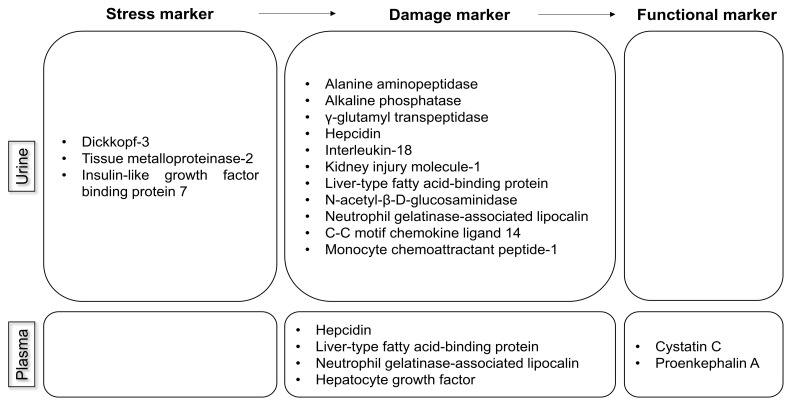
Acute kidney injury (AKI) is a common clinical syndrome that is characterized by abnormal renal function and structure. The Kidney Disease: Improving Global Outcomes (KDIGO) Controversies Conference in 2019 reviewed the stages of AKI and the definitions of AKI-related terminologies, and discussed the advances in the last decade. Along with serum creatinine level and urine output, more accurate novel biomarkers for predicting AKI are being applied for the early detection of renal dysfunction. A literature search was conducted in PubMed, Scopus, Medline, and ClinicalTrials.gov using the terms AKI and biomarker, combined with diagnosis, management, or prognosis. Because of the large volume of data (160 articles) published between 2005 and 2022, representative literature was chosen. A number of studies have demonstrated that new biomarkers are more sensitive in detecting AKI in certain populations than serum creatinine and urine output according to the recommendations from the Acute Disease Quality Initiative Consensus Conference. To be specific, there is a persistently unresolved need for earlier detection of patients with AKI before AKI progresses to a need for renal replacement therapy. Biomarker-guided management may help to identify a high-risk group of patients in progression to severe AKI, and decide the initiation time to renal replacement therapy and optimal follow-up period. However, limitations such as biased data to certain studied populations and absence of cutoff values need to be solved for worldwide clinical use of biomarkers in the future. Here, we provide a comprehensive review of biomarker-based AKI diagnosis and management and highlight recent developments.
急性肾损伤 (AKI) 是一种常见的临床综合征,其特征为肾功能和结构异常。2019 年肾脏病:改善全球预后(KDIGO)争议会议回顾了 AKI 的分期和 AKI 相关术语的定义,并讨论了过去十年的进展。除了血清肌酐水平和尿量外,更多用于预测 AKI 的准确新型生物标志物也被应用于肾功能障碍的早期检测。在 PubMed、Scopus、Medline 和 ClinicalTrials.gov 上使用 AKI 和生物标志物这两个术语,结合诊断、管理或预后进行了文献检索。由于 2005 年至 2022 年期间发表了大量数据(160 篇文章),因此选择了有代表性的文献。多项研究表明,根据急性疾病质量倡议共识会议的建议,新型生物标志物在某些人群中检测 AKI 比血清肌酐和尿液输出更敏感。具体来说,在 AKI 进展到需要肾脏替代治疗之前,更早地检测 AKI 患者的需求仍然未得到解决。生物标志物指导的管理可能有助于识别进展为严重 AKI 的高危患者群体,并决定开始肾脏替代治疗的时间和最佳随访期。然而,为了将来在全球范围内临床应用生物标志物,需要解决数据偏向某些研究人群和缺乏截断值等局限性。在此,我们全面回顾了基于生物标志物的 AKI 诊断和管理,并强调了最新进展。