Urology Clinic, Centre of Postgraduate Medical Education, 01-813 Warsaw, Poland.
Medicina (Kaunas). 2022 Mar 4;58(3):381. doi: 10.3390/medicina58030381.
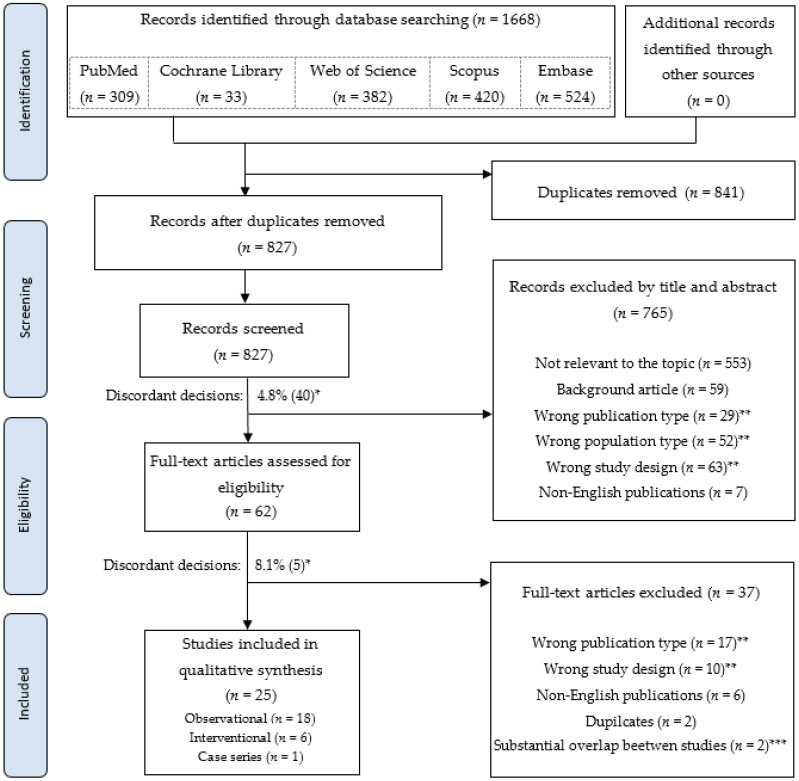
The aim of this systematic review is to evaluate the impact of radical prostatectomy (RP) on bladder function, with special attention towards detrusor underactivity investigated with the means of urodynamic evaluation. The review was performed in accordance with the PRISMA statement and was registered in the PROSPERO (ID#: CRD42020223480). The studied population was limited to men with prostate cancer who underwent urodynamic study prior to and after radical prostatectomy. Eight hundred twenty-seven studies were screened, with twenty-five finally included. A qualitative analysis was performed. Rates of detrusor underactivity (DU) before surgery were reported in eight studies and ranged from 1.6% to 75% (median of 40.8%). DU occurred de novo after RP in 9.1% to 37% of patients (median of 29.1%). On the other hand, preexisting DU resolved in 7% to 35.5% of affected men. Detrusor overactivity (DO) was the most frequently reported outcome, being assessed in 23 studies. The rate of DO preoperatively was from 5% to 76% (median of 25%). De novo was reported in 2.3-54.4% of patients (median of 15%) and resolved after RP in 19.6% to 87.5% (median of 33%) of affected patients. Baseline rates of bladder outlet obstruction (BOO) varied between studies from 19% to 59.3%, with a median of 27.8%. The most pronounced change after surgery was the resolution of BOO in 88% to 93.8% (median of 92%) of affected patients. Rates of de novo impaired bladder compliance (IBC) varied from 3.2% to 41.3% (median of 13.3%), whereas the resolution of IBC was reported with rates ranging from 0% to 47% (median of 4.8%). BOO, DO, and DU are frequently diagnosed in men scheduled for RP. BOO is improved after RP in most patients; however, there is still a substantial rate of patients with de novo DU as well as DO which may impair functional outcomes and quality of life.
本系统评价的目的是评估根治性前列腺切除术 (RP) 对膀胱功能的影响,特别关注尿动力学评估中发现的逼尿肌活动低下。该评价是按照 PRISMA 声明进行的,并在 PROSPERO(ID#: CRD42020223480)中进行了注册。研究人群仅限于接受根治性前列腺切除术之前和之后进行尿动力学研究的前列腺癌男性。共筛选了 827 项研究,最终纳入了 25 项研究。进行了定性分析。8 项研究报告了术前逼尿肌活动低下 (DU) 的发生率,范围为 1.6%至 75%(中位数为 40.8%)。9.1%至 37%的患者(中位数为 29.1%)在 RP 后新发 DU。另一方面,7%至 35.5%的受影响男性的术前 DU 得到缓解。逼尿肌过度活动 (DO) 是最常报告的结果,有 23 项研究对此进行了评估。术前 DO 的发生率为 5%至 76%(中位数为 25%)。2.3%至 54.4%的患者(中位数为 15%)出现新发 DO,受影响患者中有 19%至 87.5%(中位数为 33%)在 RP 后得到缓解。膀胱出口梗阻 (BOO) 的基线发生率在研究之间从 19%到 59.3%不等,中位数为 27.8%。手术后最明显的变化是 88%至 93.8%(中位数为 92%)的受影响患者的 BOO 得到缓解。新发膀胱顺应性受损 (IBC) 的发生率从 3.2%到 41.3%(中位数为 13.3%)不等,而 IBC 的缓解率从 0%到 47%(中位数为 4.8%)不等。接受 RP 的男性常被诊断为 BOO、DO 和 DU。大多数接受 RP 的患者 BOO 得到改善,但仍有相当一部分患者新发 DU 和 DO,这可能会影响功能结局和生活质量。