Department of Emergency Medicine, China Medical University Hospital, Taichung 404, Taiwan.
College of Medicine, China Medical University, Taichung 404, Taiwan.
Nutrients. 2022 Mar 16;14(6):1255. doi: 10.3390/nu14061255.
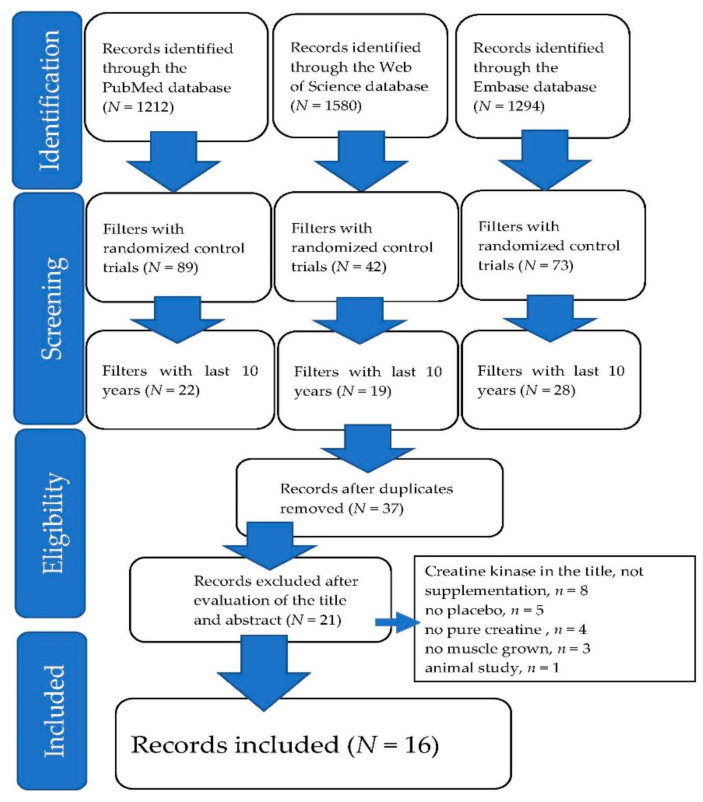
Creatine supplementation is the most popular ergonomic aid for athletes in recent years and is used for improving sport performance and muscle growth. However, creatine supplementation is not always effective in all populations. To address these discrepancies, numerous studies have examined the use of creatine supplementation for muscle growth. This scoping review aimed to investigate the effects of creatine supplementation for muscle growth in various populations, in which Arksey and O'Malley's scoping review framework is used to present the findings. For this study, we performed a systematic search of the PubMed, Embase, and Web of Science databases for theses and articles published between 2012 and 2021. A manual search of the reference lists of the uncovered studies was conducted and an expert panel was consulted. Two reviewers screened the articles for eligibility according to the inclusion criteria. Methodological quality was assessed using the National Heart, Lung and Blood Institute's (NHLBI's) quality assessment tool. A total of 16 randomized controlled trials (RCTs) were finally included. All the authors extracted key data and descriptively analyzed the data. Thematic analysis was used to categorize the results into themes. Three major themes related to muscle growth were generated: (i) subjects of creatine supplementation-muscle growth is more effective in healthy young subjects than others; (ii) training of subjects-sufficient training is important in all populations; (iii) future direction and recommendation of creatine supplementation for muscle growth-injury prevention and utilization in medical practice. Overall, creatine is an efficient form of supplementation for muscle growth in the healthy young population with adequate training in a variety of dosage strategies and athletic activities. However, more well-designed, long-term RCTs with larger sample sizes are needed in older and muscular disease-related populations to definitively determine the effects of creatine supplementation on muscle growth in these other populations.
肌酸补充剂是近年来运动员最受欢迎的运动补剂,用于提高运动表现和肌肉生长。然而,肌酸补充剂并非对所有人群都有效。为了解决这些差异,许多研究都检查了肌酸补充剂在不同人群中的肌肉生长效果。本范围综述旨在研究各种人群中肌酸补充剂对肌肉生长的影响,其中采用阿斯基和奥马利的范围综述框架呈现研究结果。为此,我们对 PubMed、Embase 和 Web of Science 数据库中的论文和文章进行了系统检索,这些论文和文章的发表时间为 2012 年至 2021 年。对未覆盖研究的参考文献列表进行了手动搜索,并咨询了专家小组。两名评审员根据纳入标准筛选文章的合格性。使用美国国立心肺血液研究所 (NHLBI) 的质量评估工具评估方法学质量。最终纳入了 16 项随机对照试验 (RCT)。所有作者均提取了关键数据并对数据进行描述性分析。使用主题分析将结果分类为主题。产生了三个与肌肉生长相关的主要主题:(i)肌酸补充剂的对象——健康年轻对象比其他对象更有效;(ii)对象的训练——所有人群都需要充分的训练;(iii)肌酸补充剂促进肌肉生长的未来方向和建议——预防损伤和在医学实践中的应用。总体而言,肌酸是健康年轻人群中肌肉生长的有效补充形式,在各种剂量策略和运动活动中,需要进行足够的训练。然而,在年龄较大和与肌肉疾病相关的人群中,需要更多设计良好、长期的 RCT 研究,以确定肌酸补充剂对这些其他人群中肌肉生长的影响。